
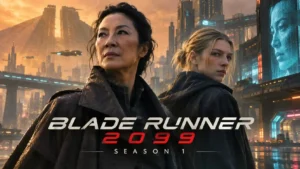
Blade Runner 2099 – Season 1 Feature Scores
Overall Scorata score: 3.9/5
Based on 27 analyzed reviews · View source samples
Explore all 84 feature scores for Blade Runner 2099 – Season 1, organized into pros and cons.
Scores by Feature
Summary
84 reviewed features-
Very positive 4.5-5.030 (36%)
-
Positive 3.5-4.426 (31%)
-
Neutral 2.5-3.415 (18%)
-
Negative 1.5-2.412 (14%)
-
Very negative below 1.51 (1%)
Pros
Sort
-
Tactile interiors, brutalist buildings and lived-in cityscapes make the setting unusually immersive, even for critics who are disappointed with the story.
-
Leopold Ross’s synths, jazz and expressive saxophone are among the most consistently praised elements. Some find the repeated musical swells or jazzy emphasis distracting.
-
Neon, ruined architecture, orange sunlight and textured retro technology earn widespread praise. A minority find the look derivative, muddy or less impressive than the films.
-
The oppressive sunshine noir, smoky interiors, retro technology and jazz create a distinctive immersive mood; its relentless gloom is not for everyone.
-
The time jump expands the established mythology and introduces new settings and ideas, though some find the additional details superficial.
-
The guarded, gradually evolving partnership is a major attraction, with the leads often praised for their chemistry and mutual suspicion.
-
Questions about replaceability, human identity and technology are particularly timely in the age of AI.
-
Lavish sets and a large-scale production make the future convincingly tangible, although budget differences from the films sometimes show.
-
Yeoh’s restraint and Schafer’s urgency anchor the season for many critics, though others find their stoicism exaggerated or their emotional range limited.
-
Faithful noir aesthetics and familiar philosophical questions make this recognizable as part of the saga, but critics disagree on whether it evolves beyond homage.
-
The leads frequently bring intensity and vulnerability to otherwise stoic roles. Some critics find the performances too wooden or repetitive, particularly when the writing gives them little to express.
-
Making replicants the ruling class gives the familiar premise an intriguing new perspective for many critics. Others find the swap unimaginative because society seems largely unchanged.
-
Carefully composed shadows and scorching sunlight give the future a distinctive look, although shaky camera work in fights can reduce clarity.
-
The conclusion is generally appreciated for wrapping up the central journey while leaving room for interpretation, although one critic found its last-minute resolutions too convenient.
-
The tension of Cora’s undercover identity and her uneasy partnership creates compelling suspense, though repeated tests and encounters can diminish its impact.
-
The relationship between engineered life and humanity remains the season’s core, with some finding its new questions profound and others finding them underdeveloped.
-
The retrofuturistic world looks expansive and richly detailed. Some critics nonetheless wanted more insight into everyday society, politics and the consequences of the uprising.
-
The propulsive mystery and visual world can keep viewers watching across the full run.
-
Olwen’s approaching expiration gives the series a moving way to examine mortality and the desire for more time.
-
The finale can deliver a satisfying, poetic sense of closure, but its resolution strikes some as too neat or unexplained.
-
The prologue recreates the earlier film’s aesthetic with striking accuracy while providing useful franchise context.
-
Identity, memory, mortality and empathy provide rich philosophical material. Critics differ over whether the series meaningfully develops those ideas or merely repeats the films.
-
Grate-filtered light, neon shadows and dramatic sunlight help create an immersive noir atmosphere.
-
Striking doomsday imagery and philosophical questions can linger long after the season ends.
-
The two female leads bring a fresh perspective to the traditionally male-centered detective story.
-
The show is praised for being a self-contained expansion instead of an endless exercise in franchise management.
-
The dense franchise connections reward a second look for clues and details that may have gone unnoticed.
-
Yeoh’s clipped delivery and careful vocal modulation convey an alien reserve with flashes of vulnerability.
-
The reversed human-replicant hierarchy is either a bold new angle or an unimaginative swap of familiar roles, depending on how convincingly its consequences land.
-
Ambiguity is part of the series’ noir appeal, with an elliptical mood and questions that can encourage interpretation.
-
The supporting ensemble includes memorable flashes of menace and eccentricity, especially Matthew Needham, though many secondary roles are too thinly drawn to leave much impression.
-
The fights benefit from Yeoh’s physical skills and Schafer’s desperate energy, but some are poorly lit, choppily edited or feel out of place in the slow-burn mystery.
-
The investigation and role reversal can be gripping, particularly when the two leads are together. Others find the MacGuffin hunt stretched thin, predictable, or hollow.
-
Several critics were absorbed by the detective story and its setting, while others found the long, somber journey tedious.
-
The expanded format feels justified to those impressed by the world and new themes, while skeptics would have preferred another film or no sequel at all.
-
The series explores the relationship between memories, trauma and personhood, with some critics finding the approach sophisticated and others wishing it went further.
-
The reversed hierarchy and the loneliness created by capitalism bring class and inequality into the story’s central concerns.
-
The expanded geography and environmental damage give the future’s ecological concerns a concrete sense of scale.
-
Effects can make the large-scale dystopian settings genuinely impressive, though the quality is not uniform across every sequence.
-
The scripts sometimes find inventive new angles on identity and mortality; detractors find the plotting labored, exposition heavy and characters underwritten.
-
The distant setting avoids forcing answers to earlier character fates, but the films’ reproductive revelations and changes to society are not always convincingly carried forward.
-
A brief appearance by Freddie Fox is a welcome addition to the prologue.
-
The ambitious philosophical mystery is enthusiastically received as a strong example of contemporary science fiction.
-
The depiction of loneliness and its corrosive effect on empathy provides a poignant dimension to the dystopian society.
-
Michelle Yeoh retains impressive physical authority in an action role centered on aging and mortality.
-
New environments beyond Los Angeles make the universe feel expansive rather than confined to familiar streets.
-
The change from rainy streets to hypnotic sunlight gives this incarnation a distinct sense of place.
-
The transition to television is praised for retaining the original cinematic story’s humanity while opening up new territory.
-
The iconic flying cars retain their futuristic appeal.
-
The extended episodic canvas offers room for new settings and mysteries, but not everyone thinks the story takes full advantage of television’s structure.
-
The directors establish a striking sun-baked noir palette, but uneven staging and some stiff performances or unclear fight coverage prevent the direction from matching the films.
-
Many effects look convincingly integrated with physical sets, but occasional digital backgrounds and lower-budget shots stand out.
-
The distinctive oversized jackets and inventive costumes attract attention, though Cora’s bulky silhouette is divisive.
-
The investigation blends science fiction, noir thriller and political resistance imagery.
-
Cora’s scrappy determination to survive makes her an engaging action heroine.
-
The prologue helps orient newcomers, though familiar character backstories can feel less necessary when the actors already convey their emotions.
Cons
Sort
-
The two leads dominate the drama, leaving much of the supporting ensemble with comparatively little depth or narrative weight.
-
The tone is exceptionally solemn, with little comic relief. Some find that consistent with the franchise, while others miss moments of levity.
-
Frequent graphic fights and bleak violence are criticized for overwhelming the drama rather than adding meaningful depth.
-
Abrupt allegiance shifts and inconsistent rules about replicant behavior can make character decisions feel contrived.
-
Some supporting figures are introduced too briefly or too late for their storylines to build much impact.
-
Darkly lit fights and dim visuals can make parts of the action unnecessarily difficult to follow.
-
Repeated test sequences and flights through the city can become time-filling devices instead of advancing the story.
-
The all-at-once rollout disappointed critics who felt this material deserved a longer weekly release.
-
Several early and middle episodes meander or introduce unnecessary side stories before the investigation gains focus.
-
The eight-episode length gives the visuals room to breathe, but many find the central investigation better suited to a shorter format.
-
Olwen’s mortality and Cora’s struggle to survive give the leads intriguing material, but thin backstories and underdeveloped supporting characters frequently blunt the drama.
-
Shaky camera work and choppy cuts make some otherwise well-choreographed fights difficult to follow.
-
The premise of passing as another identity briefly opens a thought-provoking connection to transgender experience, but the show does not develop it far.
-
A relatively simple mystery becomes needlessly laborious when the storytelling structure delays clarity.
-
The symbolism can be cryptic enough to obstruct emotional engagement.
-
The existential stakes and character motivations can be difficult to parse, weakening investment in the central mystery.
-
The relationship between the two women and Olwen’s approaching death can be poignant, but several critics feel the philosophical and visual ambitions overshadow genuine human connection.
-
The mystery asks viewers to follow convoluted plotting and opaque motivations, especially early on. Several critics found the later episodes more rewarding once the pieces came together.
-
The deliberate tempo feels faithful and absorbing to some, but many find the middle stretch padded and the mystery slow to develop.
-
The mystery offers ambitious revelations for some viewers, but others find its twists predictable or insufficiently established.
-
The unflinching seriousness suits viewers seeking solemn science fiction, but the unrelieved bleakness can be exhausting.
-
The series has considerable appeal for established fans, but its familiar sensibilities and slow pace may not bring many new viewers aboard.
-
Cora’s constant anxiety can make her difficult to connect with when the story gives her little room to reveal other sides of her personality.
-
Regular action beats and twists keep the series moving for some viewers, at the cost of the more meditative quality of the films.
-
One critic found the picture muddy but acknowledged that screener compression might have contributed.
-
Some antagonists bring effective menace or psychotic energy, while others are too familiar, flat or slow to emerge.
-
The philosophical dialogue can carry the franchise’s grand noir tradition, yet it sometimes becomes too blunt, cryptic, or utilitarian.
-
The series draws on philosophical elements of the original novel, including material left out of the films; some critics feel those nods remain superficial.
Use Cases
Best for
Sort
-
The limited-series structure provides a defined central arc and generally satisfying closure rather than requiring another season.
-
New viewers can follow the core investigation without watching the films, although existing fans will recognize more references and may find the pacing more familiar.
-
Returning fans can appreciate the familiar atmosphere, mythology and callbacks as well as the fresh settings and power reversal.
-
Fans of philosophical detective noir can enjoy the guarded partners, atmospheric investigation and morally complicated setting.
-
The series offers ambitious cyberpunk ideas and a vivid dystopia, but viewers who prize the earlier films’ emotional depth may be disappointed.
-
The existential themes and ambiguous interpretations offer plenty to discuss after watching.
-
The detailed landscapes and striking design benefit from being seen on the largest available screen.
-
A character-driven mystery gives the two leads a compelling emotional journey for viewers who enjoy noir investigations centered on personal motives.
-
Switching off the lights helps the rich neon, shadowy interiors and oppressive atmosphere come into their own.
-
The rich material and episodic format are well suited to a weekly viewing rhythm.
-
The methodical storytelling rewards sustained attention rather than distracted viewing.
-
Watching an episode or two at a time allows the deliberate pace and elaborate scenery to breathe.
Conditional or not ideal for
-
Patient viewingPatient viewers who enjoy a slow-building atmosphere can find much to appreciate, but the early confusion and padded middle may test even them.
-
Action-fan viewingAction enthusiasts may find some tense fights, but the methodical storytelling is likely to test anyone seeking constant momentum.
Cast & Creators
-
KoraSchafer’s tense physicality and desperation make Cora a compelling fugitive for many critics. Others find the repeated anxiety and lack of convincing emotional concealment limiting.
-
OlwinYeoh is widely admired for her action skills and ability to reveal vulnerability beneath Olwen’s reserve, though a minority find the performance stiff or unconvincing.
-
CreatorLuisa’s reversal of the franchise’s premise and new angles on memory and identity draw strong praise, though not all critics find the expansion distinct or emotionally developed.
-
ComposerRoss’s electronic textures, expressive saxophone and noir jazz are widely admired, although the jazzy flourishes can be excessive for some.
-
Production DesignerArbiture’s production design helps make the dystopia feel richly inhabited, with distinctive settings that both honor and expand the films.
-
Production DesignerThe production design creates tactile, eye-catching spaces and expands the familiar cyberpunk cityscapes into memorable new settings.
-
DirectorHis opening episodes are credited with establishing a rich visual world and noir tone, although some find the early storytelling inert.
-
YahyaNeedham brings calculating menace, physical authority and an effective sinister edge to the replicant enforcer.
-
RayHis supporting performance brings sinister charm to the noir mystery.
-
CinematographerHardy’s photography finds eerie beauty in the settings and maintains a striking visual standard across the episodes.
-
DirectorThe directorial team’s sun-baked and rain-soaked palette is praised, as is the quality of the episodes.
-
DirectorThe direction helps maintain the cinematic noir palette and an impressive episodic visual standard.
-
DirectorThe episodes contribute to an atmospheric mix of familiar noir gloom and new, tension-heightening sunlight.
-
EliasHis supporting performance draws both ensemble praise and criticism that his work is more frustrating than compelling.
-
ClotildeHer deranged antagonist is memorable and entertaining to some, but others find the characterization too close to a familiar franchise villain.
-
HelenaHer work is praised as part of a strong supporting ensemble.
-
JuliusHis contribution is praised alongside the other supporting performers, though his storyline is not always given enough room to develop.
-
CinematographerThe photography brings the setting to life through inventive lighting and carefully framed faces.
-
ActorHis short prologue appearance is welcomed as a pleasing cameo.
-
Set DecoratorThe set decoration helps the world feel like a recognizable yet distinct continuation of the earlier films.
-
CinematographerThe cinematography uses carefully filtered light and polluted sunlight to frame the characters within the dystopia.
-
CinematographerThe cinematography uses striking grids of filtered light and sunlit environments to add texture to the world.
-
Costume DesignerCora’s oversized bomber jacket is a divisive costume choice, with criticism that its bulky shoulders do not flatter the character.