If you want better reliability
Choose Amazfit Active Max. It scores 4.6 vs 2.3 for reliability, with a 4.1 overall score.

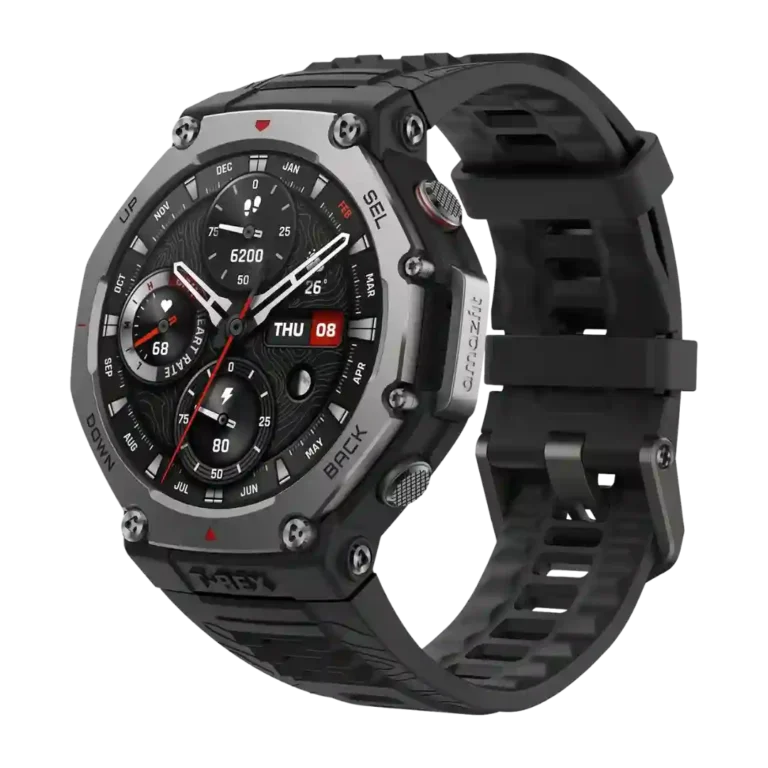
Choose the Amazfit T-Rex 3 for huge battery life, strong GPS, rugged value, and a bright AMOLED screen. Skip it if you need polished navigation, reliable readiness scores, wrist calls, or premium app depth.
Best for budget-minded hikers, runners, casual adventurers, and outdoor users who want long battery life, rugged hardware, GPS, maps, and lots of sport modes without paying flagship prices.
Not ideal for users who need premium route creation, mature app ecosystems, reliable readiness/sleep-stage insights, wrist phone calls, fast charging, or the most dependable wrist heart-rate data for hard cycling and gym work.
Across the reviews, the Amazfit T-Rex 3 lands as a rugged outdoor watch with unusually strong value, long battery life, accurate GPS, and a large, readable AMOLED display. Its biggest tradeoff is polish: many reviewers liked the feature list, but several found maps, route imports, contactless payments, app behavior, and recovery scores less finished than premium rivals. Heart rate was good enough for many steady activities but less dependable for outdoor cycling, intervals, or strength training. The watch feels compelling for budget-minded adventurers who can tolerate quirks, but it is not a fully mature Garmin/Fenix replacement.
Compared with other Smartwatches, this product is above average in value for money, Wi-Fi connectivity, data privacy, near average in mapping and navigation, GPS accuracy, below average in safety features, activity auto-detection, charging speed.
| Attribute | This product | Category average | Difference |
|---|---|---|---|
| safety features | 1.3 | 3.9 | -2.7 |
| activity auto-detection | 1.5 | 3.7 | -2.2 |
| charging speed | 2.3 | 4.1 | -1.9 |
| recovery insights | 2.1 | 3.9 | -1.8 |
| call handling | 1.5 | 3.3 | -1.8 |
| menu navigation | 2.0 | 3.9 | -1.9 |
| reliability | 2.3 | 3.7 | -1.4 |
| fit | 2.5 | 3.9 | -1.4 |
Choose Amazfit Active Max. It scores 4.6 vs 2.3 for reliability, with a 4.1 overall score.
Choose Suunto Race 2. It scores 5.0 vs 2.3 for charging speed, with a 4.0 overall score.
Choose Huawei Watch GT 6 Pro. It scores 4.7 vs 3.2 for heart rate accuracy, with a 4.0 overall score.
Choose Amazfit T-Rex 3 Pro. It scores 5.0 vs 1.5 for activity auto-detection, with a 3.6 overall score.
Products reviewers directly compared with this model, grouped into quick takeaways.
Yes. Reviewers repeatedly called it excellent value because it delivers a rugged build, AMOLED screen, GPS, maps, and long battery life at a much lower price than flagship outdoor watches.
GPS accuracy was one of the most praised areas. Most reviewers found it reliable or very good for running, hiking, cycling, and general outdoor tracking, with only isolated caveats.
It depends on the activity. Steady running and some indoor workouts were often acceptable, but outdoor cycling, intensity changes, and strength training produced more mixed results.
They are impressive for the price but not fully polished. Reviewers liked free offline maps and route following, while criticizing route import friction, no true on-watch routing, and occasional map/interface issues.
Comfort depends heavily on wrist size and tolerance for a large watch. Some reviewers found it surprisingly wearable, while others called it bulky, heavy, or uncomfortable over long periods.
Reviewers generally said no. It offers many similar-looking features for less money, but premium competitors still have better ecosystems, navigation polish, calling, app depth, and advanced training reliability.
Common drawbacks include clunky software, limited payments, no speaker for calls, slow charging, mixed readiness/sleep scores, and heart-rate limitations in harder workouts.
These are a few of the reviews included in our analysis.
![Amazfit T-Rex 3: The BEST Rugged Smartwatch of 2024? [REVIEW]](https://scorata.com/wp-content/uploads/2026/04/26475_thumb-150x150.webp)


Best for long battery life, accurate GPS and useful offline maps at a strong price. Skip it if you need payments, richer apps, a built-in LED flashlight or polished smartwatch...
Pros: mapping and navigation, value for money
Cons: smartwatch features, contactless payments

Best for accurate run tracking, deep Garmin coaching and phone-free Spotify in a light package. Skip it if you need full maps, triathlon mode, Apple Music support or the strongest...
Pros: value for money, GPS accuracy
Cons: mapping and navigation, third-party app support

Good if you want premium running features, long battery life, and maps for under $200. Skip it if you need flawless heart-rate data, multiband GPS, LTE, or richer app support.
Pros: value for money, battery life
Cons: heart rate accuracy, third-party app support

Best for accurate running metrics, excellent coaching tools, a bright AMOLED display, and dependable battery life. Skip it if you need offline maps, music storage, contactless payments, multi-band GPS, or...
Pros: battery life, value for money
Cons: mapping and navigation, smartwatch features