Other features
Ease of use
D-Link Aquila Pro AI R95No score yet
TP-Link Deco 7 Pro BE63
4.5
Everyday operation is approachable and the app is intuitive, though its richer feature list may feel more involved than simpler alternatives.
Airtime efficiency
D-Link Aquila Pro AI R95
5.0
Concurrent smart devices, streams, calls, and games remained smooth, while OFDMA and related technologies kept many-client performance stable.
TP-Link Deco 7 Pro BE63No score yet
Auto-sensing Ethernet ports
D-Link Aquila Pro AI R95No score yet
TP-Link Deco 7 Pro BE63
4.5
Interchangeable auto-sensing WAN/LAN jacks make installation easier because the modem can connect to any of the four ports.
Band steering
D-Link Aquila Pro AI R95No score yet
TP-Link Deco 7 Pro BE63
3.5
Manual band preferences are useful, but flexibility over separating the primary 2.4 GHz and 5 GHz networks is limited or varies by software.
Bandwidth management
D-Link Aquila Pro AI R95
5.0
The AI Traffic Optimiser directs bandwidth where it is needed most, reducing the need for manual tuning.
TP-Link Deco 7 Pro BE63No score yet
Beamforming effectiveness
D-Link Aquila Pro AI R95
5.0
Beamforming is cited alongside OFDMA and MU-MIMO as a reason the network remains stable with dozens of devices.
TP-Link Deco 7 Pro BE63No score yet
Channel selection
D-Link Aquila Pro AI R95
5.0
The R95 automatically chooses cleaner channels and can shift frequencies quietly when neighboring Wi-Fi causes interference.
TP-Link Deco 7 Pro BE63No score yet
Client steering
D-Link Aquila Pro AI R95No score yet
TP-Link Deco 7 Pro BE63
3.5
Manual node selection is valuable when automatic steering picks a distant node instead of the closest one.
Configuration flexibility
D-Link Aquila Pro AI R95No score yet
TP-Link Deco 7 Pro BE63
4.0
The app offers useful device, band and network settings, but granular desktop-style administration remains limited.
Connected-device management
D-Link Aquila Pro AI R95No score yet
TP-Link Deco 7 Pro BE63
4.8
Checking a client's node, renaming devices and pausing connections are easy from the app.
Dedicated backhaul band
D-Link Aquila Pro AI R95No score yet
TP-Link Deco 7 Pro BE63
2.5
There is no separate permanent backhaul radio, so wireless inter-node traffic can compete with clients for airtime.
Device identification
D-Link Aquila Pro AI R95No score yet
TP-Link Deco 7 Pro BE63
3.5
The app can identify many connected devices, although doing so may require third-party data sharing.
Device prioritization
D-Link Aquila Pro AI R95No score yet
TP-Link Deco 7 Pro BE63
4.3
Device-level priority settings help allocate bandwidth to important clients such as a gaming PC or console.
Device security scanning
D-Link Aquila Pro AI R95No score yet
TP-Link Deco 7 Pro BE63
4.0
Included vulnerability scans provide some welcome baseline network protection.
External power dependence
D-Link Aquila Pro AI R95No score yet
TP-Link Deco 7 Pro BE63
2.8
Each node needs a mains outlet, which adds a placement constraint when trying to cover the whole house.
Firmware stability
D-Link Aquila Pro AI R95No score yet
TP-Link Deco 7 Pro BE63
2.5
A reported firmware update disrupted smart-home connectivity, so update reliability is a concern for device-heavy homes.
Floor-to-floor coverage
D-Link Aquila Pro AI R95No score yet
TP-Link Deco 7 Pro BE63
4.5
Upstairs and downstairs coverage can be excellent with appropriately positioned nodes, though throughput can fall on another floor under heavy load.
Heat management
D-Link Aquila Pro AI R95No score yet
TP-Link Deco 7 Pro BE63
4.5
Ventilation and passive cooling keep the hardware reasonably cool during intense use.
Included accessories
D-Link Aquila Pro AI R95No score yet
TP-Link Deco 7 Pro BE63
4.3
The included essentials cover ordinary installation, and the reset pin is a thoughtful extra.
Instruction readability
D-Link Aquila Pro AI R95No score yet
TP-Link Deco 7 Pro BE63
2.0
The short manual covers basic installation but provides little guidance on more involved tasks such as storage sharing and MLO optimization.
Internet pause
D-Link Aquila Pro AI R95No score yet
TP-Link Deco 7 Pro BE63
4.5
The app makes pausing an individual device's internet access straightforward.
Mid-range speed
D-Link Aquila Pro AI R95No score yet
TP-Link Deco 7 Pro BE63
4.5
Medium-range throughput remains fast in most layouts, although some rivals pull ahead as the distance increases.
Model naming clarity
D-Link Aquila Pro AI R95No score yet
TP-Link Deco 7 Pro BE63
2.3
Regional variants, model aliases and similar product names can make it difficult to tell which hardware configuration is being sold.
Modem compatibility
D-Link Aquila Pro AI R95No score yet
TP-Link Deco 7 Pro BE63
2.5
Initial modem communication can be troublesome, requiring multiple resets before the first node connects.
Node placement guidance
D-Link Aquila Pro AI R95No score yet
TP-Link Deco 7 Pro BE63
4.8
Visual placement tips help avoid interference and make satellite positioning less intimidating.
Node synchronization
D-Link Aquila Pro AI R95No score yet
TP-Link Deco 7 Pro BE63
5.0
Pre-synchronized nodes reduce setup work and can join the mesh automatically.
Packaging quality and presentation
D-Link Aquila Pro AI R95No score yet
TP-Link Deco 7 Pro BE63
5.0
Thoughtful packaging, organized accessories and easy-lift nodes make unboxing unusually pleasant.
Power consumption
D-Link Aquila Pro AI R95No score yet
TP-Link Deco 7 Pro BE63
4.0
Operating power costs are modestly lower than those of a higher-end Deco system in one comparison.
Seamless handoff
D-Link Aquila Pro AI R95No score yet
TP-Link Deco 7 Pro BE63
4.8
Movement between rooms and floors can be seamless, with no buffering or dropouts in one three-node demonstration.
Self-healing network
D-Link Aquila Pro AI R95No score yet
TP-Link Deco 7 Pro BE63
4.5
Adaptive network optimization is appealing for households that want less manual troubleshooting.
Settings organization
D-Link Aquila Pro AI R95No score yet
TP-Link Deco 7 Pro BE63
4.8
The clean dashboard puts network status and common settings within easy reach without burying them in complex menus.
Status light control
D-Link Aquila Pro AI R95No score yet
TP-Link Deco 7 Pro BE63
4.7
The option to turn off the indicator at night is particularly welcome in bedrooms and home theaters.
Status light usefulness
D-Link Aquila Pro AI R95No score yet
TP-Link Deco 7 Pro BE63
3.5
The bottom-mounted indicator is subtle but can be harder to see directly.
Subscription pricing transparency
D-Link Aquila Pro AI R95No score yet
TP-Link Deco 7 Pro BE63
1.5
Advanced HomeShield pricing can be difficult to establish from product pages before purchase.
Subscription requirements
D-Link Aquila Pro AI R95No score yet
TP-Link Deco 7 Pro BE63
3.1
Core networking and basic controls are available without payment, but advanced parental controls and security can add recurring subscription costs.
Troubleshooting assistance
D-Link Aquila Pro AI R95No score yet
TP-Link Deco 7 Pro BE63
4.5
A convenient support-center link provides an easy route to assistance from within the app.
Usage schedules
D-Link Aquila Pro AI R95No score yet
TP-Link Deco 7 Pro BE63
4.2
Basic bedtime and device schedules are included without an extra charge.
USB storage sharing
D-Link Aquila Pro AI R95No score yet
TP-Link Deco 7 Pro BE63
4.6
A USB drive can provide convenient basic shared storage without requiring separate network storage hardware.
Video conferencing optimization
D-Link Aquila Pro AI R95
5.0
MLO and stable performance reduce interruptions and improve responsiveness during video calls.
TP-Link Deco 7 Pro BE63No score yet
WAN failover
D-Link Aquila Pro AI R95No score yet
TP-Link Deco 7 Pro BE63
2.0
Automatic dual-connection failover is not supported according to the supplied technical discussion, making it a poor fit for redundant WAN needs.
Wireless backhaul
D-Link Aquila Pro AI R95No score yet
TP-Link Deco 7 Pro BE63
4.0
Wireless backhaul can deliver exceptional speed for the price, but distance, obstacles and shared airtime can impair it.
Ownership and support
5 GbE support
D-Link Aquila Pro AI R95No score yet
TP-Link Deco 7 Pro BE63
2.3
The lack of 5 GbE ports limits flexibility for buyers planning faster wired networks.
Channel width support
D-Link Aquila Pro AI R95
5.0
Ultra-wide channels are credited with turning the Wi-Fi 7 specification into performance users can actually notice.
TP-Link Deco 7 Pro BE63No score yet
Customer support
D-Link Aquila Pro AI R95No score yet
TP-Link Deco 7 Pro BE63
3.5
Lifetime support is attractive, but one reported firmware-related problem was accompanied by slow assistance.
Dual-WAN support
D-Link Aquila Pro AI R95No score yet
TP-Link Deco 7 Pro BE63
2.0
The system is not an attractive choice for users who need two independent WAN connections with automatic failover.
MIMO support
D-Link Aquila Pro AI R95
5.0
MIMO-based operation helps the router stay stable with dozens of connected devices.
TP-Link Deco 7 Pro BE63No score yet
Setup guidance
D-Link Aquila Pro AI R95No score yet
TP-Link Deco 7 Pro BE63
3.9
Visual setup directions are clear and approachable, but technical jargon and advanced configuration help could be improved.
Thread border router support
D-Link Aquila Pro AI R95No score yet
TP-Link Deco 7 Pro BE63
2.0
A built-in Thread border router is not a strength of this model, so Thread-focused households may prefer another system.
Upgrade value
D-Link Aquila Pro AI R95No score yet
TP-Link Deco 7 Pro BE63
4.7
The mesh offers a worthwhile performance upgrade from older wireless systems, particularly when newer clients can use its capabilities.
USB port support
D-Link Aquila Pro AI R95No score yet
TP-Link Deco 7 Pro BE63
4.7
USB connectivity is a welcome extra that is uncommon in some competing mesh kits.
Warranty
D-Link Aquila Pro AI R95No score yet
TP-Link Deco 7 Pro BE63
3.5
The two-year warranty is reasonable, though some rival brands offer three years.
Wired backhaul support
D-Link Aquila Pro AI R95No score yet
TP-Link Deco 7 Pro BE63
4.8
Multi-gig ports make Ethernet backhaul straightforward and help maintain performance across rooms or separate buildings.
Controls and connectivity
Access controls
D-Link Aquila Pro AI R95
3.8
Family access features are useful in some households, but the limited filtering system keeps them from feeling fully developed.
TP-Link Deco 7 Pro BE63No score yet
Companion software dependence
D-Link Aquila Pro AI R95No score yet
TP-Link Deco 7 Pro BE63
2.5
Mandatory mobile-app and cloud-account management simplifies the consumer experience but is restrictive for people who prefer local, browser-based administration.
Privacy controls
D-Link Aquila Pro AI R95No score yet
TP-Link Deco 7 Pro BE63
2.5
Cloud-account management and third-party device identification raise privacy concerns for buyers who prefer local control.
Web interface quality
D-Link Aquila Pro AI R95No score yet
TP-Link Deco 7 Pro BE63
2.4
Browser access is limited compared with the app, so desktop-first administrators may find it frustrating.
Web interface setup
D-Link Aquila Pro AI R95No score yet
TP-Link Deco 7 Pro BE63
2.0
Initial configuration is app-centric rather than browser-based, which can frustrate users who prefer desktop router management.
Wi-Fi 6 support
D-Link Aquila Pro AI R95
4.5
Owners of Wi-Fi 5 and Wi-Fi 6 devices can still use the secondary 2.4GHz/5GHz network without giving up strong performance.
TP-Link Deco 7 Pro BE63No score yet
Wi-Fi standard support
D-Link Aquila Pro AI R95
4.5
Alongside its Wi-Fi 7 network, the R95 is praised for accommodating older computers and mobile devices on legacy bands.
TP-Link Deco 7 Pro BE63No score yet
Performance
Advertised speed accuracy
D-Link Aquila Pro AI R95No score yet
TP-Link Deco 7 Pro BE63
3.0
The BE10000 label describes combined theoretical radio rates, not the speed a single device should expect. Actual throughput depends on client capabilities and network conditions.
Backhaul performance
D-Link Aquila Pro AI R95No score yet
TP-Link Deco 7 Pro BE63
4.8
Backhaul can be fast and flexible, with particularly strong results when wired links or well-positioned wireless nodes are used.
Mesh performance
D-Link Aquila Pro AI R95
5.0
Smart Mesh is described as providing stable connectivity across the home rather than merely extending a weak signal.
TP-Link Deco 7 Pro BE63No score yet
MU-MIMO performance
D-Link Aquila Pro AI R95
5.0
MU-MIMO is part of the technology mix credited with preserving performance in crowded, device-heavy networks.
TP-Link Deco 7 Pro BE63No score yet
OFDMA performance
D-Link Aquila Pro AI R95
5.0
OFDMA contributes to stable service when many clients are active at the same time.
TP-Link Deco 7 Pro BE63No score yet
Roaming performance
D-Link Aquila Pro AI R95No score yet
TP-Link Deco 7 Pro BE63
4.2
Automatic roaming can be smooth, although one TV chose a distant node until its preferred node was set manually.
Satellite performance
D-Link Aquila Pro AI R95No score yet
TP-Link Deco 7 Pro BE63
3.0
Satellite throughput is often good, but it can trail the main router and introduce higher latency or jitter.
Upload performance
D-Link Aquila Pro AI R95No score yet
TP-Link Deco 7 Pro BE63
4.3
Uploads can be impressively fast near a node and hold up under traffic, but tend to decline more sharply at longer distances.
Comfort and build
Build quality
D-Link Aquila Pro AI R95No score yet
TP-Link Deco 7 Pro BE63
4.8
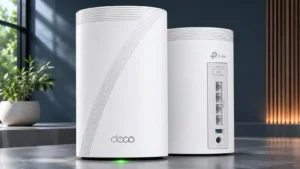
The cylindrical housings feel sturdy and well built.
Size and footprint
D-Link Aquila Pro AI R95No score yet
TP-Link Deco 7 Pro BE63
4.3
The units are compact relative to many premium mesh towers, although one tester found their size and outlet needs inconvenient.