
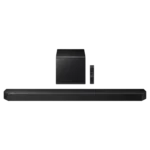
Samsung Q800F Feature Scores
Explore all 57 feature scores for Samsung Q800F, organized into pros and cons.
Scores by Feature
Summary
57 reviewed features-
Very positive 4.5-5.034 (60%)
-
Positive 3.5-4.48 (14%)
-
Neutral 2.5-3.413 (23%)
-
Negative 1.5-2.42 (4%)
Pros
Sort
-
Samsung TV integration is a major strength. Q-Symphony is repeatedly described as easy to use and capable of making the presentation larger, richer, and more theater-like.
-
Overall sound quality is very strong across most sources, with frequent praise for clarity, scale, bass, dialogue, and musicality. A small number of owners found the presentation less rich than expected or little better than TV speakers.
-
Setup is consistently excellent. Reviewers and owners repeatedly describe plug-and-play installation, automatic subwoofer pairing, and easy HDMI eARC connection.
-
Fit is generally excellent: the bar is low enough to sit under most screens and the cube-shaped sub is easy to place. The bar’s width can still be awkward between the feet of some 65-inch TVs.
-
Output is a clear strength: reviewers describe room-filling, even room-shaking volume, with enough headroom for medium and large living rooms.
-
The smart-feature suite is unusually rich, including adaptive processing, streaming integrations, and Samsung ecosystem features. Owners also responded positively to Adaptive mode and AirPlay/HomeKit integration.
-
Build quality is consistently strong, with sturdy metal-heavy construction, a solid feel, and multiple comments that the system looks built to last rather than cheap or plasticky.
-
Remote operation is a standout for ease of use: the included remote is repeatedly described as straightforward, elegant, and convenient, with TV-remote control further simplifying daily use.
-
Dialogue is one of the Q800F’s most consistent strengths, described as crisp, pristine, accurately reproduced, and easy to follow even in busy scenes.
-
The overall product is widely recommended for its sound, compact design, features, and easy integration. Negative outliers center on disappointing bass, returns, and a few serious reliability failures.
-
The Q800F works especially well where space is limited thanks to its low-profile bar, compact subwoofer, and space-conscious design. Moderate Bass mode adds another option when the sub cannot be accommodated.
-
Tonal balance is widely praised as clean, controlled, and accurate, with strong mids and vocals. A mild sharpness in the treble at higher volumes is the main caveat.
-
SpaceFit room calibration is consistently praised for adapting output to room acoustics and reducing the need for manual tuning.
-
Music performance is consistently excellent, with strong results on both Atmos mixes and ordinary stereo tracks. Reviewers praise natural vocals, punchy bass, separation, and enjoyable Adaptive-mode playback.
-
Voices come through cleanly and distinctly, from regular TV speech to music vocals. Owners repeatedly describe speech as easy to hear without excessive volume.
-
Atmos height effects are usually impressive, with strong overhead cues and convincing vertical scale in favorable rooms. Results are room-dependent, and one owner found Atmos effects almost imperceptible.
-
The compact subwoofer and clean metal styling are well liked, while the main black bar is more understated than striking. Overall, the system looks polished but not especially distinctive.
-
AirPlay use is easy and well integrated; one owner specifically liked being able to add the system alongside HomeKit.
-
Dynamic headroom is excellent, combining strong impact and room-shaking output with little compression or clarity loss.
-
Physical controls on the bar are simple, accessible, and useful for quick adjustments without reaching for the remote.
-
Spotify Connect earns positive marks for simple streaming and seamless handoff between listening locations.
-
SmartThings is generally praised as responsive, logically laid out, and easy to navigate. One owner still found Samsung’s broader software experience annoyingly overcomplicated.
-
The compact subwoofer is praised by experts and several owners for strong, smooth output and easy placement. Customer feedback is sharply divided, though, with complaints ranging from weak bass to overwhelming bass.
-
Value is strongest at discounted prices, where several reviewers call the package excellent or strong value. A few owners felt it was not worth MSRP, especially when bass disappointed or reliability failed.
-
The subwoofer normally pairs automatically and works seamlessly right out of the box. One owner later experienced a complete subwoofer connection failure, creating a notable reliability caveat.
-
Chromecast is part of a wireless streaming setup that reviewers describe as straightforward and well equipped.
-
Fine detail retrieval is excellent, with subtle percussion, background artifacts, and small musical textures remaining clear and well placed.
-
Wi-Fi streaming is described as straightforward and well stocked with streaming options, with no usability complaints in the scored accounts.
-
The up-firing drivers create a strong sense of height in several tests, though one test source considered the effect merely passable compared with real overhead speakers.
-
HDMI eARC is usually a simple, convenient one-cable path that works well with TV controls. One owner reported a serious eARC failure after months of use, pulling the overall picture down.
-
Bluetooth is part of a wireless connection set reviewers consider comprehensive and sufficient for most users, though these comments focus on availability and convenience rather than long-range stress testing.
-
Gaming performance itself is good, with low latency and a useful Game Mode Pro. The experience is held back mainly by the separate 4K/120Hz passthrough limitation.
-
The front display is easy to read and useful for quick feedback, though its information is fairly basic.
-
Low-volume performance is mostly good, with owners reporting clear, room-filling sound without needing extreme volume. One listener, however, found the system only became immersive after it was already too loud.
-
High-volume clarity is generally strong, with very little loss of definition at maximum output. One source did note that treble can become slightly sharp when pushed.
-
Format support is broad and includes major immersive options such as Dolby Atmos and DTS:X, contributing to the Q800F’s strong home-theater feature set.
-
An HDMI cable is included, adding convenience for buyers planning a wired TV connection.
-
Lip sync is excellent over HDMI eARC, with very low latency and no distracting dialogue synchronization problems reported in testing.
-
One owner valued that the system can be set up and managed offline, avoiding a Samsung account, network connection, and the tracking concerns that came with them.
-
One owner found the optional Samsung rear-speaker kit transformed the system into a much more powerful, convincing full home-theater setup.
-
Wall mounting is well supported with an included kit that forms part of a notably complete in-box package.
-
The optical input contributes to a connection set judged sufficient for most users, though it was not singled out for deeper performance testing.
Cons
Sort
-
Reliability feedback is concerning despite one owner reporting perfect operation. Other customers describe eARC failure, wireless TV or subwoofer dropouts, and even a unit that failed after one day.
-
One owner had a poor support experience: a lengthy Samsung support session produced only a temporary fix before the connection problem returned.
-
Gaming passthrough is the major weak spot: the HDMI input tops out at 4K/60Hz, and multiple sources wanted 120Hz support.
-
HDMI gaming support falls short for high-refresh-rate players because 4K/120Hz passthrough is missing.
-
The HDMI input is useful for simplifying source cabling, but video passthrough is capped at 4K/60Hz. That makes it adequate for many setups but a poor fit for gamers who want 4K/120Hz through the bar.
-
One owner found day-to-day operation a little complicated.
-
The wired connection set is capable, but the single HDMI input can be limiting for systems with several source devices.
-
Sound adjustment options are extensive, but outcomes vary. The controls and EQ are flexible, yet two owners could not tune the system to fix the sound balance they disliked.
-
Stereo imaging is mixed. The bar can sound wider than its chassis, but channel separation trails dedicated stereo speakers and some listeners found left/right placement or Adaptive-mode panning less defined.
-
Google integration is usable but not seamless, with Google Home setup called somewhat clunky.
-
Optional rear speakers expand the system effectively, but each rear needs its own power outlet, which can complicate placement.
-
Voice-assistant integration works, but setup is not entirely polished; Google Home configuration was specifically described as a little clunky.
-
TV connection stability is mixed. Several owners report seamless Samsung-TV pairing and perfect operation, while others experienced an eARC quirk or complete wireless connection failures after months of use.
-
Virtual surround can create a convincing sense of space, but it remains front-led without dedicated rears. Some listeners find it acceptable or immersive, while one owner found the surround effect nearly invisible and another said rear speakers were necessary.
-
Bass is the most polarizing trait. Experts often praise it as deep, agile, controlled, and room-shaking, but several owners call it weak while another found the subwoofer overpowering and difficult to tame.