If you want better battery life
Choose Garmin Venu 3. It scores 4.8 vs 3.1 for battery life, with a 4.1 overall score.

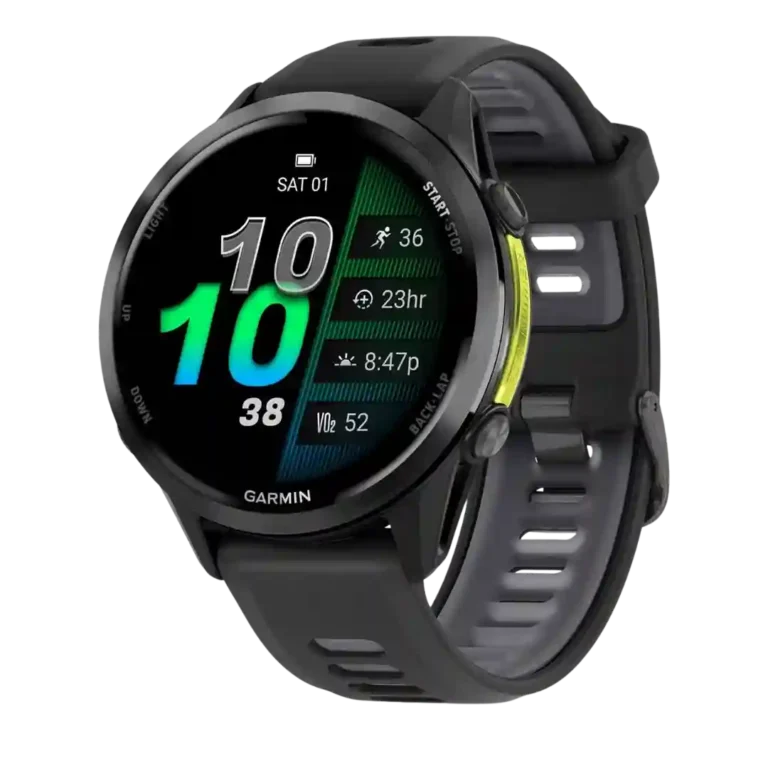
Choose the Garmin Forerunner 970 if you want elite GPS/HR accuracy, maps, coaching, and a bright AMOLED in a lighter body. Skip it if price, always-on battery, lag, or single-size fit matter more.
Best for serious runners, triathletes, and endurance athletes who want top-tier GPS/HR accuracy, full maps, adaptive coaching, recovery metrics, Garmin Pay, music, and a bright AMOLED watch that is lighter than rugged Fenix-style models.
Not for casual runners who only need basic GPS and heart-rate stats, buyers sensitive to price, people who need maximum battery life, or users who want a smaller case, LTE, or a richer smartwatch app store.
The Garmin Forerunner 970 lands as a deeply capable runner’s and triathlon watch rather than a simple lifestyle smartwatch. Across reviews, its strongest case is accurate GPS and heart-rate tracking, a vivid AMOLED display, detailed maps, useful coaching, recovery guidance, and a lighter, more comfortable design than rugged alternatives. The tradeoff is clear: the same bright screen, premium materials, and expanded features come with a high price, weaker always-on battery life, occasional lag, and a single 47mm size. Serious endurance athletes get the most from its depth, while casual runners may find the older 965, mid-tier Garmins, or simpler rivals easier to justify.
Compared with other Smartwatches, this product is above average in stress tracking, ECG functionality, contactless payments, near average in call handling, fitness tracking accuracy, below average in battery life, menu navigation, companion app quality.
| Attribute | This product | Category average | Difference |
|---|---|---|---|
| stress tracking | 5.0 | 3.5 | +1.5 |
| ECG functionality | 4.0 | 2.6 | +1.4 |
| contactless payments | 4.3 | 2.8 | +1.5 |
| battery life | 3.1 | 4.2 | -1.0 |
| menu navigation | 2.5 | 3.8 | -1.3 |
| flashlight usefulness | 4.8 | 3.7 | +1.1 |
| companion app quality | 2.5 | 3.8 | -1.3 |
| reliability | 2.5 | 3.7 | -1.2 |
Choose Garmin Venu 3. It scores 4.8 vs 3.1 for battery life, with a 4.1 overall score.
Choose Garmin Epix Pro (Gen 2). It scores 4.8 vs 2.5 for reliability, with a 4.2 overall score.
Choose Apple Watch Ultra 2. It scores 4.7 vs 3.1 for software smoothness, with a 3.9 overall score.
Choose Garmin Vivoactive 6. It scores 4.7 vs 3.0 for pairing reliability, with a 3.9 overall score.
Products reviewers directly compared with this model, grouped into quick takeaways.
Reviewers strongly agreed that land-based GPS accuracy is excellent and heart-rate tracking is reliable for running and many workouts. A few caveats appeared around open-water swims, gym intervals, and normal wrist-sensor limits.
GPS battery life was often considered adequate for races and long training days, but always-on smartwatch battery life drew repeated criticism. Several reviewers said lowering brightness helps a lot.
The 970 adds a brighter display, sapphire glass, flashlight, ECG, speaker/mic, and newer running tools. Reviewers still often called the 965 the better value because it costs less and can last longer.
The maps were praised as detailed, colorful, and helpful for routes, climbs, and trails. The common caveat was sluggish map panning or buggy round-trip rerouting in some tests.
Running Tolerance and Impact Load were usually the most useful additions. Running Economy and Step Speed Loss were more mixed because they require the HRM 600 strap and were not always clearly actionable.
Most reviewers found the 970 lighter, slimmer, and more comfortable than Fenix-style watches. The main fit concerns were the single 47mm size and the chunky feel for sleep tracking.
For a sports watch, reviewers liked Garmin Pay, music storage, notifications, calls, voice commands, and reports. It still lacks LTE and the deeper third-party app ecosystem of a true smartwatch.
These are a few of the reviews included in our analysis.

Best for long battery life, accurate GPS and useful offline maps at a strong price. Skip it if you need payments, richer apps, a built-in LED flashlight or polished smartwatch...
Pros: mapping and navigation, value for money
Cons: smartwatch features, contactless payments

Best for accurate run tracking, deep Garmin coaching and phone-free Spotify in a light package. Skip it if you need full maps, triathlon mode, Apple Music support or the strongest...
Pros: value for money, GPS accuracy
Cons: mapping and navigation, third-party app support

Good if you want premium running features, long battery life, and maps for under $200. Skip it if you need flawless heart-rate data, multiband GPS, LTE, or richer app support.
Pros: value for money, battery life
Cons: heart rate accuracy, third-party app support

Best for accurate running metrics, excellent coaching tools, a bright AMOLED display, and dependable battery life. Skip it if you need offline maps, music storage, contactless payments, multi-band GPS, or...
Pros: battery life, value for money
Cons: mapping and navigation, smartwatch features