If you want better heart rate accuracy
Choose Huawei Watch GT 6 Pro. It scores 4.7 vs 4.1 for heart rate accuracy, with a 4.0 overall score.

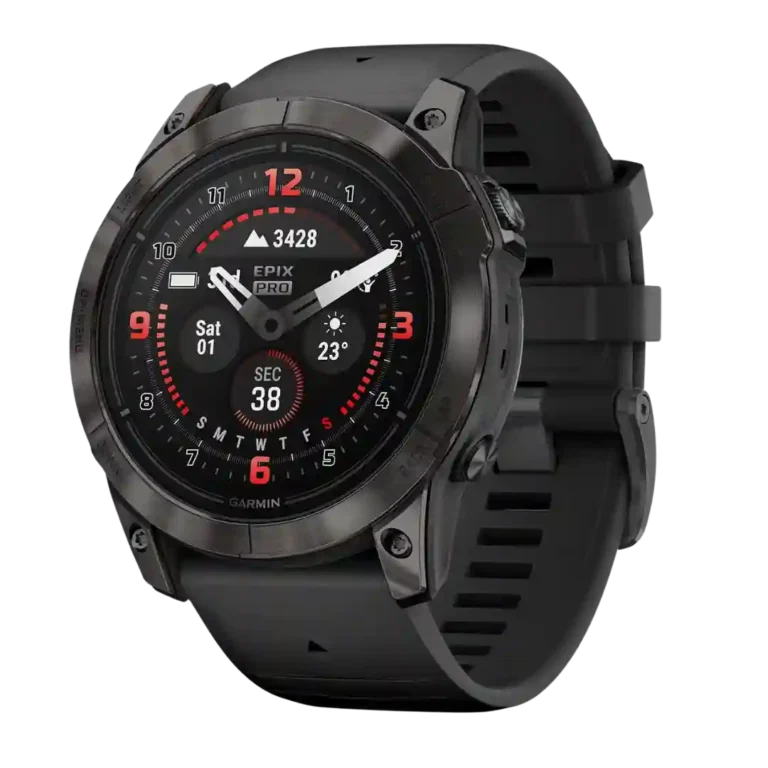
Choose the Garmin Epix Pro (Gen 2) for class-leading GPS, AMOLED mapping, long battery life, and rugged multisport tracking. Skip it if you mainly want a cheaper cycling watch, a simpler smartwatch, or polished health metrics.
Best for serious runners, hikers, multisport athletes, and outdoor users who want accurate GPS, detailed maps, long battery life, and a rugged watch-first training tool.
Not for people who mainly want a cheaper cycling device, a slick mainstream smartwatch, effortless phone integration, or simple menus without Garmin’s data-heavy learning curve.
The Garmin Epix Pro (Gen 2) earns its premium reputation on the things outdoor athletes notice most: GPS accuracy, detailed AMOLED maps, battery life, durability, and the practical flashlight. Reviewers repeatedly describe its navigation and training platform as unusually deep, and several found the display easier to read than expected outdoors. The tradeoff is complexity and cost. Garmin Connect and on-watch menus can feel dense, Garmin Pay and phone features vary by region or platform, and some health/coaching metrics are less convincing than the core GPS and battery performance. It is strongest as a rugged multisport/navigation watch, not as a simple smartwatch.
Compared with other Smartwatches, this product is above average in size options, mapping and navigation, reliability, near average in display quality, workout tracking variety, below average in watch face quality, voice assistant quality, user interface.
| Attribute | This product | Category average | Difference |
|---|---|---|---|
| size options | 4.6 | 3.1 | +1.4 |
| mapping and navigation | 4.7 | 3.4 | +1.3 |
| watch face quality | 2.5 | 3.8 | -1.3 |
| voice assistant quality | 2.0 | 3.1 | -1.1 |
| reliability | 4.8 | 3.7 | +1.1 |
| user interface | 3.0 | 3.9 | -0.9 |
| GPS accuracy | 4.8 | 4.1 | +0.7 |
| fit | 3.0 | 3.9 | -0.8 |
Choose Huawei Watch GT 6 Pro. It scores 4.7 vs 4.1 for heart rate accuracy, with a 4.0 overall score.
Choose Apple Watch Ultra 2. It scores 5.0 vs 3.0 for fit, with a 3.9 overall score.
Choose Garmin Forerunner 965. It scores 4.8 vs 4.0 for workout tracking variety, with a 3.9 overall score.
Choose Garmin Venu 3. It scores 4.7 vs 3.0 for user interface, with a 4.1 overall score.
Products reviewers directly compared with this model, grouped into quick takeaways.
Yes. Reviewers repeatedly praised its detailed AMOLED maps, GPX/course loading, on-watch routing, and GPS accuracy.
Battery life is one of the strongest points. Reviewers reported everything from about six days with heavy always-on use to multi-week use depending on size and settings.
Most reviewers found the optical heart rate sensor very good, especially for running and general workouts. A cycling-focused review still saw lag and spikes compared with a chest strap.
It handles notifications, music, payments, apps, and basic phone features, but reviewers generally saw it as a sports watch first. Apple Watch and Samsung Galaxy Watch were considered slicker for smartwatch polish.
Training Readiness and recovery-style insights were praised. Endurance Score and Hill Score drew mixed reactions because some reviewers found them promising but not fully explained or actionable yet.
It depends on use. Reviewers found the price easier to justify for serious runners, hikers, multisport athletes, and backcountry users, but overkill for cycling-only or simpler smartwatch needs.
These are a few of the reviews included in our analysis.


Best for long battery life, accurate GPS and useful offline maps at a strong price. Skip it if you need payments, richer apps, a built-in LED flashlight or polished smartwatch...
Pros: mapping and navigation, value for money
Cons: smartwatch features, contactless payments

Best for accurate run tracking, deep Garmin coaching and phone-free Spotify in a light package. Skip it if you need full maps, triathlon mode, Apple Music support or the strongest...
Pros: value for money, GPS accuracy
Cons: mapping and navigation, third-party app support

Good if you want premium running features, long battery life, and maps for under $200. Skip it if you need flawless heart-rate data, multiband GPS, LTE, or richer app support.
Pros: value for money, battery life
Cons: heart rate accuracy, third-party app support

Best for accurate running metrics, excellent coaching tools, a bright AMOLED display, and dependable battery life. Skip it if you need offline maps, music storage, contactless payments, multi-band GPS, or...
Pros: battery life, value for money
Cons: mapping and navigation, smartwatch features