
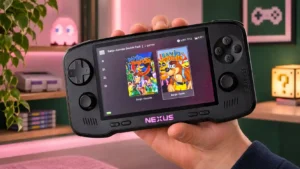
Evercade Nexus Feature Scores
Overall Scorata score: 4.0/5
Based on 31 analyzed reviews · View source samples
Explore all 49 feature scores for Evercade Nexus, organized into pros and cons.
Scores by Feature
Summary
49 reviewed features-
Very positive 4.5-5.014 (29%)
-
Positive 3.5-4.418 (37%)
-
Neutral 2.5-3.46 (12%)
-
Negative 1.5-2.47 (14%)
-
Very negative below 1.54 (8%)
Pros
Sort
-
Licensed cartridges can be collected, lent, and resold without a revocable digital-game license. That tangible ownership is central to the handheld’s appeal.
-
The native Banjo-Kazooie and DOOM releases are praised for widescreen presentation, smoother frame rates, and modernized inputs that go beyond basic emulation.
-
The bright, colorful 5.89-inch IPS screen is a major highlight and makes older games much easier to enjoy. Lower pixel density and the absence of OLED contrast remain caveats.
-
Compatibility with the existing Evercade cartridge range protects earlier purchases and lets players keep sharing one collection across multiple Evercade devices.
-
Boxed licensed cartridges, full-color manuals, and themed hardware editions make collecting part of the appeal, not just a way to acquire games.
-
A broad, licensed catalog of older arcade, console, and computer games gives collectors lots to explore. The curated selection is narrower than unrestricted emulation libraries.
-
The new twin sticks are the most meaningful control upgrade for early 3D games, though their size, potentiometer mechanism, and placement temper the praise.
-
Dedicated portrait mode presents vertical arcade games at a more fitting scale and feels steadier on the larger body. The mandatory right-stick controls frustrate D-pad purists.
-
Banjo-Kazooie and DOOM benefit from smooth, frequently 60 fps native versions. Some emulated arcade titles preserve noticeable original slowdown.
-
Starting with a cartridge is generally easy, with little account setup or installation. Even straightforward play must contend with slow cold booting.
-
The D-pad, face buttons, and shoulders often feel responsive and appropriate for retro games. Raised or stiff pads, spongy buttons, and loud clicks receive criticism.
-
Front-facing stereo speakers are consistently described as louder, clearer, and well suited to old-school game audio.
-
Cartridges are easy to insert and the streamlined interface keeps playing uncomplicated. A few settings and power-state quirks interrupt that otherwise straightforward experience.
-
Most hands-on estimates land around four to five hours, enough for substantial portable play, though long outings and demanding games can use up the charge.
-
The menus are pleasant, organized, and customizable, with helpful cartridge artwork and game details. In-game access to certain global settings is inconsistent.
-
The adjustable illuminated logo adds character and can be dimmed or switched off, a welcome touch for players who dislike bright decorative lighting.
-
The spacious chassis improves grip for some players, but low thumbsticks, flat rear surfaces, and distant triggers cause discomfort for others over long sessions.
-
Bluetooth support is a welcome upgrade alongside the headphone jack. Wireless-audio latency varies substantially between the headsets reported.
-
Many reviewers find the shell more substantial and polished than older Evercades. Sticky buttons, scratches, and problematic screen attachment undermine confidence in some units.
-
The modern shape, subtle texture, and customizable LED appeal to many, while glossy scratch-prone trim and plain coloring divide taste.
-
Many consider the $199.99 console fair value with the bundled Banjo titles, provided physical retro gaming is the goal. Extra cartridges quickly raise the total cost.
-
Textured contact points and redesigned triggers provide a secure grip for some hands, though the reach between low sticks and shoulders can feel awkward.
-
EverSync makes local wireless co-op possible without buying two copies of a cartridge. The feature is promising but not universally tested or trouble-free.
-
Games themselves generally run well, especially the optimized native ports. System startup and occasional emulator hiccups are noticeably less polished.
-
The large screen and bigger handholds are welcome, but this is a bag-sized rather than pocket-sized handheld; its portability is a tradeoff.
-
Aspect-ratio, scanline, and border controls help personalize the retro look, though scanline availability and global access vary by game.
-
The device has reassuring substance without approaching the bulk of a handheld gaming PC, but the flat shape and larger footprint can be tiring or cumbersome.
-
Sharper, widescreen native adaptations make older 3D graphics look unusually good for this hardware, though the modest LCD cannot match premium displays.
-
The updated cartridge slot is easier to use than the sometimes tight fitting on earlier models, making swaps less fiddly.
-
Wi-Fi firmware updates provide a path to software fixes and new features, although several desired improvements were not present during testing.
-
The lack of a conventional digital store is refreshing for cartridge buyers who want ownership and fewer distractions, but unsuitable for those who prefer downloadable catalogs.
-
Wi-Fi 6 and 5 GHz support make updates and monthly downloadable extras more convenient than on earlier models.
Cons
Sort
-
The absence of sleep or suspend-and-resume is a repeated frustration. Stopping play often means leaving the unit powered on or shutting down and reloading later.
-
The complete absence of HDMI or TV-out is an often-mentioned compromise, especially for owners accustomed to older Evercade handhelds that could connect to a television.
-
Lengthy power-on waits and slightly odd shutdown behavior make the handheld feel less instantly ready than a modern portable should.
-
Cold starts often take around 30–44 seconds, with extra waiting to load a cartridge. This feels especially inconvenient without a sleep function.
-
Reports of a display separating from the casing cast a shadow over the otherwise praised screen; long-term adhesive integrity warrants attention.
-
A minority of reports describe launch hardware problems, including screen adhesion, sticky controls, or inconsistent assembly, warranting a careful check of a new unit.
-
Core gaming is generally dependable, yet reports of sticky menu buttons, a failed cartridge launch, software glitches, and loosening screens deserve attention.
-
Cartridges are collectible and often contain multiple games, but typical prices around $20–$40 make expanding the library expensive compared with some alternatives.
-
Clicky shoulder controls are noticeably loud in several accounts, sometimes detracting from otherwise quiet handheld play.
-
The handheld offers useful standard headphone and USB-C connections, but charging compatibility is not universal; one tester could not charge it with a Steam Deck power adapter.
-
USB-C charging is convenient but may not accept every high-powered charger; one tester encountered incompatibility with a Steam Deck power supply.
-
Aspect-ratio choices and retro visual effects help games fit the screen, but imperfect non-integer scaling and filter limitations bother some players.
-
Several accounts describe preorder or retail supply frustrations, with availability varying by edition and seller.
-
Experiences with manufacturer responses to launch problems are uneven, including frustration about exchanges and confidence in follow-up service.
-
Older cartridge games generally preserve their original feel, but occasional slowdown, latency, and unusual boot artifacts prevent a completely seamless emulation experience.
-
Local wireless multiplayer with one cartridge is an exciting addition, and Doom sessions can work smoothly. Other tests raise stability questions and ownership of a second unit is essential.
-
The pack-in Banjo-Kazooie collection adds genuine value, and special editions offer appealing themed extras. The regular bundle lacks a power brick and protective case.
Use Cases
Best for
Sort
-
Retro play is the handheld’s defining strength: it combines a large licensed library with modern controls and a screen that makes old games inviting.
-
Existing owners gain a much better screen, dual sticks, and EverSync without replacing their cartridge library, although smaller older models may be easier to carry.
-
Vertically scrolling shooters benefit from the one-button portrait orientation, with improved display coverage. Not everyone likes controlling them with an analog stick.
-
Dual sticks and native 32-/64-bit ports give early 3D games smoother movement and camera control, with Banjo-Kazooie a particularly successful showcase.
-
Players who enjoy building a shelf of boxed retro games and reading printed manuals will find unusual satisfaction here, despite the accumulating cartridge costs.
-
Classic arcade titles benefit from the intuitive D-pad and instant portrait mode for vertical shooters, although some players dislike using a stick in the rotated layout.
-
EverSync offers local two-player gaming using a single cartridge, an attractive idea. It requires two Nexus units and has a mixture of smooth demonstrations and reported glitches.
-
The bigger display and roomier controls make long retro sessions enjoyable for some. Others report palm pressure and awkward trigger reach after extended play.
-
The twin sticks make the DOOM collection more natural to handle, though those early shooters can still show their age and the triggers are not universally comfortable.
-
A bright built-in display, respectable battery life, and a self-contained cartridge library make this a capable travel companion. It takes up more bag space than pocket-sized alternatives.
-
Bluetooth headphones make private retro play possible, but the experience depends on the headset: some testers heard no lag, while another found the delay distracting.
-
Enhanced Banjo-Kazooie ports benefit especially from analog movement, camera control, and a vivid larger screen, making classic platforming a major strength.
-
The rolling D-pad generally works well for classic fighters, with responsive directional inputs. A high pivot and some stiffness keep it from pleasing everyone.
-
Physical cartridges and a deliberately small selection of games encourage focused play without storefronts, subscription prompts, or overwhelming digital libraries.
-
Owned physical cartridges can be played without a constant online connection, avoiding dependence on a game subscription or cloud storefront.
-
Its bright screen can stay readable outdoors or in indirect light, making garden or daytime play practical. The larger body is less easy to carry casually.
-
Physical cartridges and compatibility with older Evercade machines protect collections from digital delisting. Reports of lifting display panels, however, create a durability concern.
-
The larger screen makes classic games more approachable for experienced players who find smaller handheld displays cramped. Comfort remains dependent on hand size and control reach.
-
Wired and wireless headphones make quiet private listening practical. Bluetooth timing is headset-dependent, with at least one serious delay complaint.
-
The simple, self-contained cartridge platform feels like a dedicated console, with cohesive menus and little of the setup burden of modern systems.
-
Accessible cartridge play and uncomplicated menus suit relaxed retro gaming, though the portrait controls may be a compromise for players who prefer D-pad precision.
Conditional or not ideal for
Sort
-
Docked playThe Nexus has no TV video output, so it cannot be docked to a television like some competing handhelds. The dedicated Evercade home consoles fill that role.
-
Short gaming sessionsShort sessions are hurt by slow cold booting and the lack of sleep mode: a brief interruption can force another full startup or lost unsaved progress.
-
Budget-conscious buyersThe bundled games help justify the console price, but the $20–$40 cartridges and relatively basic hardware make the overall proposition less compelling for strict budgets.
-
Demanding AAA gamesThis is built for older cartridge games rather than recent graphically demanding blockbusters. Buyers seeking modern AAA gaming are better served by a different handheld.
-
Gaming beside othersFor gaming beside someone else, wireless headphone support is helpful, though Bluetooth lag was pronounced in one test and absent in others.