If you want better charging convenience
Choose Casio G-Shock GBD-H2000. It scores 4.8 vs 3.0 for charging convenience, with a 3.5 overall score.

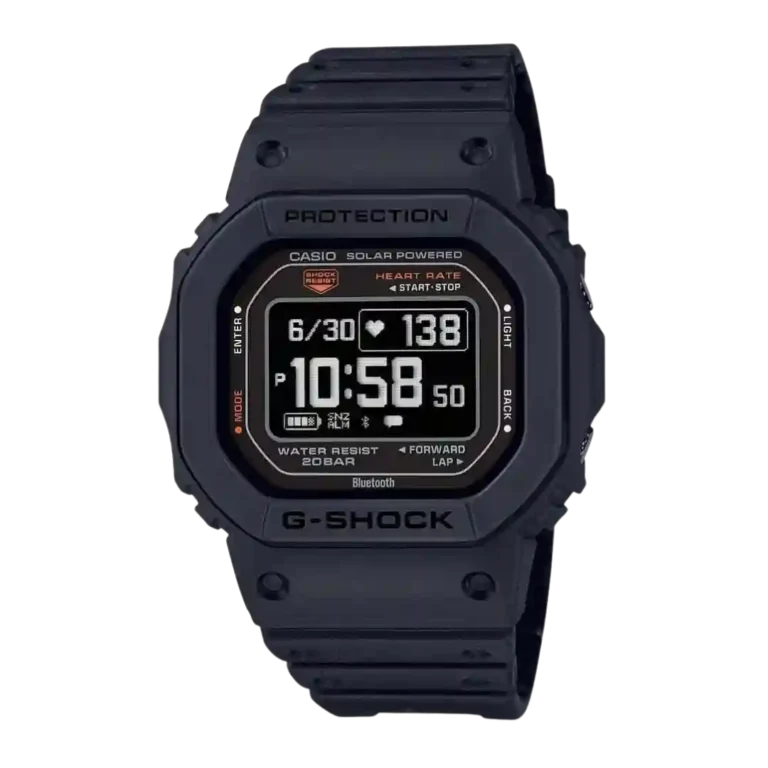
Choose the DW-H5600 if you want a tough, stylish G-Shock with basic health data and a superb MIP display. Skip it if you need polished smartwatch features, strong app integrations, or serious training accuracy.
Best for G-Shock fans who want the classic square look, rugged build, comfortable wear, and a sharp MIP display with basic health and workout extras.
Not for users who want a polished smartwatch, reliable standalone GPS, broad workout support, easy buttons, or deep integration with fitness platforms.
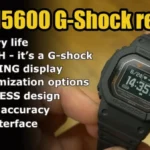
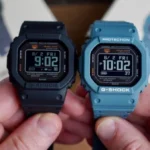
The Casio G-Shock DW-H5600 earns its strongest praise as a wearable G-Shock first: reviewers repeatedly liked the classic square styling, rugged build, soft strap, outdoor-readable MIP screen, and generally weeklong battery in lighter use. Its tradeoff is that the added smart and fitness layer feels immature. Heart rate and sleep tracking can be solid, but GPS depends on a phone, distance and step accuracy vary, workout modes are limited, and the app experience is clunky with weak integrations. The recessed buttons also turn everyday navigation into a chore. It works best as a durable retro watch with helpful health extras, not as a polished smartwatch or serious training platform.
Compared with other Smartwatches, this product is above average in durability, band quality, fit, near average in style and design, charging convenience, below average in workout tracking variety, button controls, operating system experience.
| Attribute | This product | Category average | Difference |
|---|---|---|---|
| workout tracking variety | 2.4 | 4.3 | -1.9 |
| button controls | 2.1 | 3.9 | -1.8 |
| operating system experience | 2.0 | 3.9 | -1.9 |
| app ecosystem | 1.9 | 3.6 | -1.7 |
| user interface | 2.2 | 3.9 | -1.8 |
| companion app quality | 2.4 | 3.8 | -1.4 |
| pairing reliability | 2.7 | 4.1 | -1.4 |
| fitness tracking accuracy | 2.9 | 4.1 | -1.2 |
Choose Casio G-Shock GBD-H2000. It scores 4.8 vs 3.0 for charging convenience, with a 3.5 overall score.
Choose Garmin Vivomove Sport. It scores 4.8 vs 3.7 for comfort, with a 3.7 overall score.
Choose Huawei Watch Fit 4. It scores 4.7 vs 2.8 for value for money, with a 4.3 overall score.
Choose Withings ScanWatch 2. It scores 4.7 vs 3.7 for battery life, with a 3.5 overall score.
Products reviewers directly compared with this model, grouped into quick takeaways.
Reviewers generally treated it as a hybrid or basic connected watch, not a full smartwatch. It handles notifications and health data, but lacks the depth and polish of mainstream smartwatch platforms.
The MIP display is one of the most praised features. Reviewers repeatedly called it crisp, readable outdoors, and a major improvement over typical negative LCD screens.
They are best for casual tracking. Some reviewers found heart rate, sleep, or connected GPS strong, while others saw unreliable distance, step, calorie, or heart-rate readings.
The recessed physical buttons are the clearest hardware complaint. Multiple reviewers found them stiff, hard to press, and especially annoying during workouts or menu navigation.
Battery life varied by settings and use. Several reviewers got around a week, while heavy always-on tracking and notifications could reduce that, and one review saw only two to three days.
Most reviewers criticized the app. They described it as clunky, slow, poorly organized, ad-heavy, or weak for viewing trends and exporting fitness data.
These are a few of the reviews included in our analysis.

Best for long battery life, accurate GPS and useful offline maps at a strong price. Skip it if you need payments, richer apps, a built-in LED flashlight or polished smartwatch...
Pros: mapping and navigation, value for money
Cons: smartwatch features, contactless payments

Best for accurate run tracking, deep Garmin coaching and phone-free Spotify in a light package. Skip it if you need full maps, triathlon mode, Apple Music support or the strongest...
Pros: value for money, GPS accuracy
Cons: mapping and navigation, third-party app support

Good if you want premium running features, long battery life, and maps for under $200. Skip it if you need flawless heart-rate data, multiband GPS, LTE, or richer app support.
Pros: value for money, battery life
Cons: heart rate accuracy, third-party app support

Best for accurate running metrics, excellent coaching tools, a bright AMOLED display, and dependable battery life. Skip it if you need offline maps, music storage, contactless payments, multi-band GPS, or...
Pros: battery life, value for money
Cons: mapping and navigation, smartwatch features