
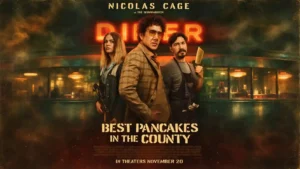
Best Pancakes in the County Feature Scores
Overall Scorata score: 2.7/5
Based on 23 analyzed reviews · View source samples
Explore all 57 feature scores for Best Pancakes in the County, organized into pros and cons.
Scores by Feature
Summary
57 reviewed features-
Very positive 4.5-5.06 (11%)
-
Positive 3.5-4.412 (21%)
-
Neutral 2.5-3.49 (16%)
-
Negative 1.5-2.419 (33%)
-
Very negative below 1.511 (19%)
Pros
Sort
-
Nicolas Cage’s high-energy turn is the most common bright spot, with his wild voice and physical transformation commanding attention. His excesses alienate some, and he spends too much of the movie offscreen for many fans.
-
Cage’s high-pitched, cartoonish delivery is one of the movie’s defining flourishes. Some find it brilliantly unhinged, while others find it a distracting affectation.
-
Cage’s co-stars often work hard to anchor the mayhem, particularly the diner staff. The ensemble earns mixed notices because the roles and writing rarely match the actors’ efforts.
-
The isolated diner creates a promising pressure-cooker atmosphere, with armed factions sizing each other up over breakfast. Its effectiveness fades for some once the standoff becomes repetitive.
-
Cage’s scarred, pig-nosed criminal makes an immediate visual impression. The outsized persona is more memorable than the depth of the character.
-
The diner feels like a believable, out-of-the-way roadside business, even when the plot around it gets less convincing.
-
The roughly 90-minute length keeps the film reasonably compact for some, even though others find individual stretches sluggish.
-
Justin Long, Shelley Hennig, Brandon Mychal Smith and another standout supporting player help enliven the diner. Many smaller roles remain thin or forgettable.
-
The early scenes promise a highly eccentric Cage-driven crime adventure, creating expectations the rest of the film struggles to match.
-
The diner and its eccentric criminal mastermind have enough personality that at least one enthusiastic viewer would welcome another outing.
-
The cheerful promise of exceptional pancakes makes an amusing contrast with the movie’s brutal crime setup.
-
There are occasional striking compositions and inventive ways to work within the diner. The visual approach is uneven rather than consistently polished.
-
A convincing roadside diner helps the single-location story feel lived in; the setting is more persuasive than many of the people inhabiting it.
-
The movie unexpectedly includes practical pancake-making tips, a small pleasure amid the criminal chaos.
-
The trailer’s freeze-frame character introductions and flashy lettering have a deliberately stylized crime-movie look.
-
One particularly enthusiastic assessment finds the diner and its larger-than-life villain entertaining enough to revisit.
-
Rapid cutting and kinetic framing give parts of the movie a lively pulp-cinema sheen.
-
The layered standoff and the order in which secrets emerge can be entertaining. Elsewhere, the long absence of the most eccentric character weakens the structure.
Cons
Sort
-
Blood effects are a frequent sore point: shots look powdery or obviously computer-generated rather than convincing. The crude visuals cheapen otherwise ambitious confrontations.
-
Several accounts fault a climactic shootout that is so dark the action becomes difficult to make out.
-
The meandering food debates sometimes land as absurd humor, but repetitive tough-guy banter and strained attempts at Tarantino-style wit are major complaints.
-
Competing criminal groups and reversals often make the story unnecessarily difficult to follow, with some motivations and confrontations lacking clear stakes.
-
Cage’s lengthy absence between the opening and final stretch disappoints many who expected him to carry the movie. A minority think rationing his appearances makes his return more effective.
-
The film gets mileage from its diner premise, but weak gunfight staging, inconsistent tone and an uneven climax leave the direction looking less assured than the ideas.
-
The final stretch rarely provides the payoff that the crowded standoff promises. Complaints range from an abrupt finish to a conventional or overly tidy resolution.
-
Several accounts criticize cheap, dusty-looking blood spray during firefights, though an occasional inventive action idea still stands out.
-
The diner hostage setup, sprawling double-crosses and fast-talking crooks evoke earlier crime films. Some appreciate the colorful central villain, but most see the overall formula as secondhand.
-
Secret identities offer fleeting intrigue, but the film devotes too little time to making its large ensemble distinctive or emotionally engaging.
-
A few kitchen brawls and a drone attack generate excitement, but many shootouts are hard to follow, poorly staged or visually murky.
-
Cookie and Dolly have occasional charm, but many gunmen and agents come across as interchangeable, obnoxious or difficult to root for.
-
Even when it offers a few lively bursts, the film often fades quickly because the action and story feel derivative. The extravagant lead character remains more memorable than the plot.
-
The screenplay has some clever diner jokes and a workable standoff premise, but its imitational banter, thin character writing and convoluted twists draw repeated criticism.
-
The law-enforcement behavior and escalating criminal maneuvers often strike critics as implausible rather than convincingly dangerous.
-
The small scale can work for casual pulp entertainment, but the limited budget shows especially in the fake blood, lighting and messy staging.
-
There is a workable crime thriller in the botched heist and diner standoff, but weak motivations, muddled factions and insufficient payoff prevent it from fulfilling its premise.
-
Most hidden identities and double-crosses are spotted well in advance. A few enjoy the escalation, but many find the revelations delayed or unconvincing.
-
The standoff builds slowly for critics who tire of the repeated banter, although others enjoy the brisk runtime and early escalation.
-
Prominent Cage-focused promotion raises expectations of a star vehicle that the film’s long stretches without him do not meet.
-
An extended argument about diner orders wears out its welcome and illustrates how some jokes run too long.
-
The closing song leaves a sour impression rather than providing a satisfying send-off.
-
Blood squibs and fake-looking spray make the violent action seem cheap rather than visceral.
-
The end-credit song receives a particularly harsh reaction for spoiling the closing mood.
-
Fans of pulp crime chaos and flamboyant Cage performances can still find a diverting watch. Many others find the thin story and clumsy shootouts more frustrating than fun.
-
The blend of menace and silliness works intermittently but frequently veers between cartoonish comedy and poorly integrated violence.
-
The two simultaneous brawls are a highlight, yet much of the gunplay lacks clear geography and coordinated movement.
-
The trailer’s oddball Cage appearance grabs attention, but prospective viewers split sharply between curiosity and outright disinterest.
-
The trailer’s dark, bloody violence makes it much less like an innocent diner comedy than the title might suggest.
-
The repetitive music rarely adds energy, except in a few of the movie’s oddest moments.
-
The film prioritizes noisy pulp entertainment over deeper ideas or emotional meaning.
-
The heightened, showy violence is a turnoff for viewers who find the excess unpleasant rather than exciting.
-
Cage’s gaudy retro outfit, curly wig and tinted glasses are impossible to miss. Whether they look inspired or ridiculous depends on the viewer’s tolerance for his eccentric style.
-
The film gets parts of the cheeky, violent crime-comedy tone right but struggles to deliver the polished payoff the genre promises.
-
The armed standoff initially creates a sense that violence could erupt at any moment. Repeated delays, fuzzy stakes and confusing action drain the tension for many viewers.
-
The contrasting personalities of Cookie and Dolly give the diner scenes some spark, and a few viewers enjoy the ensemble energy. Others find the exchanges forced or the surrounding cast underused.
-
Absurd menu disputes and deadpan reactions yield genuine laughs for some. Others find the riffs overextended, obvious or simply not funny.
-
Parallel kitchen fights earn genuine admiration, and one viewer likes the frenetic cutting. More often, chaotic editing makes major action sequences difficult to understand.
-
The prominent piglike prosthetic nose and disheveled wig make Cage nearly unrecognizable. Reactions divide between admiring the bold transformation and dismissing its artificial look.
Use Cases
Best for
Sort
-
Cage devotees get an especially bizarre and committed performance. The catch is that his character vanishes for much of the film, frustrating viewers who came mainly for him.
-
As undemanding at-home pulp entertainment, the film has enough oddball humor and energy for some viewers. Others think even a casual watch offers too little payoff.
-
For those who like absurd food-service jokes set against a deadly criminal standoff, the early material has a lively dark-comic appeal.
Conditional or not ideal for
Sort
-
Thriller fan viewingThe crowded diner showdown delivers some enjoyable tension, but muddled threats and derivative twists keep it below the standard of stronger crime thrillers.
-
Action-fan viewingAction fans may enjoy a handful of inventive fights and a weaponized drone, but poorly lit, incoherent shootouts make it a risky recommendation.
-
Comedy-fan viewingThe trailer and a few diner exchanges hint at a funny crime caper, but reactions to the actual jokes are inconsistent and sometimes outright negative.
-
Theater viewingA theatrical ticket is a hard sell for viewers who see the film as more suited to a modest home-streaming experience.
-
Returning fan viewingFans drawn to Cage’s eccentric low-budget appearances may be irritated that this production does not give its star more room.
Cast & Creators
-
Son of a BitchCage’s eccentric voice, disfigured makeup and uninhibited energy are repeatedly singled out as the film’s main attraction. A few find the shtick exhausting or misguided, and the limited screen time is frustrating.
-
DirectorSanzel finds an appealing enclosed-standoff premise and a few comic ideas, but critics often fault his dialogue, thin writing and unclear action direction. A minority appreciate the way the setup unravels.
-
CookieLong brings sympathy, deadpan humor and occasional unexpected toughness to Cookie. Some feel the underwritten role gives him little opportunity to drive the story.
-
DollyHennig grounds the diner chaos with a watchful, tough-edged Dolly, and several viewers enjoy her pairing with Long. Her character’s limited development weakens that good work.
-
Agent OttoSmith’s deadpan Agent Otto provides some of the movie’s best comic relief, especially his bafflement at the diner’s pancake claims.
-
Agent MargotGerman helps the corrupt-agent side of the confrontation feel threatening even when the writing gives the ensemble too little depth.
-
RyderPatel brings menace as Ryder despite being surrounded by material that several critics find beneath the cast’s abilities.
-
EditorKarlsson’s deft cross-cutting helps make the simultaneous fights a rare clearly executed action highlight.
-
EditorHäll’s parallel editing of two fights is singled out as one of the movie’s best-crafted moments.
-
ActorScott stands out as an agent whose performance briefly outshines the more prominent supporting players.