
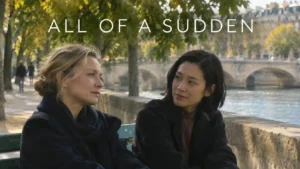
All of a Sudden Feature Scores
Overall Scorata score: 4.4/5
Based on 33 analyzed reviews · View source samples
Explore all 67 feature scores for All of a Sudden, organized into pros and cons.
Scores by Feature
Summary
67 reviewed features-
Very positive 4.5-5.041 (61%)
-
Positive 3.5-4.419 (28%)
-
Neutral 2.5-3.42 (3%)
-
Negative 1.5-2.45 (7%)
Pros
Sort
-
The film champions dignity, compassion, patience and the possibility of meaningful change even when larger problems cannot be solved.
-
The two leads are widely praised for their sensitivity, intellectual energy and ability to convey profound intimacy without melodrama.
-
The profound, nonsexual friendship between Marie-Lou and Mari is the emotional center. Most find it beautifully convincing, though a few feel it is overwritten or idealized.
-
The leads share extraordinary natural chemistry, making their intellectual exchanges and physical tenderness feel like an authentic bond.
-
Soft lighting, graceful tracking shots and unobtrusive framing make ordinary gestures and extended conversations visually expressive.
-
Care, mortality, capitalism, communication and the value of human life form a remarkably rich intellectual framework.
-
The nursing-home scenes humanize patients and illuminate the challenges of patient-centered care, staffing pressures and dignity at the end of life.
-
The film gradually builds to powerful catharsis through small gestures, conversation and compassion. Not everyone connects with its quiet emotional register.
-
The film explores the conflict between financial efficiency and human care in unusual depth. The political arguments are compelling for many, though some find them overly explicit or insufficiently open to dissent.
-
Patient staging, restrained emotion and expressive camera placement make everyday encounters compelling. The approach can become overly academic or idealistic.
-
Natural landscapes, striking nighttime silhouettes and understated city imagery create a beautiful visual language that supports the themes.
-
Long, bilingual conversations create intimacy and explore difficult ideas with considerable intelligence. Some exchanges sound more like lectures or recitations than spontaneous talk.
-
French and Japanese flow into each other naturally, making language an expressive tool for intimacy. An untranslated public exchange is more divisive.
-
The emphasis on hope, dignity and solidarity is deeply restorative for many. Some feel the third act crosses into naive idealism.
-
The screenplay connects personal relationships with sophisticated social and philosophical questions. Some viewers find the exposition overwritten and the late developments too neat.
-
The extended explanation of capitalism is a striking point of division: many find it spellbinding and essential, while others experience it as dry or overly academic.
-
The film treats people with dementia as individuals with histories and personalities, finding emotion in their interactions with caregivers and relatives.
-
The ensemble brings warmth and naturalism to an unusually talkative film. Restrained performances prioritize subtle expression over dramatic display.
-
At more than three hours, the film demands a substantial time commitment. Many find its length essential to the emotional payoff; others feel it could be shortened.
-
Autism and dementia are approached through dignity, inclusion and nonverbal communication. One criticism is that the film does not sufficiently distinguish different kinds of cognitive disability.
-
The film finds distinctive ways to connect theater, healthcare and philosophical dialogue, though some see it as a return to familiar techniques rather than a major departure.
-
The possibility of sudden deterioration gives the time the women spend together urgency and significance.
-
The leads’ fluency in their non-native languages is widely admired, lending authenticity to the conversations.
-
Mortality is treated with restraint and dignity, emphasizing the value of living rather than manipulating grief.
-
The restrained score and subtle percussion complement the natural sounds and avoid heavy-handed emotional cues.
-
The supporting performances bring sensitivity and warmth, especially the older actor and the autistic teenager. Some supporting roles leave a particularly lasting impression.
-
Mari’s illness lends the friendship urgency without reducing her to a victim. The restrained portrayal of pain and uncertainty avoids cheap melodrama.
-
Many appreciate the film’s refusal to manipulate emotion, while others feel the late optimism becomes mawkish.
-
The embedded stage performances echo the care-home themes and become emotionally meaningful, though some find the monologues overlong.
-
The film favors everyday Paris locations and an authentic care-home setting over familiar tourist imagery.
-
The conclusion brings the philosophical ideas into emotional focus for many viewers. Others find the final act scattered, overly tidy, or too sentimental.
-
Natural light and small pools of illumination create understated, emotionally resonant images.
-
The central relationship and the film’s emotional and philosophical ideas can linger long after the credits.
-
Images of light in darkness and parallels between bodily and societal collapse give abstract ideas a concrete, expressive form.
-
Theater offers a practical and philosophical means of connecting with others, coping with illness and reconsidering institutional care.
-
Chance encounters and prolonged dialogue gradually bring the film’s ideas together. Some viewers find the later narrative cluttered or too conveniently resolved.
-
The measured pace gives ideas and relationships room to develop, building toward an affecting payoff. Some stretches ramble, and even appreciative viewers sometimes wish for tighter editing.
-
A calm, tender atmosphere is enhanced by natural settings and gentle sound.
-
The director makes dense ideas and long conversations surprisingly engaging rather than simply instructional.
-
Family reminiscences restore a sense of personality and history to residents, including difficult or unresolved relationships.
-
The leads feel thoughtful and fully inhabited, though their abstract conversations sometimes obscure everyday personality. Some of the nursing staff could have been developed further.
-
Everyday workplace pressures and understated emotion often feel authentic. Convenient coincidences, idealized characters and an unusually harmonious resolution can strain credibility.
-
The portrayal of burnout and institutional pressures is often convincing. Critics disagree over whether the nurses’ competing perspectives receive sufficient nuance.
-
The characters are exceptionally appealing to viewers who connect with the film’s generous humanism.
-
Fluid editing allows the conversations and intertwined performances to flow naturally.
-
Nature and human well-being are connected through the film’s philosophical concerns and verdant settings.
-
The adaptation makes the source correspondence into a personal, cinematic narrative rather than merely reproducing the letters.
-
The sustained focus on two women exchanging sophisticated ideas is a welcome departure from conventional dramatic priorities.
-
The theater scenes model a compassionate and inclusive approach to mental health and disability.
-
The philosophical and emotional layers inspire at least some viewers to revisit the film.
-
Hushed wind, birdsong, rustling leaves and percussion heighten the intimate caregiving scenes.
-
An ambitious story finds hope and meaning in an unexpected friendship between two women confronting the limits of care and mortality.
-
The terminal diagnosis adds a quiet, persistent uncertainty to the women’s time together.
-
The film exposes the pressures of financial incentives and understaffing in healthcare, at times rather explicitly.
-
The similar names Marie-Lou and Mari reinforce the parallels between the two women.
-
Occasional gentle humor punctures the dense philosophical discussions without undermining the drama.
-
Political and institutional questions are woven into the drama with conviction.
-
The reflective style may appeal beyond existing fans, although viewers who dislike extended conversation may find it overlong.
-
The quiet Paris-set drama offers rich subject matter and a compelling central relationship, though its emotional impact varies.
-
The mysterious connection between the women is appealing, but the closing resolution can sweep away more difficult ambiguities.
Cons
Sort
-
Convenient linguistic coincidences, travel and care-home decisions can stretch the story’s credibility.
-
The overt explanations are divisive: many find the whiteboard discussion fascinating, while others experience it as overly instructional.
-
The tension between management and labor is significant, but the portrayal risks condescension toward workers who resist reform.
-
One English subtitle is criticized for flattening the nuance of an expression about moving at the appropriate pace.
-
Some of the philosophical ideas are repeated more often than necessary.
-
The film’s firm philosophical perspective leaves relatively little room for opposing arguments.
-
The central pair anchors a strong cast, but the wider staff sometimes feel underdeveloped or unevenly integrated.
Use Cases
Best for
Sort
-
Patient viewers who settle into the extended discussions and gradual rhythm are most likely to appreciate the intellectual and emotional payoff.
-
The film offers a hopeful, life-affirming perspective on compassion and the possibility of meaningful change.
-
Viewers already familiar with the director’s patient, dialogue-driven approach are especially likely to appreciate it.
-
The ideas about capitalism, dignity, disability and connection invite sustained discussion and reflection.
-
People with experience of caring for parents or relatives with dementia may find the film particularly affecting.
-
The film can serve as an entry point into the director’s work despite its unusual length and conversational style.
Conditional or not ideal for
-
Emotion-sensitive viewingThose sensitive to terminal illness may find its persistent uncertainty and familiarity with the experience of losing loved ones emotionally difficult.
Cast & Creators
-
DirectorHamaguchi earns widespread praise for turning prolonged conversations and everyday gestures into emotionally resonant cinema. His deliberate approach can occasionally feel pedagogical, overextended or too idealistic.
-
Marie-Lou FontaineEfira anchors the drama with warmth, understated exhaustion and vulnerability. Her fluency in Japanese and chemistry with her co-lead are especially impressive.
-
Mari MorisakiOkamoto brings serene intelligence, sensitivity and emotional restraint to a woman confronting mortality. Her exchanges with Efira make the central bond compelling.
-
WriterThe co-written screenplay is admired for its depth, humane perspective and skill in adapting correspondence into an expansive dramatic structure.
-
CinematographerGuichaoua’s soft lighting, vivid natural imagery and unobtrusive camera work give extended dialogue and everyday moments visual resonance.
-
GoroNagatsuka brings memorable warmth and quiet presence to his scenes as the older performer.
-
EditorThe fluid editing helps the extended conversations and closely interwoven performances unfold naturally.
-
TomokiKurosaki is singled out for a sensitive supporting performance.
-
ComposerThe sparing score is appreciated for serving the film’s intimate, dialogue-driven approach.