Other features
AC outlet count
Pecron E1000LFP
4.6
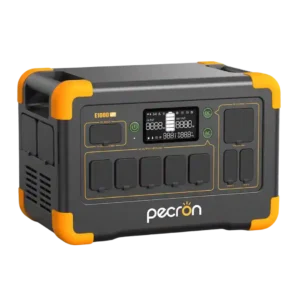
Five AC receptacles are unusually generous for a compact 1kWh station and are widely appreciated, although one owner felt five was more than this inverter really needs.
Pecron F5000LFPNo score yet
Cable storage
Pecron E1000LFP
5.0
The included drawstring cable bag is a simple but useful touch for keeping the charging leads together.
Pecron F5000LFPNo score yet
Dust resistance
Pecron E1000LFP
2.5
Large ventilation openings make this a poor choice for very dusty environments unless it is kept well protected.
Pecron F5000LFPNo score yet
Firmware updates
Pecron E1000LFPNo score yet
Pecron F5000LFP
1.0
Firmware support is a concern for at least one long-time Pecron owner, who says updates have been notably absent. That matters because some app and charging quirks appear fixable in software.
Frequency stability
Pecron E1000LFP
4.5
The inverter held 60Hz during a sustained heavy-load run, supporting stable operation under stress.
Pecron F5000LFPNo score yet
Heat management
Pecron E1000LFP
3.3
Thermal behavior is the biggest point of disagreement: multiple units handled full load without overheating, while one sample repeatedly ran dangerously hot and shut down.
Pecron F5000LFPNo score yet
Impact resistance
Pecron E1000LFP
4.5
Solid corner bumpers provide useful protection against everyday knocks and handling, adding confidence when moving the station around.
Pecron F5000LFPNo score yet
Instruction quality
Pecron E1000LFP
4.5
The manual is reasonably comprehensive and covers the information a typical owner is likely to need.
Pecron F5000LFPNo score yet
Inverter quality
Pecron E1000LFP
5.0
One hands-on evaluation called the inverter outstanding after it powered a broad set of real appliances without instability.
Pecron F5000LFPNo score yet
Lifting ease
Pecron E1000LFP
4.0
At about 30 pounds it is not light, but the dual handles make it manageable for an average adult to lift and move.
Pecron F5000LFPNo score yet
Outlet accessibility
Pecron E1000LFP
3.0
All-front access is convenient in tight spaces, yet floppy protective covers and crowded spacing can make actual plug access less pleasant than the layout first suggests.
Pecron F5000LFPNo score yet
Outlet selection
Pecron E1000LFP
4.7
The port mix is broad and practical for camping, cameras, small electronics, and backup use, with AC, USB, car-socket, barrel, and high-current XT60 options.
Pecron F5000LFPNo score yet
Over-temperature protection
Pecron E1000LFP
5.0
Thermal protection correctly prevented charging when the pack was too hot, helping protect the battery after a demanding run.
Pecron F5000LFPNo score yet
Pure sine wave output
Pecron E1000LFP
4.3
The inverter does produce a pure sine wave and can look very clean at moderate loads, although visible distortion increases as output approaches the maximum.
Pecron F5000LFPNo score yet
Remote control
Pecron E1000LFP
4.5
App control makes it convenient to switch outputs and manage the station without standing next to it.
Pecron F5000LFPNo score yet
Remote monitoring
Pecron E1000LFP
4.8
Wi-Fi/app access is genuinely useful for checking remaining charge and operating status from a tent, another room, or another building.
Pecron F5000LFPNo score yet
Self-discharge rate
Pecron E1000LFPNo score yet
Pecron F5000LFP
5.0
One measured test found very low standby loss on the DC side and good retention when left ready for use. That makes long-duration readiness relatively inexpensive in stored energy.
Solar cable compatibility
Pecron E1000LFP
3.0
The included MC4-to-XT60 lead is useful, but its very short length may require an extension with some panels.
Pecron F5000LFPNo score yet
Storage convenience
Pecron E1000LFP
5.0
With most connections on the front and one side, the station can sit flush near a wall while remaining easy to access.
Pecron F5000LFPNo score yet
USB-A ports
Pecron E1000LFP
5.0
The two USB-A ports are a welcome addition alongside USB-C, preserving support for older accessories and charging cables.
Pecron F5000LFPNo score yet
USB-C ports
Pecron E1000LFP
5.0
Dual USB-C ports complement the legacy USB-A connections and give the front panel a well-rounded device-charging setup.
Pecron F5000LFPNo score yet
Weather resistance
Pecron E1000LFP
2.0
Its open ventilation and need for a dry environment make it poorly suited to unprotected exposure in rain, dust, or harsh weather.
Pecron F5000LFPNo score yet
Wheel quality
Pecron E1000LFPNo score yet
Pecron F5000LFP
3.4
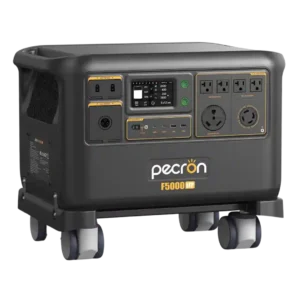
The bundled trolley is helpful when it is assembled correctly, but feedback is inconsistent. Some reviewers find it easy and stable, while others report cross-threaded or incorrect wheels and even warn about tipping if the casters are locked poorly.
Performance
Air filter access
Pecron E1000LFPNo score yet
Pecron F5000LFP
5.0
The removable fan vent is appreciated because it makes dust cleanup straightforward. Reviewers called out the easy access as a thoughtful maintenance detail.
Cooling performance
Pecron E1000LFP
2.3
Cooling results conflict sharply: several units stayed cool with smooth, quiet fan control, while one sample overheated repeatedly and required long cooldown periods.
Pecron F5000LFPNo score yet
MPPT controller performance
Pecron E1000LFPNo score yet
Pecron F5000LFP
5.0
Solar tracking performed well in hands-on testing, with the reviewer satisfied by how the dual inputs handled real arrays. The controller setup complements the unusually large solar-input ceiling.
Startup performance
Pecron E1000LFPNo score yet
Pecron F5000LFP
2.0
One demanding tool test exposed inconsistent behavior when the inverter had to decide whether it could start a difficult load. Most ordinary appliances fare better, but this result adds caution around challenging motor starts.
Controls and connectivity
App privacy
Pecron E1000LFPNo score yet
Pecron F5000LFP
5.0
One owner appreciated being able to use the system without creating another account or handing over personal information. That reduces app dependence for privacy-conscious users.
Bluetooth connectivity
Pecron E1000LFP
1.7
Bluetooth pairing is a weak spot: multiple users had trouble connecting directly and ended up relying on Wi-Fi or setting Wi-Fi up first.
Pecron F5000LFPNo score yet
Review contexts may differ, so use caution when interpreting the score gap.
Wi-Fi connectivity
Pecron E1000LFP
4.5
Wi-Fi worked reliably in regular use and was especially useful for checking the station remotely, even when Bluetooth setup was less straightforward.
Pecron F5000LFPNo score yet
Review contexts may differ, so use caution when interpreting the score gap.
Battery and charging
Battery longevity
Pecron E1000LFP
4.5
Its long-cycle LiFePO4 pack is positioned as something to keep for years rather than replace quickly.
Pecron F5000LFPNo score yet
Battery management system
Pecron E1000LFP
4.0
The BMS successfully protected the pack during a frozen recharge scenario, even though the displayed state of charge became inaccurate.
Pecron F5000LFPNo score yet
Battery percentage accuracy
Pecron E1000LFP
2.3
Cold-weather self-heating can confuse the state-of-charge display, with readings temporarily stuck or implausibly high; the charging system may still be functioning correctly underneath.
Pecron F5000LFPNo score yet
Battery storage performance
Pecron E1000LFP
2.5
Storage retention trails at least one close competitor, making the Pecron less ideal for buyers who plan to leave it sitting for long periods between outages.
Pecron F5000LFPNo score yet
Battery voltage compatibility
Pecron E1000LFPNo score yet
Pecron F5000LFP
5.0
A DIY-focused test found the F5000 worked well with an external battery arrangement using compatible voltage and connections. That opens useful possibilities for experienced users building custom storage setups.
Car charging speed
Pecron E1000LFP
2.0
Car charging works but is slow enough to be a meaningful limitation for users who depend on topping up while driving.
Pecron F5000LFPNo score yet
EV charging usefulness
Pecron E1000LFPNo score yet
Pecron F5000LFP
5.0
A hands-on test found the F5000 capable of providing meaningful emergency EV charging. It is not framed as the primary use case, but the available power makes it a useful fallback.
LiFePO4 battery
Pecron E1000LFP
5.0
LiFePO4 chemistry adds to the value proposition, especially at the sub-$400 pricing highlighted by one owner.
Pecron F5000LFPNo score yet
Replacement battery cost
Pecron E1000LFPNo score yet
Pecron F5000LFP
5.0
Expansion batteries are viewed as unusually affordable relative to competing ecosystems. Reviewers like that extra capacity can be added without paying the premium prices common among flagship brands.
Comfort and build
Durability
Pecron E1000LFP
1.5
One carefully handled sample lost a bottom bumper foot, creating a serious concern about long-term physical durability.
Pecron F5000LFPNo score yet
Handle comfort
Pecron E1000LFP
4.8
The side handles are consistently comfortable and make the roughly 30-pound station easier to carry.
Pecron F5000LFPNo score yet
Housing durability
Pecron E1000LFP
4.5
Rubberized bumpers and a rugged shell feel ready for vehicle and RV use, although broader durability feedback is not uniformly positive.
Pecron F5000LFPNo score yet
Materials quality
Pecron E1000LFP
2.5
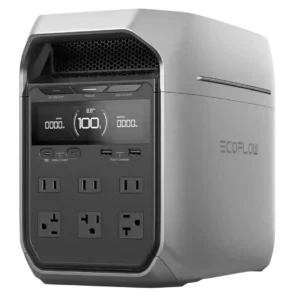
Compared directly with EcoFlow, the Pecron's plastics feel less premium and contribute to its more utilitarian presentation.
Pecron F5000LFPNo score yet
Size and footprint
Pecron E1000LFP
5.0
The power-to-size ratio is a strong point, providing 1,800W output and 1kWh-class storage without an oversized enclosure.
Pecron F5000LFPNo score yet
Water resistance
Pecron E1000LFP
2.0
The vented enclosure does not inspire confidence around water, so it is better treated as a dry-location power station.
Pecron F5000LFPNo score yet
Tracking and training
Energy usage tracking
Pecron E1000LFPNo score yet
Pecron F5000LFP
5.0
The touchscreen and app provide detailed usage statistics, including AC, DC, solar, and cost information. Reviewers value the unusually deep visibility into where energy is coming from and going.
Ownership and support
Operating cost
Pecron E1000LFPNo score yet
Pecron F5000LFP
5.0
One reviewer sees solar-driven daily use as a way to cut grid electricity costs enough for the system to earn back part of its purchase price. The economics improve when the large solar input is used regularly.