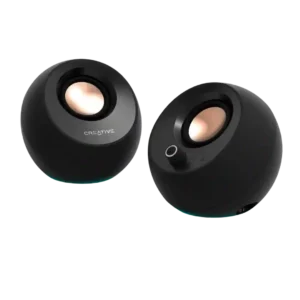
Creative Pebble Pro
Where It Has the Edge
- Dynamic headroom is 4.0 vs 2.5. Adequate USB-C PD power gives the speakers noticeably more punch, scale, and bass authority. Running only from a...

Scorata scores summarize analyzed review evidence on a 1–5 scale; they are not laboratory measurements or a simple average of customer star ratings. Feature scores summarize the reviews covering that feature. The overall score averages feature scores within each review, then combines review averages. When both expert and customer evidence are available, those two groups receive equal weight. Products can have different review coverage, so small score gaps do not establish a winner.
Recommendations prioritize important features for the category, with a score of at least 3.5, a gap of at least 0.25 points and at least two supporting reviews per product. Features with widely varying scores or broad connectivity contexts are excluded from recommendations. These safeguards do not establish statistical significance.
Quick verdict
The review evidence points to a tradeoff: Dynamic headroom versus Packaging quality and App usability and reliability. Choose according to which strengths matter more to you; the overall score alone does not settle that choice.
Choose Creative Pebble Pro for Dynamic headroom.
Choose Creative XF1 for Packaging quality and App usability and reliability.
Scores are out of 5. Missing scores mean missing review evidence, not a missing feature.
High-resolution codecs, Dolby, and DTS formats are not supported, keeping the feature set basic. The speakers are built for straightforward computer audio rather than advanced home-theater formats.
High-resolution support is welcomed for high-quality music files and streaming, giving the system appeal beyond basic computer audio.
USB and aux provide useful flexibility, and USB often produces the best sound. However, several Mac and USB users report failed recognition, dropouts, dead interfaces, or the need to reconnect cables.
Wired connections are generally liked for flexibility and dependable operation, with USB-C offering digital playback and auxiliary input accommodating analog sources.
Low-level listening is inconsistent: some users hear crisp, distinct notes even very quietly, while others find bass and depth fade away. The result depends heavily on power and tuning.
Low-volume reproduction earns direct praise, making the pair suitable for listening without constantly turning it up.
Proper spacing and toe-in can produce clear left-right separation and a convincing desktop soundstage. Positioning matters, and a few users find the effect less consistent away from the sweet spot.
Directional cues and a precise center image are praised at close range. One listener needs more careful positioning to achieve the stereo sweet spot.
Most owners hear a clear, surprisingly full upgrade over laptop or monitor speakers, especially for the price. A smaller group finds the tuning merely average or disappointing.
Sound quality is usually praised relative to size and price, especially after EQ. Limited deep bass and inconsistent high-volume refinement temper the enthusiasm.
Bass is the biggest tradeoff: mid-bass can be surprisingly punchy with proper power and placement, but deep bass is limited and opinions vary widely. Listeners seeking real low-end weight will want a subwoofer or larger speakers.
Bass is often described as controlled and clear, yet deeper weight and physical impact remain recurring limitations. A separate subwoofer is the favored remedy for demanding music and cinematic effects.
Packaging quality is inconsistent: some units arrived in thin or damaged shipping materials, although several speakers survived without damage.
Protective speaker wrapping and easy removal from the box make favorable first impressions.
The combined volume and power control is a recurring weak point, with complaints about uneven steps, bent or loose caps, awkward long presses, and inconsistent clicking. Keyboard volume control is often easier.
The multifunction knob is reported to work well in practice, making device changes a simple button press.
Voice prompts and status LEDs are more intrusive than helpful for some users, especially when reconnecting or in a dark room. Others appreciate the visible mode feedback once they learn the color meanings.
The ability to disable startup and source-change tones is welcomed for avoiding unwanted audible status cues.
Build impressions are split: many find the speakers solid and well made for the price, while others report cheap plastic, bent knobs, dead USB interfaces, or short service life. Quality control is not fully consistent.
The cabinet surface, sturdy enclosure, and rear-plate integration earn praise for tactile quality and reducing unwanted vibration.
The permanently attached cable between the left and right speakers is a recurring cable-management complaint. It can prevent hidden routing through desks and makes the minimalist presentation harder to achieve.
The supplied interconnect makes desk placement straightforward, but its reach can become restrictive on wider furniture.
Computer-powered operation is convenient, but the expert review describes it as less power-efficient than using the dedicated higher-power path.
The energy-saving setting is positively recommended in the introductory setup video.
The set is designed for close desktop listening rather than a full home theater. It lacks the scale, deep bass, and surround capability needed for a convincing large-screen system.
Subwoofer expansion is considered sensible for a small desktop home theater or TV-based listening arrangement.
Adequate USB-C PD power gives the speakers noticeably more punch, scale, and bass authority. Running only from a low-power computer port can leave them sounding restrained.
Powerful peaks lose richness as protective compression intervenes, and the pair cannot match the impact of a much larger KEF system.
General satisfaction is positive, with many calling the set practical and effective for everyday desktop audio. A few buyers report outright defects or poor overall quality.
The package is widely recommended as a useful compact desktop upgrade with thoughtful features. Some find it competitive rather than distinctive, and many articles assess its launch features rather than tested performance.
The lightweight cabinets are easy to place and move, but they can slide, wobble, or be knocked over. Some owners wish the bases had more mass and grip.
Light, manageable cabinets make moving the speakers around a workstation easy.
At ordinary desk levels the speakers are often clean, but maximum volume can introduce harshness, rattling, breakup, or audible distortion. Several owners still report impressively clean output for the size.
Clean output at substantial volume impresses some listeners. Others hear congestion or unpleasant sound near the top of the range, and protective compression can reduce fullness.
Mids, vocals, and general balance are common strengths, while the treble can sound dull and the low end ranges from thin to boomy. Several listeners improve the tuning with software EQ.
Natural balance is a frequent strength, especially after tuning and at close range. Default tuning generally makes good use of the small cabinets.
The overall presentation is usually smooth, balanced, and immersive enough for desktop use. It remains a compact near-field system rather than a full-range replacement for larger speakers.
The sound is praised for a coherent tonal presentation that stays well balanced despite compact-speaker limitations.
Near a desk, many users find the volume more than adequate, particularly with a 30W USB-C PD adapter. Others say USB-only output is restrained and reaches normal listening levels only near the top of the volume range.
The pair offers substantial loudness for desk and small-room use. Approval becomes less consistent at higher settings, where some listeners hear strain or find the sound unbearable.
Clarity and fine detail are standout qualities, with voices, instruments, and small audio cues often sounding cleaner and sharper than expected. A few critical listeners still hear muddiness or limited resolution.
Instrumental detail and small atmospheric sounds are frequently praised. Pricier systems can reveal more nuance, but resolution is considered strong for the size and cost.
Spoken voices usually sound crisp and intelligible, making the speakers well suited to calls, narration, tutorials, and podcasts. A few listeners still prefer headphones for very fine editing.
Voices are praised for natural, neutral definition and clear positioning. Forward upper mids can need adjustment with some music.
The compact footprint fits crowded desks, offices, dorm rooms, and small apartments especially well. It can fill a modest room for casual listening, but it is most consistent at close range.
Bedrooms, dorms, and home offices are favorable settings; close listening in a study brings especially pleasing balance. Larger rooms reveal weaker bass substance.
Dialogue is one of the clearest strengths, with calls, movies, videos, and tutorials coming through cleanly. This makes the set especially useful for work desks and casual viewing.
Movie dialogue is judged clear enough with the Movies preset despite the lack of a dedicated dialogue-boost feature.
The Creative software is widely viewed as limited, offering little useful EQ or RGB control. Firmware and platform support can also be awkward, especially for Mac-only users.
The interface is often praised as quick and understandable, with especially enthusiastic reactions to parametric tuning. One initial pairing sequence prevented discovery until the phone was disconnected and found through the app.
Bluetooth codec support is basic, with SBC-only playback specifically criticized and no higher-quality aptX or AAC option confirmed. Buyers prioritizing wireless fidelity may find the format support limiting.
LDAC is a recurring attraction for compatible sources. Apple devices fall back to AAC, so those users miss a promoted part of the wireless feature set.
There is little useful onboard or app-based tone control, so correcting dull, boomy, or bass-light tuning often requires third-party software. Several listeners get much better sound after manual EQ adjustments.
Precise parametric EQ is one of the strongest attractions and can substantially improve the sound. Some users find the controls daunting, while others call the interface exceptionally approachable.
The source, lighting, and volume controls are useful and accessible, but long-press functions and indicator logic take practice. Missing play/pause and tone controls also frustrate some owners.
Front-facing controls are praised for convenient volume adjustment and one-press source switching.
Many owners report quick, stable pairing, but a meaningful minority experiences random drops, reconnection loops, choppy audio, or failures after sleep. Platform and power configuration appear to influence results.
Wireless operation is described as reliable, with fixed desk distances presented as favorable for maintaining high-bitrate playback.
Casual music listening is enjoyable, clear, and spacious for a small desktop set. Bass-heavy genres and critical listening expose the limits more readily than vocals, acoustic music, or background listening.
Distinct instruments and broadly useful tonal balance suit varied music. Personalized EQ helps some listeners prefer the pair over a bassier alternative.
Bluetooth adds welcome flexibility for phones and computers, and switching is easy for many users. Some systems require extra troubleshooting, manual reconnection, or a separate Bluetooth adapter.
Bluetooth is repeatedly welcomed within a flexible desktop connection package, particularly for switching between a computer and phone.
Review contexts may differ, so use caution when interpreting the score gap.
There is no optical connection, so buyers must rely on USB, aux, or Bluetooth. That is acceptable for most computers but limits compatibility with some TVs and audio setups.
The absence of optical input makes the system less appropriate for television users who need that connection.
The speaker-mounted headphone path draws repeated complaints about hiss and awkward source switching. Users who frequently alternate between speakers and wired earphones should be cautious.
Several listeners miss a headphone output, particularly a convenient front socket for switching to private listening.
Price-to-performance is the product's clearest strength, with many buyers calling it hard to beat for compact desktop sound. Weak bass, power-adapter costs, or reliability problems reduce the value for some owners.
Most assessments find strong value in the sound, features, and size. Price criticism comes from budget-focused shoppers and one listener who considers the pair a little expensive.
Most buyers describe a quick plug-and-play installation with several connection choices. Tiny instructions, unclear indicators, and platform-specific connection issues make setup frustrating for a minority.
Basic hardware setup and app installation are usually straightforward. One app discovery failure required changing the Bluetooth pairing sequence.
The compact spherical shape and RGB accents look modern to many buyers, but the dark green finish is highly polarizing. Some also find the plastic cheap-looking or the speakers bulkier than the minimalist branding suggests.
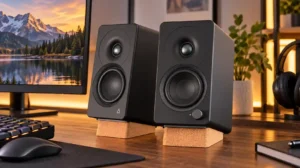
Most impressions favor the understated bookshelf styling and warm cork accents. One listener dislikes the base color and would prefer black.
The compact stereo pair suits a clean PC setup, but it cannot deliver the room-shaking bass of a system with a dedicated subwoofer.
Adding a powered subwoofer is repeatedly welcomed as an easy path to a fuller 2.1 system without replacing the main speakers.
The auxiliary input adds useful flexibility alongside USB-C and Bluetooth. Front access is less convenient than on speakers with a readily accessible jack.
The optional angled cork stands are appreciated for directing sound toward the listener without an extra accessory purchase.
A separate 30W USB-C PD adapter unlocks noticeably more volume, bass, and fullness for many users. The speakers work from a computer port, but not including the adapter is one of the most repeated caveats.
Separate amplification is credited with clearer, more controlled output, and the integrated electronics keep extra audio boxes off the desk.
The defeatable power-saving mode earns praise for letting PC users avoid unwanted automatic sleep during quiet periods.
Small bass adjustments and Desktop mode can improve fullness and control. Heavy boosts may sound oppressive, reduce clean volume, or interact poorly with the room.
The two-metre speaker cable is considered sufficient for most desks, though wider shelf or sideboard placements may stretch its reach.
The simple speaker link and power arrangement are appreciated for keeping a desktop setup tidy with few wires.
The active crossover receives favorable assessments for splitting frequencies before amplification and keeping the compact system controlled.
The separate woofer and tweeter arrangement is positively assessed for improving clarity, detail, and overall balance across content.
At greater listening distances, compression of powerful pulses limits dynamic impact and gradually thins the sound.
The matte cabinet surface is liked for its smooth finish and silky, dense feel.
Several articles praise wide frequency coverage as useful for detail and varied desktop content. A tuned listening test also finds accurate reproduction.
The exposed drivers are liked for a clean, uncovered appearance without fabric grilles.
TV users needing HDMI ARC are poorly served, and one listener specifically wishes for eARC in a future model.
The lack of HDMI limits appeal for TV-based setups, where that connection would simplify integration.
The included cork stands are repeatedly welcomed for aiming and supporting the speakers. One video criticizes the absence of an auxiliary cable.
The front knob makes source changes quick and convenient, allowing easy transitions among a PC, phone, and laptop.
The RGB rings are generally praised as subtle, attractive, and easy to turn off. Controls are basic, and a few users report stuck LEDs, failed colors, nighttime glow, or colors that clash with the green shell.
Quiet listening retains clear, convincing sound rather than losing the detail that some competing speakers struggle to preserve.
The supplied USB-A cable requires an adapter for the Mac Mini setup shown in the unboxing video.
Maximum output is impressive for such small cabinets, but pushing toward the top can reveal compression, congestion, or harshness.
Compatible mobile devices can obtain higher-quality wireless playback, while iPhone and iPad users face the less capable AAC path described in the supplied coverage.
Most sources welcome the small footprint beside a monitor. One video points out that even smaller desktop speakers can use less space.
The small pair is convenient to relocate around a workspace. Mains power makes it unsuitable as a battery-powered outdoor speaker.
Room-filling output is praised for bedrooms and home offices. Larger spaces and demanding bass material expose the limits of the small system.
Parametric EQ is valued for targeting specific room resonances and desktop placement problems with more precision than broad tone controls.
The compact cabinets and optional stands offer useful placement choices. The main speaker’s fixed right-channel assignment can frustrate alternative layouts.
Output is strong for such small speakers and ample for ordinary desktop use. It does not deliver the force of substantially larger systems.
The screw-secured cork coasters are credited with creating a stable supporting base.
Stereo separation helps distinguish movie and game sounds, with clean imaging at the desk. Achieving the ideal image can require some positioning work.
Automatic low-frequency routing to a connected subwoofer is credited with easing the workload on the small main woofers.
The subwoofer output is repeatedly singled out as useful for adding bass depth without discarding the compact pair.
The EQ tools are praised for letting music listeners reshape the tonal balance toward a warmer or more detailed presentation.
The lack of HDMI ARC and optical connections weakens the case for a TV-centered setup.
The separate tweeters are credited with pleasing high-frequency warmth and improved detail in the compact design.
Cork stands and sturdy cabinets are credited with reducing desk vibration and resonance, while also aiming the sound more usefully.
At greater distances, the useful volume range narrows as bass struggles and protective compression reduces richness.
Windows app support receives unusually enthusiastic praise for making speaker settings available directly on the PC.
The stationary Bluetooth connection is positively assessed as reliable and favorable for consistent wireless playback.
The customized woofers are credited with useful punch, clarity, and lower distortion within the limitations of their small size.
Nexus offers extensive sound adjustment, especially welcome through its Windows app. It is less useful as a full music remote because playback still requires the streaming app.
LDAC-capable playback is valued for higher wireless quality, while one listening comparison finds only a small advantage from going wired. Benefits depend on the source device and codec.
Range reports are limited and mixed: some users connect reliably around a room, while others experience dropouts at only a few meters. It is safest as a close-range desktop connection.
The software is liked for useful sound tools, responsive operation, and effective desktop tuning. Its basic presentation and lack of full playback control leave room for improvement.
The front dial gives convenient volume access and doubles as an effective source-switching control.
Direct USB can stay properly synchronized with video, while Bluetooth may introduce noticeable lag. The reports are too limited and setup-dependent for a universal conclusion.
A small but serious cluster reports static, popping, buzzing, or ringing, sometimes even while no audio is playing. Several of those cases ended in returns.
The simple cabinets are easy to wipe down and keep clean. Take care around the volume knob, which can be moved accidentally during cleaning.
Clear directional cues, distinct environmental details, and satisfying effects make the pair appealing for desktop gaming. Stereo immersion is useful even without a surround system.
Mids are commonly praised for clear detail and natural voices. Forward upper mids can sound harsh with some mixes and may benefit from EQ.
Movies benefit from clear speech and tailored EQ, but the stereo presentation can feel contained. Extra bass weight requires a separate subwoofer.
Close desk listening is the strongest use case, with natural voices, clean imaging, and useful aiming from the cork stands.
These are near-field speakers that sound best aimed toward a listener at the desk. Room-filling performance varies, and both volume and tonal quality can drop with distance or poor positioning.
Clarity is a recurring strength, especially for nearby listening and distinct voices or instruments. More expensive speakers can still offer greater refinement.
Ready-made profiles offer useful shortcuts for games, music, and movies, particularly when manual tuning feels complex. The huge selection can also become unwieldy or seem excessive.
The angled stands are credited with a wider, more immersive sound stage by one video assessment.
One movie-listening assessment finds the sound fairly contained and lacking a spatial effect.
There is no included subwoofer or dedicated sub-out, and many users want one for rock, movies, and bass-heavy games. The built-in low end is adequate for casual use but cannot deliver subwoofer impact.
The pair can provide enjoyable stereo entertainment, but some assessments criticize the absence of a true surround or expansive spatial experience.
There is no true spatial-audio or surround-processing support. One owner describes an immersive, crisp presentation, but it remains a conventional two-speaker stereo system.
Treble is often clear and detailed, and can compare favorably with a bassier model. Some listeners instead find the upper frequencies shrill or harsh.
USB-C offers convenient digital computer audio, with positive assessments of cleaner reproduction. One listening test finds its advantage over wireless modest.
USB audio is valued as a reliable computer connection and an effective route to high-resolution playback.
One customer reports very long battery life, but no other source evaluates portable battery endurance. This isolated claim is not enough to establish a consistent pattern.
USB-C power and data are convenient, flexible, and easy to integrate with modern computers. The higher-power USB-C PD path is especially useful, although the required adapter is not included.
Construction draws favorable comments about a solid feel and careful assembly. The pair still feels less premium than some substantially pricier speakers.
The driver size offers useful output for a compact computer speaker, but small drivers also impose audible limits on impact and fullness.
The dense, silky surface and careful assembly are liked, although more expensive models can feel more premium.
Small cabinets fit desks comfortably while preserving impressive output for their size. Their physical limits remain audible in bass depth and untuned sound.
Higher-quality wireless codec support is treated as a strength, particularly when LDAC can be used with a compatible source.
Missing HDMI eARC is a repeated reason to favor PC use or consider another speaker for a television.
The lack of a true surround system is presented as a limitation for buyers seeking multichannel immersion.
USB-C, auxiliary input, and Bluetooth are consistently valued for flexible device use, with subwoofer output adding room for expansion.
A self-contained plug-in setup and straightforward expansion are valued for avoiding separate audio equipment or replacing the pair later.
A few units fail to wake properly after outages or power changes, forcing users to unplug, reconnect, or move the power source. These quirks can worsen over time.
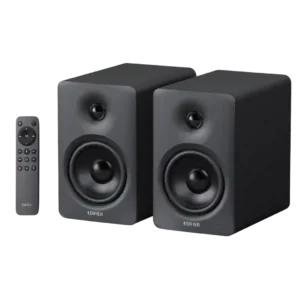
Choose the M90 for powerful, spacious sound, exceptional connectivity, and easy TV integration in a compact desktop-friendly pair. Skip it if you need Wi-Fi or AirPlay, front-mounted controls, or deep...
Pros: Bass performance, Value for money
Cons: On-device controls, Auto-off and standby behavior
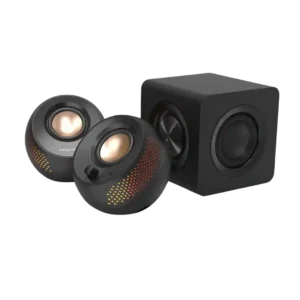
Choose the Creative Pebble X Plus if you want compact desktop speakers with RGB, strong volume, and subwoofer-backed bass. Skip it if you need deep sub-bass, clean cable management, advanced...
Pros: Value for money, Subwoofer
Cons: App reliability, EQ customization