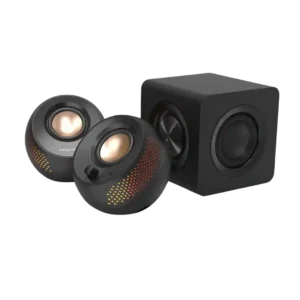
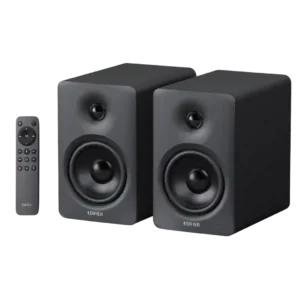
Creative Pebble X Plus Computer Speakers
Where It Has the Edge
- On-device controls is 3.9 vs 2.5. On-device controls were generally useful and tactile, but one reviewer found volume steps coarse and another wanted more...

Scorata scores summarize analyzed review evidence on a 1–5 scale; they are not laboratory measurements or a simple average of customer star ratings. Feature scores summarize the reviews covering that feature. The overall score averages feature scores within each review, then combines review averages. When both expert and customer evidence are available, those two groups receive equal weight. Products can have different review coverage, so small score gaps do not establish a winner.
Recommendations prioritize important features for the category, with a score of at least 3.5, a gap of at least 0.25 points and at least two supporting reviews per product. Features with widely varying scores or broad connectivity contexts are excluded from recommendations. These safeguards do not establish statistical significance.
Quick verdict
The review evidence points to a tradeoff: On-device controls versus Inter-speaker connectivity and Bluetooth codec support. Choose according to which strengths matter more to you; the overall score alone does not settle that choice.
Choose Creative Pebble X Plus Computer Speakers for On-device controls.
Choose Edifier M90 for Inter-speaker connectivity and Bluetooth codec support.
Scores are out of 5. Missing scores mean missing review evidence, not a missing feature.
Inter-speaker connectivity was a recurring complaint because fixed, short, hard-wired cables limited placement and raised durability concerns.
The generously long speaker-to-speaker cable allows proper stereo spacing across desks, shelves, and TV stands.
Power requirements were a repeated caveat because full performance often required a separate 30W or higher USB-C PD adapter that was not included.
The active, bi-amplified design needs no separate receiver, DAC, or power amplifier, simplifying both desktop and TV systems.
Dynamic headroom depended heavily on power and volume level; some reviewers wanted more output, while others found the sound fuller with stronger power delivery.
The bi-amplified design gives the compact speakers strong punch and reserve, keeping music and movie effects lively as volume rises.
Detail retrieval was mixed: some reviewers praised treble/midrange detail and improved clarity, while others missed micro-details or upper-frequency sparkle.
Vocals, instruments, and small textures are generally clear and well separated. The smooth upper treble can occasionally blend fine details on dense recordings.
Cohesion was mixed: one review praised better layering and separation, while another found the subwoofer did not fully disappear into the system.
Drivers blend smoothly into a unified, clean presentation, with vocals and instruments remaining organized across music, games, and video.
Reviewers generally found the system loud for its compact size, with several saying it can get very loud, though a few noted limits near the top of the volume range.
The M90 gets far louder than most desktop setups require and comfortably fills small to medium rooms. Output remains impressive in larger spaces, though the compact drivers cannot match full-size speakers.
Build quality was generally solid, especially for the subwoofer, though some reviews still described plastic or less-premium satellite construction.
The dense MDF-style cabinets feel solid, rigid, and more premium than typical computer speakers. One unit showed average panel fit, but most found the enclosure impressively substantial.
High-volume behavior was mostly positive: one review found no driver or amplifier distortion at maximum volume, while another noted quality loss above roughly 80 percent.
Most listeners found the sound clean and controlled even when pushed hard, with little hiss or obvious distortion. At extreme levels, bass can become boomier and a few tracks lose some composure.
Voice and vocal clarity were a consistent strength, with reviewers praising clear vocals, good presence, and cleaner vocals through the Plus system.
Voices sound clear, forward, and full-bodied across music, podcasts, and TV. They remain intelligible without becoming shouty or thin.
Frequency balance was mixed: several reviewers praised clear, full, or powerful sound, while others heard a warm tilt, muted treble, or mids that were too high or thin.
The overall tuning is warm-neutral or broadly balanced, with strong bass and clear vocals. Depending on preset and placement, the mid-high range can sound cool, dry, recessed, or slightly rough, making the nine-band EQ especially useful.
One reviewer praised the compact size as easy to fit into a desktop setup.
The speakers have reassuring heft but retain a compact, desk-friendly footprint. They are easy to position on shelves or media consoles without feeling flimsy.
Physical control responsiveness was mixed-positive: several reviewers liked the tactile buttons and dial, while one criticized the cheap-feeling volume knob.
The remote buttons respond quickly, have practical sizing, and remain easy to use in a dark room.
Bluetooth codec support was a clear weakness because reviewers repeatedly noted SBC-only support and the lack of AAC or AptX.
LDAC provides unusually strong wireless quality for this class, while AAC keeps iPhone playback respectable. LDAC is unavailable on Apple devices and cannot be used simultaneously with multipoint.
On-device controls were generally useful and tactile, but one reviewer found volume steps coarse and another wanted more sound-shaping control.
The only physical knob and power control sit on the rear of the active speaker, making direct adjustments awkward. Most users will rely on the remote, app, or TV remote instead.
EQ customization was highly platform-dependent: some reviewers praised Windows equalizer controls, while others criticized no EQ or limited controls in mobile/Mac apps.
The nine-band EQ and saveable presets make meaningful tonal and room corrections easy, with presets accessible from the remote. Power users may miss full parametric EQ, and some changes require a Bluetooth app connection.
Bluetooth stability had limited but strong positive evidence, with one reviewer reporting stable, issue-free Bluetooth testing.
Pairing is usually fast and stable at normal room distances. An isolated customer report found repeated disconnections when using Bluetooth with a TV.
App feedback was split: the app could detect or personalize the system, but several reviewers criticized limited mobile/Mac support, missing EQ, or Windows app issues.
ConneX is usually fast, clear, and stable, with useful input, firmware, and EQ controls. It can feel basic, sometimes requires Bluetooth for changes, and a few users found reconnection or setup unnecessarily fiddly.
Audio format support was criticized in one review for being locked to 16-bit/48 kHz with no higher-resolution option.
Hi-res wired processing and LDAC playback preserve more detail than basic Bluetooth, with a clearly audible benefit on compatible high-resolution material.
Wired input support was a strength overall, with reviewers praising broad audio-source support and USB/AUX options, though one noted limited additional connection methods.
HDMI eARC, optical, USB-C, AUX, and sub-out cover nearly every desktop, TV, and legacy source. Multiple devices can remain connected and be switched without moving cables.
Stereo presentation was considered better than a single speaker and immersive at a desk, but constrained by short speaker spacing and imperfect handling of complex mixes.
The speakers create a wide, stable stereo image with convincing center vocals and precise placement. A few demanding recordings reveal less pinpoint separation than dedicated hi-fi monitors.
Latency evidence was mostly positive, with two reviewers reporting no audio-video lag or latency issues and one noting a minor Bluetooth delay for video.
HDMI eARC provides responsive, well-synced TV and gaming audio. One customer encountered noticeable Bluetooth video delay, so wired TV use is the safer choice.
Surround-style processing had limited but positive evidence, with one reviewer saying the app processing brought the sound to life.
The wide front stage gives flyovers and directional effects convincing space, but it remains a stereo system rather than true surround sound.
The subwoofer was the most discussed upgrade: reviewers often praised punch, boom, and better bass, but some still found sub-bass depth, integration, or headroom limited.
The dedicated sub output makes it easy to add deeper extension. Many desktop listeners will be satisfied without one, while action movies and bass-heavy music benefit clearly from a subwoofer.
The angled drivers created a surprising sense of scale in one detailed review, supporting a strong score for perceived height and scale.
The M90 produces unusually wide, deep, and tall staging for its size, especially over HDMI or optical and with careful placement.
Setup ranged from easy to mildly frustrating: reviewers liked basic plug-in simplicity but repeatedly criticized cable clutter and cable management.
Most setups are plug-and-play, with USB-C and HDMI working in minutes. Docking-station arrangements and the app's Bluetooth connection can require extra troubleshooting or clearer instructions.
Value was broadly positive for a compact 2.1 desktop system, but not unanimous because some reviewers preferred cheaper Pebble models or saw platform-dependent value.
The combination of sound quality, HDMI eARC, broad inputs, app EQ, and compact size makes the M90 strong value as an all-in-one system. One customer preferred a much cheaper alternative, but the wider consensus is highly favorable.
Design and aesthetics were usually praised for the compact, cute, tasteful, or good-looking Pebble style, with only minor reservations about plastic finish.
The restrained, boxy design looks modern and purposeful without flashy styling. It blends easily into desks and living rooms, although the busy rear panel is less elegant.
AirPlay 2 is absent, so the M90 cannot join an Apple multi-room setup and must rely on Bluetooth or wired connections.
Bluetooth and HDMI wake quickly, but USB-C, optical, and AUX may require the remote or app. The aggressive default sleep behavior can interrupt quiet content, though firmware and app settings can largely fix it.
AUX and optical inputs make it easy to use turntables with preamps, older media players, and legacy televisions.
The crowded rear panel can turn into a visible tangle when several sources are connected at once.
TV and movie dialogue comes through crystal clear, nuanced, and naturally centered, even during busy scenes.
The exposed drivers have no grilles, leaving the soft tweeters vulnerable to curious fingers or accidental contact.
HDMI eARC is a standout strength, delivering simple TV setup, reliable CEC volume control, and strong audio quality. It makes the M90 a convincing alternative to a compact soundbar.
HDMI eARC, CEC, clear dialogue, and wide stereo imaging make the M90 an excellent bedroom or office TV upgrade. Larger rooms and effects-heavy movies may still need a subwoofer or bigger speakers.
The box includes a generous cable selection, but a few customers received defective USB-C or power cables that required replacement.
Lighting was generally liked for customization and visual flair, though some reviewers found it dim, side-biased, or not personally useful.
Microphone-related usefulness was positive, with reviewers praising the handy input and external peripheral flexibility.
The compact radio remote is highly useful for volume, inputs, playback, and EQ presets, and it works without line of sight. Because the physical controls are on the rear, the remote becomes nearly essential.
The compact footprint and substantial output are an excellent match for desks, bedrooms, offices, apartments, and small to medium living rooms.
Recycled cardboard-style protective forms reduce packaging waste while still keeping the speakers well protected.
HDMI eARC and CEC connect reliably, wake quickly, and let the TV remote control volume and power without fuss.
Bass is punchy, fast, and unusually authoritative for four-inch drivers, with little muddiness or bloat. Deep sub-bass and large-room impact remain limited, so bass-heavy listeners may want a subwoofer.
Directional effects are easy to track, with strong impact and spacious rendering for desktop or couch gaming. HDMI eARC also keeps TV gaming responsive.
Detail and clarity remain intact at apartment-friendly listening levels, making the M90 especially effective for quiet desktop use.
Highs are generally smooth, detailed, and comfortable for long sessions. Some listeners heard recessed, cool, or slightly rough upper frequencies, which the EQ can usually tame.
Bluetooth pairing is quick and straightforward, making casual phone and tablet playback easy.
Review contexts may differ, so use caution when interpreting the score gap.
Multipoint makes switching between two devices convenient and generally seamless. Enabling it disables LDAC, so shoppers must choose convenience or the highest Bluetooth quality.
Music sounds lively, clean, and enjoyable across genres, with rich vocals, punchy bass, and useful detail. The tuning favors accessible long-session listening over strict studio-monitor neutrality.
There is no Wi-Fi streaming, direct music-service support, or multi-room playback, which is a notable limitation for shoppers wanting a networked speaker.
The optical input is handy for televisions, media players, and older digital sources. It sounds good, though it does not support the same automatic wake behavior as HDMI.
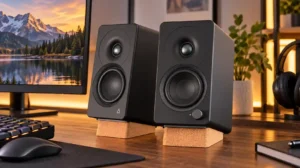
Choose the XF1 for clear desktop audio, flexible connections, and powerful EQ in a compact pair. Skip it if you need deep bass without a subwoofer, consistently polished sound at...
Pros: Placement footprint, speaker size
Cons: HDMI ARC, HDMI ARC support
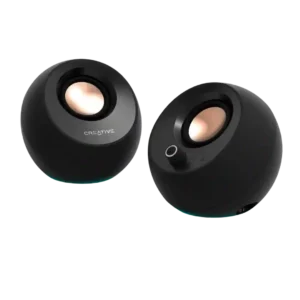
Choose these for clear, compact desktop sound, easy inputs, and standout value. Skip them if you need deep bass, room-filling volume, flawless USB/Bluetooth reliability, or a power adapter in the...
Pros: Overall sound quality, Value for money
Cons: Amplifier power requirements, Wired input