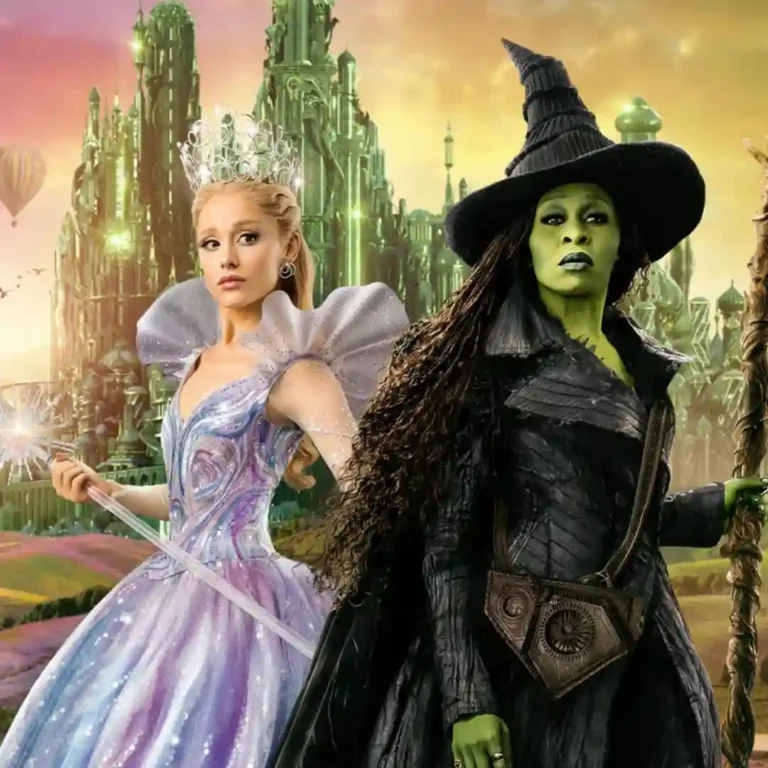
Choose it if Erivo and Grande’s performances, lavish Oz craft, and an emotional friendship finale matter more than a tidy plot. Skip it if you want Part One’s pacing, songbook, humor, or a cleanly structured standalone story.
Best for
Best for Wicked fans who already care about Elphaba and Glinda, and for viewers who prioritize Erivo and Grande’s performances, lavish costumes and sets, and an emotional musical payoff.
Not for
Less suited to newcomers or viewers who want a tightly paced standalone story, consistently memorable songs, bright readable visuals, or the lighter comic energy of Part One.
Verdict
Wicked: For Good is carried by Cynthia Erivo and Ariana Grande, whose vocals, dramatic work, and shared chemistry earn the broadest praise. The production design and costumes also remain major strengths, and the finale lands emotionally for many viewers. The tradeoff is a second act that reviewers frequently find both padded and rushed, with abrupt character turns, weaker songs, and a complicated overlap with The Wizard of Oz. Visual reactions are split as well: the physical craft can be sumptuous, while dim lighting and uneven CGI blunt some of the spectacle. Fans of the stage musical are more likely to embrace the faithful wrap-up; newcomers and viewers already lukewarm on Part One may find the structural problems harder to overlook.
lead performance: 4.9, 45 reviews, strong consensus
Cynthia Erivo and Ariana Grande receive overwhelming praise, often described as the reason the film survives its weaker plotting and pacing. Their vocals, dramatic work, and shared scenes are consistently highlighted.
The performances are one of the film’s safest strengths, with the central cast repeatedly praised for carrying material that many reviewers found structurally weaker. Even mixed reviews often single out the acting as a reason the sequel still works.
Costumes are a standout craft element, repeatedly described as lavish, imaginative, character-rich, and visually striking. Even reviews critical of the movie’s lighting tend to praise the wardrobe itself.
production design: 4.6, 32 reviews, moderate consensus
Production design is among the strongest consensus positives. Oz is repeatedly described as elaborate, colorful, detailed, sumptuous, and richly built even by critics who dislike the lighting or CGI layered over it.
The emotional payoff is one of the strongest areas of agreement. The Elphaba-Glinda relationship, especially the title duet and final stretch, is repeatedly described as moving, tear-inducing, and cathartic.
faithfulness to source material: 4.6, 11 reviews, strong consensus
The film is widely seen as a faithful translation of Act II, which pleases established fans but also preserves many of the stage version’s structural weaknesses. Several reviewers explicitly treat that faithfulness as both strength and limitation.
The screenplay draws substantial criticism for disjointed structure, underexplained turns, repetitive ideas, and additions that do not justify the expanded runtime.
Pacing is the most persistent complaint. Reviewers repeatedly describe a strange combination of dragging scenes and rushed plot turns, with the two-film split often blamed for making Act II feel both padded and hurried.
The story becomes harder to follow as it intersects with The Wizard of Oz. Reviewers criticize abrupt character turns, missing connective tissue, and an expectation that viewers will fill gaps from prior knowledge.
Digital effects are a recurring visual weak spot. Reviewers call out uncanny de-aging, artificial animals, and conspicuous digital environments, though a few felt the effects integrated well enough with the practical sets.
Editing is one of the clearer weaknesses, with complaints about choppy musical staging, awkward transitions, and material that feels in need of substantial trimming.
The central friendship remains compelling, but the story is widely regarded as weaker than Part One. Critics repeatedly point to Act II’s rushed turns, Wizard of Oz overlap, and strained connective plotting.
Erivo earns near-universal praise for powerhouse vocals and a more vulnerable, mature Elphaba. Even reviewers disappointed by the film repeatedly cite her acting and singing as reasons the sequel remains compelling.
Grande is one of the film’s clearest strengths, with reviewers praising her comic timing, vocals, dramatic restraint, and the added depth she brings to Glinda. Her quieter heartbreak and growth are repeatedly singled out as highlights.
Bailey receives strong notices for bringing more gravity, tenderness, and nuance to Fiyero. Reviewers often say he makes a lot of limited screen time, even when the character or romance is underwritten.
Slater is praised for giving Boq anger, sorrow, and menace as his story darkens. Reviewers who discuss him tend to like the performance and often wish the film gave him more room.
Tazewell’s costumes are a consistent visual highlight, praised as imaginative, character-rich, and strikingly detailed. The wardrobe remains impressive even when reviewers dislike how the film photographs it.
Crowley’s production design is strongly praised for elaborate, eye-popping sets that give Oz physical scale and detail. Even visually critical reviews tend to separate the rich set work from lighting or CGI problems.
Compared with other Movies, this product is above average in value for money, makeup quality, special effects quality, near average in character development, ending satisfaction, below average in cultural representation, editing quality, screenplay quality.
Comparison summary
50 compared features
Above average0.4+ pts higher
17(34%)
Same as averagewithin 0.3 pts
12(24%)
Below average0.4+ pts lower
21(42%)
Largest category differences
Attribute
This product
Category average
Difference
cultural representation
1.0
3.6
-2.6
editing quality
1.3
3.4
-2.1
value for money
5.0
3.2
+1.8
makeup quality
5.0
3.2
+1.8
screenplay quality
1.3
2.9
-1.6
realism
1.7
3.3
-1.6
cinematography
2.9
4.1
-1.3
pacing
1.8
2.9
-1.1
Consider This Instead
If you want better CGI quality
Choose Project Hail Mary. It scores 4.7 vs 1.8 for CGI quality, with a 4.3 overall score.
Products reviewers directly compared with this model, grouped into quick takeaways.
Wicked
Similar: overall qualityThe reviewer rates the sequel roughly on par with Wicked overall.
Better: song qualityA new song is judged more generic than Wicked’s best-known musical numbers.
Cats (2019)
Similar: CGI character realismThe Cowardly Lion’s digital appearance is unfavorably likened to the unconvincing felines in Cats (2019).
In the Heights
Alternative: movie-musical appealIn the Heights is recommended as another big-screen musical adaptation for viewers who liked this film.
FAQ
Is Wicked: For Good as good as the first Wicked?
Reviewers are divided. The leads and production craft remain widely praised, but many consider the second-act story, pacing, and song lineup weaker than Part One.
How are Cynthia Erivo and Ariana Grande?
They are the strongest area of agreement. Reviewers repeatedly praise their vocals, dramatic performances, and the emotional chemistry between Elphaba and Glinda.
Are the songs as memorable as Part One?
Usually not, according to the reviews. No Good Deed and For Good are frequent highlights, while the two new songs and much of Act II are often described as less memorable.
Is Wicked: For Good suitable for younger children?
Some reviewers appreciate the PG-level restraint, but others warn that the darker story, frightening transformations, implied violence, and an intimate scene may be uncomfortable for younger viewers.
Do you need to know The Wizard of Oz or the stage musical?
Familiarity helps. Several reviewers say the plot becomes harder to follow when it overlaps with The Wizard of Oz, while established Wicked fans are more likely to accept the Act II turns.
Is the ending satisfying?
That is one of the biggest splits. Many find the final Elphaba-Glinda material moving and tear-inducing, while others call the resolution rushed, contrived, anticlimactic, or tonally mismatched.
Sample Expert Reviews We Analyzed
These are a few of the reviews included in our analysis.
Best for pristine archival footage, immersive sound, and a surprisingly tense look at Disneyland’s construction. Skip it if you want a comprehensive, deeply critical history; several reviewers found the 78–79-minute...
Best for an intimate, inventive archival portrait with strong emotional and cultural impact. Skip it if substantial nudity or an occasionally wandering biographical structure will frustrate you.
Pros: chemistry between characters, emotional impact
Best for an audacious, text-driven conspiracy thriller with gorgeous 16mm atmosphere and mounting dread. Skip it if long stretches of reading, deliberate repetition, and an intentionally austere narrative sound more...
Best for a profound, formally inventive meditation on grief, memory, and the ethics of filming family. Skip it if intensely personal addiction material, a 114-minute runtime, or occasional repetition will...