
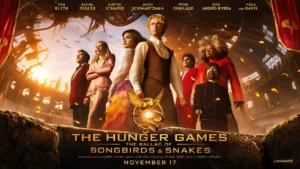
The Hunger Games: The Ballad of Songbirds and Snakes Feature Scores
Overall Scorata score: 3.9/5
Based on 47 analyzed reviews · View source samples
Explore all 49 feature scores for The Hunger Games: The Ballad of Songbirds and Snakes, organized into pros and cons.
Scores by Feature
Summary
49 reviewed features-
Very positive 4.5-5.017 (35%)
-
Positive 3.5-4.412 (24%)
-
Neutral 2.5-3.48 (16%)
-
Negative 1.5-2.410 (20%)
-
Very negative below 1.52 (4%)
Pros
Sort
-
The cast is widely credited with lifting the film, especially the leads and sharply drawn supporting eccentrics.
-
Blyth’s conflicted young Snow and Zegler’s charismatic Lucy Gray are major strengths, even when the writing gives them too little room.
-
Vocal characterization is a welcome part of this return to Panem, helping the dramatic world and its characters feel distinctive.
-
The casting brings together vivid established performers and promising younger leads, with especially strong praise for the supporting lineup.
-
The origin of the Games and the less opulent, postwar Capitol enrich Panem’s history; the new perspective is often cited as a reason to return.
-
Sets, interiors and monumental Capitol architecture make the earlier Panem feel lived-in and politically oppressive.
-
Costumes are a near-universal highlight, from Lucy Gray’s theatrical colors to the Capitol’s severe uniforms and Gaul’s flamboyant looks.
-
Jason Schwartzman’s mordant hosting provides laughs and relief from the gloom, although some find the comic relief strained.
-
The folk singing and live performances strengthen Lucy Gray’s character for many, but their placement occasionally stalls the drama.
-
The stripped-down arena and final confrontation generate tension for some, while others miss the suspense of the earlier films.
-
Francis Lawrence receives credit for confidently returning to Panem and balancing brutal spectacle with intimate drama, although some find the later pacing difficult.
-
Viola Davis, Peter Dinklage, and Jason Schwartzman provide some of the most memorable work, often rescuing weaker passages.
-
The film’s critique of propaganda and media manipulation resonates with some critics, while others find the messaging blunt or superficial.
-
Snow’s compromises and ambition deepen the franchise’s moral questions, even if the eventual villainous turn feels too predetermined for some.
-
Lucy Gray’s folk songs give the movie a distinctive voice and emotional pull, but a few listeners find the repeated musical interruptions overused.
-
Blyth and Zegler make distrust and attraction palpable, but some critics feel the script skips over the emotional foundations of their romance.
-
The rough, enclosed early Games create a harsher and more immediate kind of action, but viewers who prefer elaborate arenas sometimes find the competition visually plain.
-
The cinematography distinguishes the brutalist Capitol from the atmospheric forest, though some rapid movement and wide-lens choices divide opinion.
-
Fans of dystopian YA get a substantial new angle on familiar ideas, although some feel the franchise did not need another origin story.
-
The film closely follows Suzanne Collins’ novel, pleasing some book readers, though a few think the dense adaptation would have worked better in more screen time.
-
Most find substantial entertainment in the performances, Games and atmosphere, even when the extended third act holds them back.
-
The film examines authoritarianism, class and propaganda with uncommon ambition for a YA blockbuster, though some think it merely repeats its ideas.
-
Snow is compelling for many as an unsteady antihero, but his selfishness and Lucy Gray’s relative lack of development leave others detached.
-
Editing quality is a welcome part of this return to Panem, helping the dramatic world and its characters feel distinctive.
-
Franchise continuity is a welcome part of this return to Panem, helping the dramatic world and its characters feel distinctive.
-
The birth of the Games as televised propaganda offers a sharp picture of how entertainment can normalize cruelty and inequality.
-
Opening sequence quality is a welcome part of this return to Panem, helping the dramatic world and its characters feel distinctive.
-
Production value is a welcome part of this return to Panem, helping the dramatic world and its characters feel distinctive.
-
Zegler’s songs are beautifully performed, but some find the timing and frequency of the numbers disruptive to dramatic momentum.
Cons
Sort
-
At roughly 157 minutes, the film can feel overstuffed and more exhausting than its promising first half warrants; a minority feel it sustains the length.
-
The elaborate title draws mockery from some critics, who find it cumbersome or overwrought.
-
Lucy Gray’s stylized Southern/Appalachian accent is a sticking point for some, despite admiration for her vocal performances.
-
The first two sections often move with urgency, while the extended Peacekeeper finale is frequently accused of dragging, rushing key turns, or both. A few find that quieter ending the strongest section.
-
Many appreciate the tragedy and unease; others miss the heartfelt investment of the Katniss films or find key deaths strangely muted.
-
Snow’s gradual corruption is intriguing and sometimes unsettling, yet some critics feel his pivot and Lucy Gray’s motivations are insufficiently developed.
-
Practical environments blend convincingly with effects for some, although the digital cityscapes and occasional green-screen feel draw criticism.
-
Originality draws criticism, with the uneven latter stages reducing the effect of otherwise promising material.
-
Dialogue quality draws criticism, with the uneven latter stages reducing the effect of otherwise promising material.
-
The three-chapter format permits a large story but produces an abrupt tonal break after the Games, leaving viewers divided over the ending.
-
Viewers sometimes struggle to follow the dense Capitol power dynamics and Snow’s final choices, though others find the story legible.
-
Villain quality draws criticism, with the uneven latter stages reducing the effect of otherwise promising material.
-
There is disagreement about a second viewing: some are eager to return to Panem, while others find this long installment too frustrating to revisit.
-
The retro-futurist Capitol is often described as striking, imposing and distinctive despite sporadic complaints about artificial-looking imagery.
-
The final stretch splits opinion: some find its moral payoff gripping, while others consider the rushed, ambiguous resolution unsatisfying.
-
Tonal consistency draws both praise and criticism: the ambitious prequel has memorable high points but can struggle to sustain its ideas through the finale.
-
The prequel wins over fans who value its examination of Snow and early Panem, while skeptics question whether that history needed another long film.
-
The script has intellectually ambitious material but varies in success at explaining Snow’s transformation and reconciling the romance with the political story.
-
Snow and Lucy Gray share an intriguing but morally compromised connection. Some praise the chemistry, while others question whether the romance and betrayal feel earned.
-
The return to Panem impresses many with its mature origin story and political ambitions, but a notable group finds the prequel unnecessary or underdeveloped.
Use Cases
Best for
Sort
-
The strongest recommendation is for viewers interested in how spectacle, class inequality and propaganda prop up authoritarian power.
-
Returning Hunger Games fans gain revealing history and familiar references, though several warn that the long final act is weaker than the series at its best.
-
A character-led origin story works best for those curious about Snow’s moral decline, provided they can tolerate some abrupt motivations.
-
The folk ballads and Zegler’s singing are a major attraction, though song placement occasionally interrupts the storytelling.
-
Book readers will recognize a largely faithful adaptation and its themes, but major plot compression and missing inner narration can still frustrate.
-
The arena dangers and suspicious final confrontation can be gripping, but thriller fans seeking relentless action may be disappointed by the quieter final act.
-
Its best psychological material asks how self-preservation gradually curdles into cruelty and ambition.
-
The questions about complicity, power and manipulation give viewers plenty to discuss after the credits.
-
The clash between fascistic media power and rebellious districts provides material for politically engaged viewers.
-
The Capitol’s imposing design and arena spectacle reward a large screen, particularly for viewers drawn to expansive fantasy worlds.
-
The grand production design and stark arena scenes are worth IMAX presentation for viewers who prize immersion.
-
The mature political themes aim to engage young adults without talking down to them, though the child-on-child violence is disturbing.
-
The widescreen craft and tense Games make it an appealing theater outing despite the demanding runtime.
-
Adult viewing is possible but comes with caveats, chiefly the extended final act and uneven emotional development.
-
Survival-story viewing is possible but comes with caveats, chiefly the extended final act and uneven emotional development.
Conditional or not ideal for
Sort
-
Newcomer viewingThe political setup can be followed without watching the earlier films, but some reviewers caution that the prequel is a less welcoming starting point.
-
Action-fan viewingThe early arena sequences provide visceral action, though this installment emphasizes politics and character decisions more than elaborate competitions.
-
Stress-sensitive viewingThe grim, close-quarters deaths and betrayal may be upsetting to viewers sensitive to stress or cruelty.
Cast & Creators
-
Lucy Gray BairdRachel Zegler’s magnetic presence and expressive singing bring Lucy Gray to life, though some critics feel the character and romance are underwritten.
-
Coriolanus SnowTom Blyth gives Snow charm and a chillingly calculating streak, making his transformation compelling even when the script races through crucial changes.
-
ActorJason Schwartzman steals scenes as the smarmy Games host, balancing dark laughs with the film’s portrait of media cruelty.
-
Volumnia GaulViola Davis turns Dr. Gaul into a gleefully frightening, flamboyant force; a few find her heightened camp excessive.
-
Casca HighbottomPeter Dinklage gives the academy dean bitterness and wounded conscience, with several critics singling out his supporting turn.
-
ActorHunter Schafer lends Tigris tenderness and moral warmth, despite limited screen time.
-
Casting directorDebra Zane receives praise for casting a mix of established actors and promising new performers.
-
Casting directorDylan Jury receives praise alongside Debra Zane for balancing fresh performers with established talent.
-
DirectorFrancis Lawrence expands Panem with commanding production choices and vivid arena violence, even if the last act divides viewers.
-
Sejanus PlinthJosh Andrés Rivera brings idealism and emotional weight to Sejanus, countering Snow’s growing ambition.
-
Costume designerTrish Summerville’s eye-catching costumes give Capitol hierarchy and Lucy Gray’s individuality distinctive visual character.