
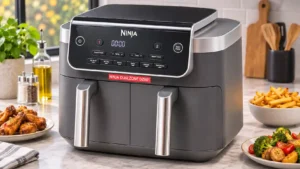
Ninja DualZone DZ801 Feature Scores
Overall Scorata score: 3.3/5
Based on 15 analyzed reviews · View source samples
Explore all 44 feature scores for Ninja DualZone DZ801, organized into pros and cons.
Scores by Feature
Summary
44 reviewed features-
Very positive 4.5-5.07 (16%)
-
Positive 3.5-4.413 (30%)
-
Neutral 2.5-3.410 (23%)
-
Negative 1.5-2.413 (30%)
-
Very negative below 1.51 (2%)
Pros
Sort
-
Smart Finish is the most consistently praised convenience: it staggers starts so two different recipes complete together without manual timing.
-
Match Cook copies one zone’s settings to the other, making two identical batches easier to run without entering everything twice.
-
Fast preheating is a repeatedly noted strength, including against otherwise higher-performing dual-basket competitors.
-
Its fast cooking is a repeat advantage, particularly for frozen snacks. Dense vegetables and meats take longer, though still at a reasonable pace.
-
The nonstick drawers wipe clean and removable plates simplify washing. Two separate baskets still mean more surfaces than a single-drawer fryer.
-
Frozen fries and nuggets develop a satisfying crunch quickly. Homemade fries and some larger pieces are less consistent, especially beside higher-performing models.
-
It gets back up to cooking heat quickly after a drawer is opened, limiting the interruption from checking or adding food.
-
Separate baskets support air frying, broiling, roasting, baking, reheating and dehydrating. The flexibility is a strength, although inconsistent mode labeling and narrower fan controls temper it.
-
The crisper plates are repeatedly described as dishwasher-safe, while descriptions of basket care vary. Check exact-model instructions before putting the baskets in the dishwasher.
-
One hands-on account reports deep-fry-like crispness without submerging French fries in oil.
-
The refreshed dual-basket design receives strong praise for its incremental refinements. Longer-term testing and comparison with cheaper alternatives temper the enthusiasm.
-
The refreshed touch panel is considered more responsive and straightforward to follow for two-dish cooking.
-
Frozen fried food generally turns out golden and crispy, and one comparison found slightly improved wing and nugget results. Meat remains considerably less reliable than potato snacks.
-
A refreshed, more modern housing improves its visual appeal compared with the earlier model.
-
Separate airflow paths are credited with keeping aromatic foods from influencing what cooks in the neighboring drawer.
-
The PTFE-coated baskets are credited with easy cleanup and release, although shoppers trying to avoid this coating will need another product.
-
Six available methods cover considerably more than simple frying, with low-temperature settings for dehydrating and higher modes for roasting or broiling.
-
Its newer, active model status is considered a possible advantage for continued parts availability, though actual long-term support is not proven.
-
Once it reaches its cooking temperature, heat fluctuates little. However, the stable temperature itself can sit above the setting selected.
-
A guide credits the independently routed airflow with keeping temperature conditions separate between baskets.
Cons
Sort
-
More than one account notes that pulling a basket out does not automatically pause the cooking cycle. Manually stopping it adds an extra step.
-
The fryer tends to run hotter than the selected temperature, so standard recipes can brown sooner than expected. This is one of its clearest tested drawbacks.
-
Side-by-side drawers keep foods separate and are simple to access, but their small individual cooking floors limit single-layer spreading and large cuts.
-
Several guides find the coating specifications unclear or incomplete. Other reporting distinguishes ceramic crisper plates from PTFE-coated baskets, so buyers should check exact surfaces.
-
The one-year limited warranty is shorter than the two-year coverage available from some compared competitors.
-
Because it typically runs hot, following recipes without checking them may lead to earlier or stronger browning than expected.
-
The absence of a built-in meat probe is a drawback versus higher-end models that stop cooking at a target doneness.
-
Some descriptions report that cooking continues when a drawer is pulled out. Remembering to pause manually matters when checking hot food.
-
Eight quarts across two drawers is useful for a family meal, but each four-quart compartment is relatively small. Larger items and thickly piled batches can run out of room.
-
Conflicting descriptions of certain specialty presets make the documentation less reassuring for people buying specifically for those modes.
-
The continued airflow reported when a drawer is removed creates avoidable energy use.
-
Wings and chops can develop crisp patches while other parts stay rubbery or dry. Shoppers focused on excellent meat texture should consider alternatives.
-
An accessible exact U.S. owner guide was not established in one comparison, leaving program and electrical details less clear.
-
Noise surfaced as a complaint in a small set of early owner ratings, although the limited sample does not establish how common it is.
-
Without a basket window, you cannot watch food brown without opening a drawer. That makes it less attractive for visual monitoring.
-
High appliance wattage and incomplete exact-model electrical documentation warrant checking outlet suitability before use.
-
Early feedback is encouraging, but the 2026 model has far less long-term owner history than established Ninja alternatives. Some commentators prefer a longer-proven model.
-
It is somewhat more compact than several 10-quart Ninja models, but still takes meaningful countertop space. Drawer clearance and its weight matter in tight kitchens.
-
Variable fan speeds help adapt the cooking method, but some rivals offer a wider range for fine control.
-
The updated unit is lighter than some older or higher-capacity counterparts, though at roughly 17 pounds it is not a featherweight.
-
Its value is strongest for regularly cooking different dishes simultaneously. For mostly single-food batches, the cost and space premium buys functionality that may go unused.
-
Frozen snacks cook fairly consistently, but proteins and certain homemade foods have more uneven results than the strongest rivals. Other testing reports modest airflow improvements over its predecessor.
-
Browning can be uneven, particularly on homemade fries or next to premium dual-basket competitors. Some side-by-side testing also reports incremental improvement over the older DZ201.
-
The six modes cover low-temperature dehydrating and hotter roasting or broiling. Reports differ on the maximum in some listings, so the precise program matters.
Use Cases
Best for
Sort
-
This is the DZ801’s defining use: chicken, fish or another main cooks in one basket while vegetables or fries finish in the other. Independent timing keeps both ready together.
-
The two drawers work particularly well for three or four people when one holds the main and the other a side. Bigger families may face multiple rounds.
-
Fast snack cooking and coordinated mains and sides make it well suited to weeknight dinners for small families.
-
Dedicated high-heat broiling helps expand the jobs it can handle beyond ordinary air frying.
-
Fresh-cut fries benefit from the revised airflow in one comparison, but controlled testing still finds pale or mushy pieces in some batches.
-
Roasted vegetables can share a basket arrangement with the main dish. Denser vegetables take longer than frozen snacks but still finish within a practical time.
-
Its broad temperature and fan options make dehydrating produce a practical additional job, rather than a token preset.
-
Frozen fries, tots, onion rings and similar sides are among its best-performing foods, coming out quickly with mostly uniform crispness.
-
French fries are a dependable strength, particularly frozen ones, which cook quickly and brown mostly evenly.
-
Using both drawers for a double batch of the same food adds some practical meal-prep capacity, provided the food can be spread between them.
-
Baking benefits from the low-to-high temperature and adjustable fan settings, though each drawer limits the size of what can fit.
Conditional or not ideal for
Sort
-
Cooking for one or twoCouples cooking two different dishes can make good use of the zones. Solo portions or a single food are often simpler and cheaper with a smaller one-basket fryer.
-
Whole chickens and tall roastsA whole chicken or similarly bulky roast will not fit in either narrow four-quart compartment. Look for a larger single chamber for this job.
-
Meat and poultry cookingMeat results divide opinion: some comparative cooking finds improved wing crisping, but controlled tests report rubbery patches and moisture loss.
-
Avoiding traditional PTFE-coated air-fryer basketsThe absence of a clearly advertised PFAS-free basket claim makes this an uncertain option for shoppers avoiding conventional PTFE coatings.