
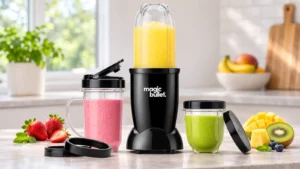
Magic Bullet Blender Feature Scores
Overall Scorata score: 3.4/5
Based on 28 analyzed reviews · View source samples
Explore all 99 feature scores for Magic Bullet Blender, organized into pros and cons.
Scores by Feature
Summary
99 reviewed features-
Very positive 4.5-5.019 (19%)
-
Positive 3.5-4.426 (26%)
-
Neutral 2.5-3.425 (25%)
-
Negative 1.5-2.426 (26%)
-
Very negative below 1.53 (3%)
Pros
Sort
-
The compact base takes up remarkably little room on a counter or in a cabinet.
-
The small footprint leaves much more worktop space than a full-size pitcher blender.
-
Dishwasher-safe cups and lids simplify cleanup. Accounts differ on the blades, so hand-wash the blade assembly and follow the specific set's care instructions.
-
The low upfront price and useful accessories make it appealing for simple jobs, but weak performance on hard ingredients reduces its value for more ambitious blending.
-
The cups and motor base fit together quickly and require little learning.
-
Removable cups and blades simplify everyday cleanup, although trapped food and leaks can create extra work.
-
The motor base is easy to tuck away; the extra cups and lids take more room to organize.
-
Small batches of pesto and other simple sauces are a particularly useful application.
-
The travel lid turns a blending cup into a portable drink container, reducing dishes and preparation steps.
-
The light motor base is easy to lift and move into storage.
-
Several owners report four to fifteen years of service, particularly with lighter everyday recipes, although others question its durability.
-
The blend-and-drink format is particularly convenient for making one portion at a time.
-
The simple push-and-twist interface is easy to learn, although harder recipes require more hands-on shaking and intervention.
-
Hummus and other dips are achievable, although thick chickpea mixtures may need stirring and can finish chunky.
-
The simple press-and-twist design eliminates complicated switches and buttons.
-
The light, compact construction is easy to carry, although blending requires an outlet.
-
The assortment of cups and lids offers considerable flexibility for the low price.
-
Fruit and liquid smoothies are generally tasty and drinkable. Some recipes leave bits of greens, seeds, or ice behind.
-
Several personal cups make it convenient to blend individual drinks and small dressings without transferring them.
-
Twisting the cup into place allows hands-free blending, though thick ingredients may need intervention.
-
Small cups bring ingredients close to the blades, making oil-and-vinegar dressings easy to emulsify.
-
Longevity varies: several owners report years of use, but broken cup tabs, worn gaskets, and motor failures are also concerns.
-
Soft foods can be puréed effectively in small amounts, while denser mixtures may stay coarse.
-
The blade is initially sharp and effective for lighter work, although long-term use can dull it.
-
The narrow cup can help small portions reach the blade, and rounded corners simplify scrubbing, although the shape limits larger chopping jobs.
-
Short presses offer useful manual pulsing for coarse chopping and other small jobs.
-
Lip rings make sipping from the blending cups more comfortable.
-
Replacement blades and other parts are available, but buyers should be cautious about unofficial parts.
-
Simple shakes often take less than a minute; harder ingredients can take much longer than in stronger blenders.
-
Small amounts of garlic, vegetables, and salsa can be chopped with short pulses, but uniform onion pieces are harder to achieve.
-
It handles more than smoothies, including dips, dressings and some chopping, but it cannot replace a powerful all-purpose blender.
-
The optional flat milling blade is useful for spices, grains, and coffee, though it is not included with every set.
-
The storage lids make it easy to keep extra drinks and dips in their blending cups.
-
The removable blade is easy to access, but residue underneath and around its threads can be difficult to scrub.
-
Replacement blade assemblies can be inexpensive and easy to find.
-
Ingredients mix well for straightforward recipes.
-
Tightly fitting cups and lids can prevent spills when properly secured.
-
Owners who use it for simple personal portions often love it; demanding performance tests are considerably less favorable.
-
Small milkshakes are a reasonable fit for the simple personal blending design.
-
Blending soapy water loosens food residue, but stubborn material around the blade or cup rim may still need scrubbing.
-
Some motors last for years with light use, while others eventually fail or stop mid-blend.
-
The brand has a favorable reputation for helpful support, although direct service experience is not established here.
-
A handled cup can be comfortable to hold, although tightening the lid can take considerable wrist strength.
-
The included recipe book is easy to follow.
-
A one-year warranty backed by an established service operation adds modest reassurance at the low price.
Cons
Sort
-
The motor and blade struggle to break down hard ice even with repeated pulsing and shaking.
-
The sealed jars are not designed to blend hot liquids; allow cooked ingredients to cool before blending.
-
Plain ice is a major weakness: cubes frequently rattle around or remain in large chunks rather than turning into snow.
-
Dense vegetables, hard nuts, and ice readily overwhelm the small motor, particularly when little liquid is added.
-
The base can wobble or walk across the counter during operation.
-
The small jars suit individual servings but run out of room quickly with bulky ingredients.
-
Whole almonds, pieces of fruit, and fibrous vegetables can escape the blades even after repeated blending.
-
Ingredients frequently collect on the sides or above the blades, requiring stops to shake or scrape the cup.
-
The short continuous-run limit makes recipes requiring several minutes of uninterrupted blending impractical.
-
Long blending sessions can warm mixtures or melt frozen fruit, changing the intended texture.
-
Spinach can blend nicely in a liquid smoothie, but kale, celery and more demanding green drinks often remain fibrous.
-
The 250-watt motor is adequate for soft drinks and light preparation but lacks strength for hard ice and dense mixtures.
-
Leaks at the blade gasket or cup lid are a recurring concern, although some owners report tight seals.
-
The predominantly plastic construction feels inexpensive compared with sturdier personal blenders.
-
Rubber feet offer some grip, but the lightweight machine can move around during difficult blends.
-
Leakage around the blade assembly and worn gaskets are recurring frustrations.
-
Conflicting or missing cup-capacity information makes it difficult to know exactly how much the included jars hold.
-
Nut butter results vary considerably, from surprisingly spreadable to gritty chopped nuts; expect frequent shaking and added oil.
-
One speed limits the ability to adapt the machine to different textures and recipes.
-
There is no variable speed adjustment for controlling delicate or demanding blends.
-
Results vary with ingredient toughness and blending technique; fibrous celery and leafy greens can leave substantial pulp.
-
Thick mixtures and residue can collect on cup walls, threads, and under the blade.
-
Extended or difficult blending raises concerns about overheating and interruptions.
-
The plastic construction looks vulnerable to scratches and wear.
-
Smooth results are achievable with easy ingredients, but tough recipes often leave uneven chunks or material stuck to the cup.
-
The optional milling blade works well for certain spices and grains, but results with the standard blade and harder dry ingredients are uneven.
-
Noise is polarizing: some find it relatively tolerable, but others describe it as loud enough to want ear protection.
-
Long blending can create unwelcome foam rather than a clean, smooth drink.
-
The lack of presets leaves the timing and texture entirely up to the user.
-
The cup sizes suit a single drink, but larger recipes and ice quickly exceed their useful capacity.
-
The blade can last for years, but concerns about fragility and eventual dulling make it a poor fit for hard dry ingredients.
-
There is no dedicated place to stow the power cord.
-
The tightly sealing travel lid can be difficult to open.
-
Coffee bean residue and smell can linger in the plastic if the container is not washed promptly.
-
Excess plastic wrapping is disappointing compared with alternatives that use recyclable paper.
-
Repeated use with brightly colored ingredients can leave the plastic cups stained.
-
Frozen fruit can blend successfully with enough liquid and time, but large frozen pieces often remain intact.
-
Some units remain dependable for years, but broken tabs or mid-blend shutdowns can render the appliance temporarily or permanently unusable.
-
Some owners find the build solid for the price, while others consider the plastic components flimsy and the base insubstantial.
-
The understated, compact design appeals to some owners, while others find the finish cheap and unattractive.
-
Plastic cups are lightweight and convenient, but opinions on their sturdiness range from reassuring to flimsy.
-
Thick smoothie bowls are hit or miss: one acai recipe blended well, while dense mixtures with little liquid are difficult.
-
Liquid and ingredient order help establish circulation, but thicker mixtures can struggle to form a useful vortex.
-
Small quantities of nuts can be ground, particularly with the optional milling blade, but the standard blade often leaves large pieces.
-
Basic liquids and soft ingredients blend well, but harder recipes expose the limits of the motor and blade.
-
The cord is adequate for a nearby outlet, though one tester found it fairly short.
-
Lids can fit securely, but some users encounter poor sealing.
-
Some cups seal reliably, while other lids require considerable tightening or leak during shaking.
-
Some cups withstand years of washing, while others have fragile activator tabs or risk warping in high-temperature dishwasher cycles.
-
Simple protein powders and liquid shakes work well, but recipes containing dense nuts or other hard additions can remain chunky.
-
Soft recipes can be pleasantly smooth, but harder ingredients introduce grit, visible flecks, and larger pieces.
-
Push-to-blend operation is straightforward, but there is little precision beyond manually pulsing or stopping.
-
The standard cross blade handles light chopping and liquid blends, but its geometry can push dense ingredients away from the cutting area.
-
Easy recipes are often ready in seconds, while frozen or dense mixtures can require extended blending and manual intervention.
Use Cases
Best for
Sort
-
Basic fruit smoothies are the strongest use, although recipes loaded with frozen fruit and greens can require extra effort.
-
The low cost is attractive for simple personal blends, but paying more may be worthwhile for hard ingredients or frequent demanding recipes.
-
Soft fruits, yogurt, and liquids are ideal ingredients for the modest motor and narrow cup.
-
The tiny base is ideal for small kitchens and apartments where countertop and cabinet space are limited.
-
Small portions of pesto, salsa, and other sauces are a good match, especially when enough liquid is present.
-
Personal cups are an excellent match for one smoothie, especially soft recipes with sufficient liquid.
-
Protein powder and liquids blend conveniently, but adding hard nuts or frozen ingredients can leave a chunky shake.
-
It can save time on small amounts of garlic, salsa, or other light preparation, but is less capable than a dedicated food processor.
-
Owners who stick to simple drinks and light food preparation appreciate the quick operation for everyday use.
-
Blend directly in the cup and fit the travel lid for a quick drink on the way out the door.
-
Small cups and easy emulsification make homemade dressings a strong use case.
-
Small quantities of drinks, sauces, and soft foods fit the narrow personal cups particularly well.
-
The inexpensive, straightforward design is a good starting point for basic blending.
-
For infrequent smoothies and light food preparation, its compact size and low cost are appealing.
-
Soft, cooled foods can be puréed in small portions for baby food.
-
The personal-size cups work well when preparing drinks, dips, or sauces for one or two people.
-
Light whipping tasks such as small portions of whipped cream are manageable.
-
With a compatible flat milling blade, small quantities of coffee beans can be ground quickly.
-
The tiny base and easy storage make it practical for dorm-room kitchens.
-
Extra cups help prepare individual blends in advance, but small capacity makes large weekly batches impractical.
-
Protein powder mixes well with liquid for a quick personal drink.
-
A compact, inexpensive personal blender is practical for a first apartment or dorm with limited storage.
-
Simple sauces, smoothies, and dips can be made quickly without taking out a full-size blender.
Conditional or not ideal for
Sort
-
Ice-heavy blendingLarge amounts of ice are a poor fit for the weak motor and small cup, even with shaking or pulsing.
-
Thick blendsThick blends can stall circulation, forcing extra liquid and repeated scraping; some dips still turn out acceptably.
-
Frozen fruit smoothiesFrozen fruit smoothies can work with ample liquid and smaller pieces, but hard frozen chunks frequently survive blending.
-
Large-batch blendingThe jars are too small for generous batches of smoothies or sauce; larger quantities require repeated rounds.
-
Quiet home blendingSome find the motor tolerable, but its sharp, loud sound can be disruptive in quiet homes.
-
Nut butter preparationDense nut butter is an unreliable task: it may require oil and repeated shaking, and often remains gritty or chunky.
-
Dry ingredient blendingThe standard blade struggles with hard dry ingredients; the optional milling blade and small portions can improve results.
-
Vegetable choppingSmall quantities of vegetables can be chopped with brief pulses, but uniform chopping of larger pieces is difficult.
-
Vegetable dicingSmall-scale dicing may work with short pulses, but onions often collect in uneven chunks.
-
Soup preparationSmall portions of cooled soup ingredients can be blended before reheating, but hot ingredients must not go into the sealed cup.
-
Juice preparationFibrous green drinks are often coarse and chunky rather than juice-like, even after extended blending.
-
Large family mealsMaking family-sized portions requires multiple blending rounds, so a larger pitcher is more convenient.
-
Early-morning blendingQuick operation suits rushed mornings, but the motor can be loud enough to disturb sleeping household members.
-
Frozen drinks and cocktailsLiquid slushies can work, but hard ice and thick frozen cocktails frequently remain chunky.
-
Limited hand strengthTightening lids and pressing the cup down can be difficult for people with reduced wrist or hand strength.