
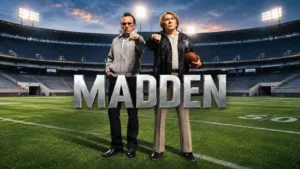
Madden Feature Scores
Overall Scorata score: 2.2/5
Based on 26 analyzed reviews · View source samples
Explore all 59 feature scores for Madden, organized into pros and cons.
Scores by Feature
Summary
59 reviewed features-
Very positive 4.5-5.02 (3%)
-
Positive 3.5-4.48 (14%)
-
Neutral 2.5-3.49 (15%)
-
Negative 1.5-2.428 (47%)
-
Very negative below 1.512 (20%)
Pros
Sort
-
The transition into announcing and telestrator sequences can be lively and affectionate, but the film skips past important developments in Madden’s on-air partnership.
-
Christian Bale and Kathryn Hahn emerge as frequent bright spots, with Bale’s Al Davis often singled out. Several critics argue the thin material sidelines Hahn, Sienna Miller, and John Mulaney.
-
The missed family time puts a human cost on Madden’s devotion to football, giving the warmer parts of the movie some substance.
-
Nostalgia appeal draws positive reactions for adding energy or personality to the biographical material, though the movie’s approach remains divisive.
-
The Cage–Bale partnership produces some of the liveliest scenes, although disagreement remains over whether their exaggerated personalities form a believable friendship.
-
Play diagrams appearing across the screen are an inventive visual nod to Madden’s football mind and the telestrator.
-
Masculinity portrayal draws positive reactions for adding energy or personality to the biographical material, though the movie’s approach remains divisive.
-
Production design draws positive reactions for adding energy or personality to the biographical material, though the movie’s approach remains divisive.
-
Professional life portrayal draws positive reactions for adding energy or personality to the biographical material, though the movie’s approach remains divisive.
-
Theme depth draws positive reactions for adding energy or personality to the biographical material, though the movie’s approach remains divisive.
Cons
Sort
-
Story quality is criticized for how little it contributes to a convincing or emotionally satisfying portrait of Madden.
-
Rather than penetrating the man behind the football icon, the movie often moves through recognizable milestones with limited insight into his contradictions.
-
Its frantic montages exhaust some viewers while other stretches drag; the pace rarely gives personal or historical moments much breathing room.
-
The film jumps among coaching, broadcasting, marriage, and video-game development without making their transitions feel cohesive.
-
Major turning points often arrive and disappear without genuine consequences, leaving the triumphant career milestones short on tension.
-
Direct-to-camera interviews and other mock-documentary touches are introduced with promise, then used so irregularly that many find them distracting.
-
A handful of eccentric moments and actor exchanges land well, but broad, sketch-like comedy is more frequently criticized as forced and repetitive.
-
The affectionate, outsized portrait risks turning an admired football figure into a lovable caricature rather than a fully realized person.
-
Genre blending is criticized for how little it contributes to a convincing or emotionally satisfying portrait of Madden.
-
Historical depth is criticized for how little it contributes to a convincing or emotionally satisfying portrait of Madden.
-
Cage’s imitation of Madden’s distinctive voice draws especially sharp criticism, whereas Bale’s Al Davis accent is more often praised.
-
A small number of viewers find the strange football spectacle irresistibly fun; most consider it noisy, underdeveloped, or simply disappointing.
-
Character development is criticized for how little it contributes to a convincing or emotionally satisfying portrait of Madden.
-
Wild camera movement, period costumes, and animated football graphics give the picture an unmistakable look, but its busyness often overwhelms the story.
-
Nicolas Cage brings boundless physical commitment, but many find his John Madden too cartoonish, especially his voice. A smaller camp enjoys the bizarre, energetic interpretation.
-
John Madden’s coaching, television, and gaming careers all appear, but compressing so much life into one movie frequently makes the treatment feel rushed or surface-level.
-
Casting Cage divides opinion, with some admiring the audacity and others calling it a fundamental mismatch; Bale is much more consistently accepted as Al Davis.
-
Character appeal is criticized for how little it contributes to a convincing or emotionally satisfying portrait of Madden.
-
Cage’s exaggerated speech is often described as muffled, inconsistent, or unlike Madden’s recognizable broadcasting style.
-
Emotional impact is criticized for how little it contributes to a convincing or emotionally satisfying portrait of Madden.
-
The creation of the Madden NFL game is a divisive third act, described as charming by some and shallow, inaccurate, or too promotional by others.
-
The telestrator and broadcasting material have flashes of football insight, but critics question the games, simplified coaching explanations, and historical continuity.
-
David O. Russell’s restless approach produces visual eccentricity but often undermines clarity, character depth, and a stable tone.
-
Abrupt jumps, uneven music fades, and montage-heavy construction make the picture feel cobbled together, despite occasional energetic flourishes.
-
The tribute-like finale works for some nostalgic viewers, but others fault its abruptness and its emphasis on Al Davis’s Hall of Fame recognition.
-
Football-history enthusiasts point to incorrect timelines, game footage, and invented incidents. Some enjoy the loose biographical style, but authenticity is a repeated concern.
-
Writing quality is criticized for how little it contributes to a convincing or emotionally satisfying portrait of Madden.
-
The cast is a major point of contention: some enjoy the bold transformations, while many find the exaggerated acting closer to sketch comedy than believable biography.
-
Heavy prosthetics, fat suits, and flamboyant wigs create unmistakable transformations, yet several viewers find them artificial or distracting rather than persuasive.
-
Dialogue quality is criticized for how little it contributes to a convincing or emotionally satisfying portrait of Madden.
-
Franchise commercialization is criticized for how little it contributes to a convincing or emotionally satisfying portrait of Madden.
-
Production value is criticized for how little it contributes to a convincing or emotionally satisfying portrait of Madden.
-
Rewatch value is criticized for how little it contributes to a convincing or emotionally satisfying portrait of Madden.
-
The jump from heartfelt family conflict to exaggerated sports farce is a recurring frustration, even for viewers who enjoy the movie’s oddness.
-
The video-game storyline is one of the most disputed sections, attracting praise for its eccentric comedy but repeated complaints about accuracy and weak dramatic stakes.
-
Romance quality is criticized for how little it contributes to a convincing or emotionally satisfying portrait of Madden.
-
The classic-rock needle drops can make the period atmosphere fun, though their constant use and awkward fades sometimes become tiresome.
-
The marriage and work-life conflict occasionally add heart, especially through Kathryn Hahn, but the domestic stakes are often resolved too quickly to make a lasting impression.
-
Atmosphere is criticized for how little it contributes to a convincing or emotionally satisfying portrait of Madden.
-
Creative process insight is criticized for how little it contributes to a convincing or emotionally satisfying portrait of Madden.
-
Marketing accuracy is criticized for how little it contributes to a convincing or emotionally satisfying portrait of Madden.
-
Marketing appeal is criticized for how little it contributes to a convincing or emotionally satisfying portrait of Madden.
-
Narrative repetition is criticized for how little it contributes to a convincing or emotionally satisfying portrait of Madden.
-
Portrayal of women is criticized for how little it contributes to a convincing or emotionally satisfying portrait of Madden.
-
Archival footage quality is criticized for how little it contributes to a convincing or emotionally satisfying portrait of Madden.
-
Period visuals and occasional graphic flourishes draw praise, but some find the camerawork hyperactive or surprisingly flat given Robert Richardson’s involvement.
-
The maximalist 1970s and 1980s looks provide period flavor, though exaggerated wigs and styling can make scenes resemble a comedy sketch.
-
Reactions to celebrity cameos are divided between appreciation for the eccentric treatment and frustration with how it fits the larger film.
-
John Madden and Al Davis’s complicated bond is widely seen as the film’s strongest dramatic possibility, but many feel it receives too little sustained attention.
Use Cases
Best for
Sort
-
Its bizarre misfires may entertain viewers who appreciate unintentionally funny films, but even some of those viewers find the novelty exhausting.
-
Viewers with fond memories of Madden’s broadcasting can enjoy the familiar catchphrases, career milestones, and nostalgic celebration despite the film’s loose approach.
-
One favorable assessment singles out the laughter of a moviegoing crowd as a benefit that home streaming misses.
-
Longtime football followers familiar with Madden’s broadcasting years may recognize more of the references and eccentricities.
Conditional or not ideal for
Sort
-
Sports-film viewingCommitted football fans are most likely to enjoy the familiar personalities and history, though some knowledgeable fans are among the harshest critics of its inaccuracies.
-
Cage fan viewingAdmirers of Nicolas Cage’s extreme transformations may enjoy the committed oddness; others who normally like him find the caricature embarrassing.
-
Biographical insight viewingViewers hoping for substantive new insight into John Madden are likely to leave unsatisfied by the film’s rushed, idealized overview.
-
Video-game fan viewingThe Madden NFL origin story receives substantial screen time but is often called inaccurate, dramatically weak, and a poor introduction to the franchise’s actual creation.
-
Casual streaming viewingStreaming makes the eccentric film easy to sample at home, though its busy storytelling and missed communal laughs limit the experience for some.
-
Non-sports-fan viewingViewers with little interest in NFL history may struggle to connect with the rapid succession of football milestones and oversized characters.
-
Raiders fan viewingThe Raiders setting, Al Davis, and historical references offer some nostalgic pleasure, but accuracy complaints may particularly frustrate knowledgeable team followers.
-
Historical educationThe movie is a questionable teaching tool for football history because several viewers flag misleading timelines and invented events.
-
Background viewingThe rushed presentation and theatrical caricatures make background viewing an unreliable choice for viewers looking for a convincing, satisfying experience.
-
Absurdist-comedy fan viewingSuitability for absurdist-comedy fan viewing depends on tolerance for the movie’s heightened style and spotty historical storytelling.
Cast & Creators
-
DirectorHis high-energy approach draws sporadic admiration for sheer eccentricity but is primarily faulted for unruly editing, broad comedy, and a lack of coherent focus.
-
John MaddenCage’s physical commitment is unmistakable, but most critics find his voice and broad caricature unconvincing; a minority enjoy his unapologetically strange performance.
-
Al DavisBale’s swaggering Al Davis is one of the clearest strengths, with frequent praise for his accent, energy, and partnership with Cage, despite a few complaints of overacting.
-
VirginiaHahn frequently provides welcome grounded emotion as Virginia, although several reviews say the script gives her repetitive or marginal material.
-
Trip HawkinsHis Trip Hawkins gets mixed reactions: amusing and suitably earnest to some, a thin, awkward or underused comic insertion to others.
-
Vince McGaryThe neighbor role is repeatedly criticized as pointless or poorly integrated, with little comic payoff.
-
CarolMiller’s period transformation and Carol Davis portrayal earn occasional compliments, but the role is commonly regarded as severely underwritten.
-
Pat SummerallHis Pat Summerall is praised as an enjoyable supporting presence in the broadcasting scenes.
-
WriterThe screenplay is faulted for muddled priorities and thin dramatic follow-through despite a promising three-career premise.
-
CinematographerThe period look attracts some compliments, though critics also find sections flat or disappointingly ordinary.