If you want better AC charging speed
Choose EcoFlow River 2. It scores 5.0 vs 1.8 for AC charging speed, with a 4.0 overall score.

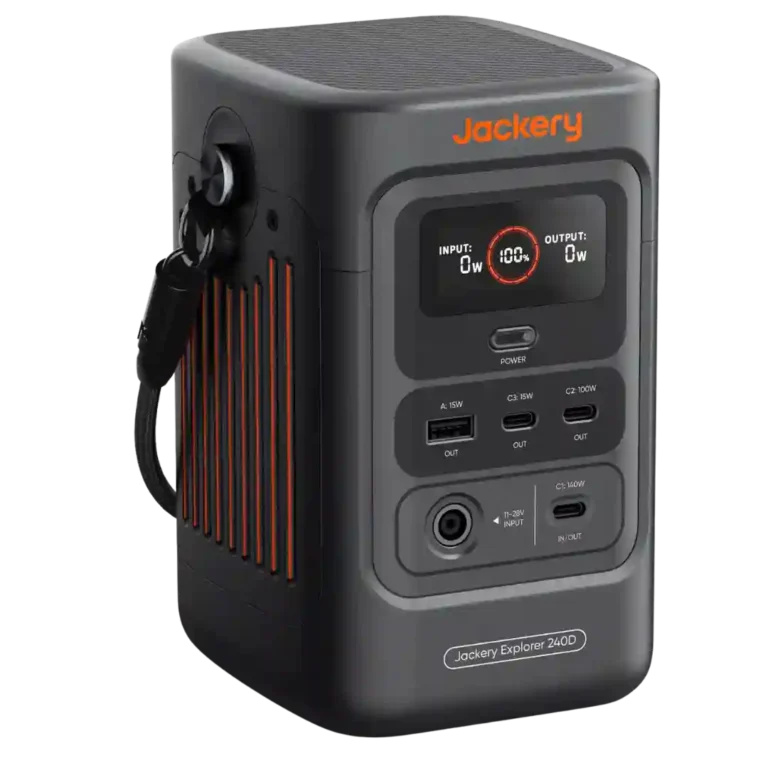
Choose the Explorer 240D for exceptionally portable, fast USB-C power for laptops, phones, cameras, and short trips. Skip it if you need an AC outlet, overnight appliance runtime, airline carry-on compatibility, or a complete charger bundle.
Best for photographers, campers, digital nomads, road-trippers, gamers, and emergency-kit users whose devices charge by USB-C or USB-A. It is especially compelling when pack weight and fast laptop charging matter more than appliance support.
Not for anyone needing wall-plug appliances, overnight CPAP or cooler runtime, whole-home backup, airline carry-on use, or built-in smart monitoring. Buyers without a high-wattage USB-C charger should also budget for accessories.
The Explorer 240D is best understood as an oversized, exceptionally capable USB-C power bank rather than a traditional power station. Its 4.85-pound body, 256Wh LiFePO4 battery, 140W USB-C port, four-device support, and clever cable-handle make it unusually convenient for laptops, phones, cameras, drones, gaming handhelds, and short off-grid work. Fast dual-input and useful solar charging strengthen the package. The tradeoff is fundamental: there is no AC outlet or 12V accessory socket, so wall-plug appliances, many CPAP setups, coolers, and broader emergency loads are outside its role. Sparse included accessories and mixed reports about battery reporting, idle drain, support, and electronics reliability also temper the long-life claims. For USB-native travel and field use, however, the size-to-capacity balance is excellent.
Compared with other Generators, this product is above average in weight, cable storage, DC output, near average in value for money, solar charging speed, below average in AC outlet count, high-demand appliance support, AC charging speed.
| Attribute | This product | Category average | Difference |
|---|---|---|---|
| AC outlet count | 1.0 | 3.9 | -2.9 |
| high-demand appliance support | 1.3 | 4.1 | -2.8 |
| AC charging speed | 1.8 | 4.5 | -2.7 |
| battery chemistry | 2.0 | 4.6 | -2.6 |
| remaining runtime estimate | 1.5 | 4.0 | -2.5 |
| load handling | 2.0 | 4.5 | -2.5 |
| overload protection | 2.0 | 4.5 | -2.5 |
| battery storage performance | 1.5 | 3.9 | -2.4 |
Choose EcoFlow River 2. It scores 5.0 vs 1.8 for AC charging speed, with a 4.0 overall score.
Choose Bluetti Elite 30 V2. It scores 5.0 vs 1.5 for 12-volt outlet, with a 4.4 overall score.
Choose Jackery Explorer 1000 V2. It scores 4.8 vs 1.0 for built-in light, with a 4.4 overall score.
Choose Jackery Explorer 300. It scores 5.0 vs 1.0 for AC outlet count, with a 4.2 overall score.
Products reviewers directly compared with this model, grouped into quick takeaways.
No. It is a DC-only station with USB-C and USB-A outputs, so standard wall-plug devices cannot connect.
It supports up to four devices across three USB-C ports and one USB-A port, with 200W total output and up to 140W from one USB-C port.
With suitable high-power dual input, it can reach about 80% in one hour. Standard lower-wattage USB-C chargers take substantially longer.
Yes. The dedicated input accepts about 100W, and strong sunlight can produce a full charge in roughly three to four hours. Third-party panels may need an adapter.
Direct 240D sources cite LiFePO4 cells rated around 6,000 cycles and roughly a decade of use. Some reports caution that the BMS or other electronics may fail sooner.
Generally no. It lacks an AC outlet and its 256Wh capacity is too limited for dependable overnight appliance or medical-device use.
No. At 256Wh, it exceeds the battery capacity generally allowed for passenger carry-on use.
These are a few of the reviews included in our analysis.
Jackery Explorer 240D review: 256Wh LiFePO4 power bank, 200W pure DC output, 1-hour fast charge, 4.85 lb. Real-world tests, pros, cons, and...
This compact Jackery power station is at its lowest price we've seen, and today is your last day to take advantage of this sale.
The Jackery Explorer 240D packs an 80,000mAh LiFePO4 battery and 200W output, and it's discounted for Amazon Prime Day.
Miniature power station or super high-capacity power bank?
I tested the Jackery Explorer 240D for 3 months. 240 Wh, 300 W output, 8.6 lb. Real-world fridge runtime, CPAP hours, and solar charging speed.

Best for rapid charging, versatile ports, excellent app control, and portable backup for appliances or electronics. Skip it for unattended low-load use or sustained heavy loads unless fan behavior and...
Pros: overall product satisfaction, solar panel compatibility
Cons: long-term reliability, standby power loss

Best for fast-charging, high-output backup power that can run major appliances and roll easily between locations. Skip it if you need frequent lifting, a small footprint, or a screen that...
Pros: overall product satisfaction, recharge speed
Cons: weight, lifting ease

Best for fast charging, strong portable output, and short outage or camping duty. Skip it for quiet rooms, multi-day whole-home backup, or solar-only use with small panels.
Pros: overall product satisfaction, runtime
Cons: noise level, weight

Choose the P280 for high-output home, RV, or off-grid backup with fast charging, strong usable capacity, UPS protection, and expansion. Skip it if you need lightweight portability, polished app control,...
Pros: overall product satisfaction, battery expandability
Cons: weight, built-in light