If you want better fit
Choose Garmin Forerunner 255S. It scores 4.7 vs 2.5 for fit, with a 4.1 overall score.

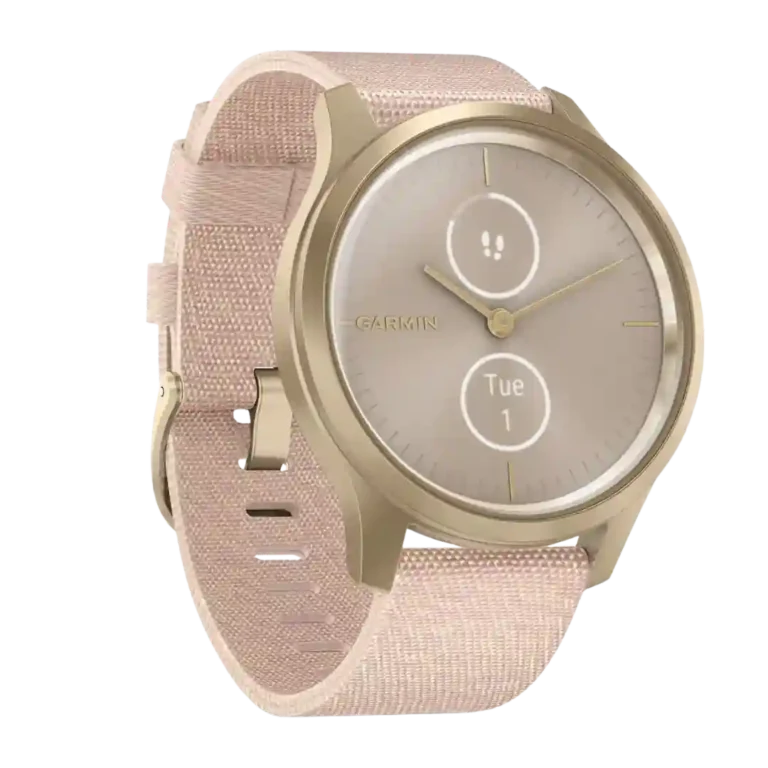
Choose the Garmin Vivomove Style for a dressy hybrid watch with strong battery life, wellness insights, and discreet notifications. Skip it if you need bright outdoor readability, polished touch controls, built-in GPS, or maximum smartwatch value.
Best for someone who wants a traditional-looking watch first, with Garmin wellness data, basic notifications, long battery life, and casual workout tracking tucked behind the analog design.
Not for users who prioritize bright outdoor screens, standalone GPS, rich smartwatch apps, polished touch input, advanced sport metrics, or the best feature-per-dollar value.
Across reviews, the Garmin Vivomove Style succeeds most as a fashion-first hybrid: reviewers repeatedly praise the analog look, hidden display, comfort, battery life, and Garmin Connect insights. That elegance comes with clear tradeoffs. The hidden AMOLED screen is discreet but often dim outdoors, and the buttonless touch interface is repeatedly described as finicky or harder to navigate than a standard smartwatch. Fitness tracking is strong enough for everyday workouts, steps, heart-rate zones, and wellness metrics, but reviewers note limits such as connected GPS, thinner sport features, and weak app support. Value depends heavily on wanting the traditional-watch design more than a fully featured smartwatch.
Compared with other Smartwatches, this product is above average in cross-platform compatibility, app ecosystem, style and design, near average in recovery insights, step counting accuracy, below average in outdoor visibility, coaching features, band quality.
| Attribute | This product | Category average | Difference |
|---|---|---|---|
| outdoor visibility | 1.7 | 4.4 | -2.7 |
| coaching features | 2.0 | 3.9 | -1.9 |
| band quality | 2.0 | 3.9 | -1.9 |
| button controls | 2.0 | 3.9 | -1.9 |
| touchscreen responsiveness | 2.2 | 4.0 | -1.8 |
| GPS accuracy | 2.3 | 4.1 | -1.8 |
| value for money | 2.3 | 3.8 | -1.6 |
| music controls | 2.0 | 3.6 | -1.6 |
Choose Garmin Forerunner 255S. It scores 4.7 vs 2.5 for fit, with a 4.1 overall score.
Choose Garmin Lily 2 Active. It scores 5.0 vs 2.0 for band quality, with a 4.3 overall score.
Choose Garmin Approach S50. It scores 4.9 vs 2.2 for touchscreen responsiveness, with a 4.0 overall score.
Choose Garmin Approach S70. It scores 5.0 vs 1.7 for outdoor visibility, with a 4.2 overall score.
Products reviewers directly compared with this model, grouped into quick takeaways.
It works well for casual workouts, steps, heart-rate zones, and everyday activity tracking. Reviewers said it is not as robust for advanced training data or detailed sport metrics.
Reviews were generally positive. Several reviewers reported around four to five days, and one long-term reviewer said it could go days without needing the charger.
No. Multiple reviewers called the display dull or hard to see in bright sunlight, making outdoor readability one of the clearest drawbacks.
No. Reviewers noted that it relies on a connected phone for GPS, which can be accurate but also more cumbersome than a watch with standalone GPS.
They are useful for quick glances and basic replies, but not universally reliable. One reviewer had app-specific notification failures, and others found message layouts or interaction limited.
Yes. Reviewers repeatedly praised Garmin Connect for readable data, charts, health metrics, and making the watch more useful.
These are a few of the reviews included in our analysis.
![Garmin VIVOMOVE STYLE: Final Review [Likes & Dislikes]](https://scorata.com/wp-content/uploads/2026/04/26768_thumb-150x150.webp)

Best for long battery life, accurate GPS and useful offline maps at a strong price. Skip it if you need payments, richer apps, a built-in LED flashlight or polished smartwatch...
Pros: mapping and navigation, value for money
Cons: smartwatch features, contactless payments

Best for accurate run tracking, deep Garmin coaching and phone-free Spotify in a light package. Skip it if you need full maps, triathlon mode, Apple Music support or the strongest...
Pros: value for money, GPS accuracy
Cons: mapping and navigation, third-party app support

Good if you want premium running features, long battery life, and maps for under $200. Skip it if you need flawless heart-rate data, multiband GPS, LTE, or richer app support.
Pros: value for money, battery life
Cons: heart rate accuracy, third-party app support

Best for accurate running metrics, excellent coaching tools, a bright AMOLED display, and dependable battery life. Skip it if you need offline maps, music storage, contactless payments, multi-band GPS, or...
Pros: battery life, value for money
Cons: mapping and navigation, smartwatch features