
Runner
Where It Has the Edge
- humor is 3.5 vs 3.0. The comedy works best when Wilson’s lighter persona bounces off Ritchson’s seriousness. Reactions range from genuinely funny to...

Scorata scores summarize analyzed review evidence on a 1–5 scale; they are not laboratory measurements or a simple average of customer star ratings. Feature scores summarize the reviews covering that feature. The overall score averages feature scores within each review, then combines review averages. When both expert and customer evidence are available, those two groups receive equal weight. Products can have different review coverage, so small score gaps do not establish a winner.
Recommendations prioritize important features for the category, with a score of at least 3.5, a gap of at least 0.25 points and at least two supporting reviews per product. Features with widely varying scores or broad connectivity contexts are excluded from recommendations. These safeguards do not establish statistical significance.
Quick verdict
The review evidence points to a tradeoff: humor versus family friendliness and age appropriateness. Choose according to which strengths matter more to you; the overall score alone does not settle that choice.
Choose Runner for humor.
Choose Hershey for family friendliness and age appropriateness.
Scores are out of 5. Missing scores mean missing review evidence, not a missing feature.
Despite the distributor’s family-friendly reputation, this is not treated as a strong kids’ pick. The violence, deaths, child peril, and language push it toward older teens and adults.
Its gentle tone, restrained language and positive moral values make it particularly appealing for families.
Scott Waugh earns strong marks for physical action staging and keeping a modest thriller lively. The main criticism is that some sequences become choppy or the broader structure loses momentum.
The direction is gentle and accessible but often lacks energy, moving through milestones without giving the drama room to breathe.
The roughly 90–98 minute runtime is usually considered efficient, brisk, and well judged. One negative take says it feels noticeably longer than its actual length.
The 110-minute running time feels overly long to viewers who find the story underwhelming.
Redemption, selflessness, courage, sacrifice, and family give the film more thematic weight than its action setup suggests. One critic finds the redemption arc too bluntly inserted.
The film celebrates generosity and perseverance, but its simple treatment rarely explores their underlying motivations or contradictions.
The ticking clock and pursuit create strong tension for some viewers, especially once the stakes are established. Others feel the stop-start structure and toothless villains drain urgency.
The familiar outcome and quickly resolved obstacles leave little dramatic tension.
The conclusion earns a strong positive note for tying Hank’s personal grief into the mission and landing an emotional payoff.
The school’s founding offers a touching emotional payoff for some, although the concluding historical montage is predictable.
Tone is one of the movie’s biggest weaknesses. The mix of brutal action, goofy comedy, melodrama, and sincerity works for some as camp, but often feels uneven or poorly blended.
The generally pleasant tone suits its intended feel-good experience.
Assessments of the language differ: one calls the film mostly free of foul language, while another warns that foul language runs throughout. Family suitability is therefore treated cautiously.
Language is notably restrained, with only a brief mild obscenity described.
CGI impressions are split. One take found no obvious cheap CGI or blue-screen work, while another singled out a car-chase moment as distractingly game-like.
The opening CGI chocolate shot is criticized for looking suspiciously artificial rather than appetizing.
The musical score draws a severe complaint for sounding generic and cheaply assembled rather than distinctive or cinematic.
The jaunty period score enchants some viewers but grates on others who find it excessively sugary.
Character work is better than the simple premise suggests in several takes, especially Hank’s grief, Ben’s growth, and the villain’s motivation. Others find key subplots thin, undercooked, or too familiar.
Milton’s family background and persistence are evident, but the film rarely explores his deeper motivations or moral complexity.
The brisk chase structure and ticking clock keep the movie moving for most viewers, and the roughly 90–100 minute length often helps. Hospital cutaways and extended chatter are the main momentum killers.
Some appreciate how efficiently the film covers decades, but many find the first half slow or important setbacks too quickly resolved.
Realism is a weak point overall. Grounded character moments and some convincing action help, but implausible collisions, geography, injuries, and plot logic repeatedly break believability.
The sanitized characters and convenient resolutions make the story feel artificial rather than authentically human.
For a straightforward action movie, the story lands more heart than many expected, especially around grief, sacrifice, and the child awaiting the organ. A few emotional beats are judged forced or unearned.
Kitty’s illness, romance and the school’s legacy provide moving moments for sympathetic viewers, though many find the emotional treatment too shallow.
The script is one of the most divisive areas: some praise smart twists, emotional depth, and surprise, while others call it thin, generic, undercooked, or poorly written.
The script covers major milestones clearly, but much of its dialogue, characterization and conflict feel formulaic or overly earnest.
Ritchson and Wilson’s odd-couple pairing is one of the most praised elements, with many finding their contrasting styles charming and fun. A few critics see only serviceable chemistry or no spark at all.
The leads' chemistry divides opinion: some find the marriage genuine and warm, while others feel little romantic spark.
Themes of kindness, sacrifice, redemption, family, and doing the right thing are usually seen as sincere without becoming overly preachy. One take finds some hospital material sanctimonious.
The emphasis on kindness, perseverance and sharing success resonates strongly with favorable viewers. Critics find the moral message overly simplistic or ineffective.
The plot is widely considered formulaic, predictable, and built from familiar buddy-action tropes. Better notices still credit a few twists and surprising character choices with keeping it from feeling completely stale.
The familiar biopic formula and reluctance to take creative risks limit originality, despite a few inventive visual touches.
Dialogue is a recurring weak spot. It is variously called merely fine, exposition-heavy, not great, or cringey, with banter sometimes becoming too chatty.
Some lines sound forced and overly earnest, although the restraint of the dialogue and use of visual storytelling also earn praise.
The dramatic material divides sharply. Some find genuine sadness and emotional weight, while others see the hospital drama as manufactured and unbelievable.
Its charitable themes and romance can be touching, but conveniently resolved setbacks make the drama feel lightweight.
The comedy works best when Wilson’s lighter persona bounces off Ritchson’s seriousness. Reactions range from genuinely funny to forced or underpowered, so the laughs are not equally reliable throughout.
There are a handful of laughs, although some come from the film’s unintentionally absurd earnestness.
The simple organ-delivery premise works as a clear action engine, but opinions split on how well the story supports it. Stronger takes enjoy the heart and twists; weaker ones see thin logic and generic construction.
An uplifting rise from hardship to generosity appeals to some viewers, while others find the story too sanitized, predictable and thin.
The action photography can be immersive and stylish, especially when wide lenses and mobile cameras keep viewers close to the stunts. Shaky camera work also draws complaints when it obscures the choreography.
The photography ranges from beautiful period scenery and appealing candy close-ups to gray or overly bright imagery.
Editing quality is uneven. Precise, readable action earns praise in some places, but choppy cutting and shaky presentation are recurring complaints elsewhere.
The opening transitions show some creativity, but the film misses opportunities to sustain that inventiveness.
This skews older than a typical family action movie. Violence, deaths, child peril, and some language led family-focused assessments to steer younger kids away.
Its non-graphic content is broadly accessible, although illness, grief and complicated business history are better suited to older children.
Music choices are more often criticized than praised. Covers, soundalikes, out-of-place needle drops, and a Christian-rock closing song all attract complaints of varying severity.
The charming soundtrack complements the period setting and sentimental story.
The cast is usually a strength, with the leads often praised for carrying familiar material through charisma, physicality, and comic timing. Even some negative takes credit the performers more than the script.
The leads often bring warmth and charm, particularly to the marriage, but stiff staging and thin writing limit their range.
The supporting players generally help the movie, with Leila George and Owen Wilson receiving particular praise in different takes. A few critics argue Wilson is underused despite his charm.
The supporting ensemble is frequently praised for its warmth and period character, although some performances feel stiff or merely adequate.
Alan Ritchson is widely seen as the movie’s anchor, bringing physical credibility, likability, and dry humor to a familiar action-hero role. Even several mixed reviews say he carries weak material.
Finn Wittrock’s optimism and Alexandra Daddario’s warmth help enliven the story, even when the script gives them little dramatic depth.
Australia’s sunny coastal locations and action environments are often attractive, with some praise for how the camera uses them. One critic feels the locations could have been showcased far more effectively.
The period imagery has a nostalgic warmth for some viewers; others find the chocolate-brown palette drab or the lighting artificial.
Most reactions find it fun, watchable, or easy to enjoy despite obvious flaws. The harshest takes call it generic, mildly entertaining, or simply a miss.
The film can be pleasant, comforting entertainment, but many find its low-conflict storytelling bland and unengaging.
The fights, chases, crashes, and stunt-heavy mayhem are the movie’s clearest strength for most critics. A minority dislike the shaky presentation or feel the PG-13 staging pulls its punches.
Historical photographs in the closing credits create a meaningful connection between the dramatization and the real couple.
The film covers a broad span of Hershey’s life, from childhood to philanthropy. Compressing so many milestones leaves some important experiences underdeveloped.
The broad life story provides useful introductory facts but often glosses over hardship, motivation and historical complications.
The portrait of Hershey is sympathetic to a fault, with critics objecting to the omission of uncomfortable historical details and moral complexity.
Alcohol appears briefly without excessive drinking, fitting the otherwise restrained family-oriented approach.
The post-film Pay It Forward ticket appeal is criticized as intrusive and annoying.
The real-life photographs and images of children helped by the couple’s work give the final credits emotional meaning.
The couple’s celebratory reaction to avoiding the Titanic strikes several reviewers as insensitive given the tragedy.
The strained relationship between Milton and his father receives little meaningful exploration, with much of the estrangement occurring offscreen.
As a throwback buddy-action thriller, it generally delivers the chases, fights, banter, and pace fans expect. Its formulaic writing and uneven presentation keep it from winning over everyone.
The grief following Kitty’s death is compressed into a few brief moments rather than fully explored.
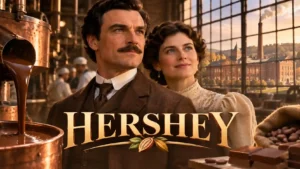
The lead’s period-appropriate moustache is an effective historical detail.
The origins of Hershey’s caramel and chocolate businesses offer interesting history, but the film leaves significant social and labor issues unexplored.
The opening chocolate close-up is praised for its attractive lighting.
The historical sets and locations give the period setting a convincing sense of place.
The inconsistent aging treatment is distracting: Milton visibly ages while Kitty appears largely unchanged.
Despite the agreeable tone, the conventional storytelling leaves little lasting impression for some viewers.
Financial setbacks recur in a repetitive pattern of money shortages followed by easy solutions.
Financial setbacks and personal hardships seldom create sustained uncertainty because solutions arrive so readily.
The linear chronology is easy to follow but often feels like a checklist rather than a cohesive emotional journey.
The opening match cut and creative transitions are appealing, but comparable visual invention is scarce afterward.
The couple’s generosity and school provide a moving centerpiece for many viewers. Critics argue that the charitable legacy is presented too reverentially and omits uncomfortable history.
The central mission is simple and easy to follow, which several critics see as a strength. It gives the action a clear engine without requiring a complicated setup.
The narrative follows familiar milestones and resolves difficulties so readily that the story rarely surprises or challenges viewers.
Unexpected details about the candy-making business and the couple’s life give the familiar biography some welcome surprises.
Kitty is seen by some as an inspiring, active partner and by others as a character too narrowly defined by her husband’s goals.
The physical stunt work stands out as a major production strength, with one assessment calling it a cut above.
The chocolate company's involvement is conspicuous, and many find the film more like corporate promotion than an independent biography.
The business plot includes loans, orders and product development but gives too little attention to how Hershey innovated.
The film emphasizes Christian values with little overt religious dialogue; favorable viewers appreciate this restraint, while some critics find its moral framing reductive.
Milton and Kitty’s partnership provides welcome warmth, but the romance is sometimes cheesy, unconvincing or pushed aside by the business plot.
Its unabashed sweetness is comforting for some and cloying for others, especially when tragedy or conflict is softened.
The marital flirtation is relatively tame, though it includes mildly suggestive moments.
Visual-effects quality is mixed. Some effects are considered good overall, but moving vehicle backgrounds are singled out as needing another pass.
Business rivals rarely pose a convincing threat, and the principal competitor is too absent to create sustained conflict.
The brutality is highly divisive. Some action fans enjoy the crunchy, surprisingly hard PG-13 mayhem, while others find it excessive, off-putting, or too intense for younger viewers.
The film is framed as a crowd-pleasing action vehicle, with its brisk runtime, familiar star personas, and absurd mayhem seen as accessible strengths.
Kitty’s independent spirit and warmth make her especially appealing, while Milton’s likability sometimes comes at the cost of complexity.
Critical reception lands on the positive side overall, with reported Rotten Tomatoes scores in the upper-60s to 70% range. The enthusiasm is real but not unanimous.
The candy imagery often makes viewers crave chocolate, even when they are less enthusiastic about the film itself.
The costumes recreate the changing historical eras attractively and help establish the nostalgic atmosphere.
The period sets and locations help bring nineteenth- and early twentieth-century Pennsylvania to life.
Critics object to the omission of the school’s early racial restrictions and later labor disputes, which limits the historical portrait.
The sets and locations earn praise for their immersive quality, but one reviewer finds the overall filmmaking cheap-looking.
Rewatch interest is limited. Several takes describe it as forgettable, a one-time watch, or something worth revisiting only casually with someone who has not seen it.
Several critics say the movie is more comfortable as a home or streaming watch than a must-see theatrical event. Its entertainment is solid, but the premium big-screen value is questioned.

A deeply human coming-of-age drama carried by remarkable performances and an honest portrayal of grief. Its gentle optimism moves most viewers, though some find the final stretch hurried or overly...
Pros: Grief portrayal, acting performance
Cons: pacing

Billie Jean King’s magnetic first-person storytelling makes this an exhilarating portrait of athletic courage and social change. The filmmaking follows a familiar documentary structure, and her full tennis résumé gets...
Pros: entertainment value, Biographical coverage
Cons: Narrative structure

Choose this inventive, unsettling documentary for fearless questioning, dark humor, and unpredictable storytelling. Skip it if you want a short, straightforward exposé with definitive answers.
Pros: originality, humor

A singular voice, powerful piano playing and intimate film photography make this concert absorbing for receptive listeners. Its uninterrupted, often similar-sounding songs and lack of background context are an acquired...
Pros: directing quality, cinematography
Cons: pacing, Song variety