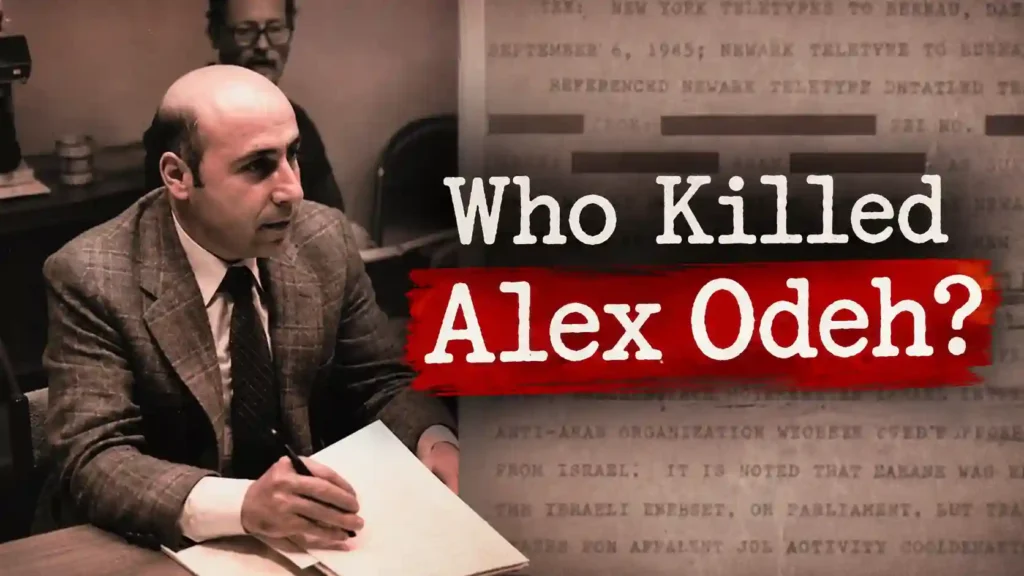
Who Killed Alex Odeh?

Who Killed Alex Odeh? Movie Review

Released: October 30, 2026
Updated: 2 days ago
3.6
Overall review score
192
Review insights
36
Scored features
20
Expert reviews
Content guidance
Scorata recommended age 15+

Real-world assassination, racist threats, extremist rhetoric, and armed training footage create disturbing material. A grieving family describes lasting fear of further bomb attacks.

Bottom Line

Revealing archives and disturbing political connections make this an urgent account of a long-denied injustice. Scattered storytelling and limited attention to Odeh’s life keep it from being equally satisfying as a personal portrait or conventional mystery.

Viewers seeking an investigative documentary or political context around an overlooked historical injustice. The archival material and reporting provide the strongest reasons to watch.

Viewers seeking a resolved true-crime case or a comprehensive biography. The inquiry offers little closure and often lets Odeh’s personal story recede.

Verdict

Who Killed Alex Odeh? is most rewarding as a historical and political investigation into why a decades-old killing has remained beyond accountability. Archival news coverage, family testimony, and David Sheen’s reporting expose troubling connections between prejudice, extremist violence, and institutional inaction. Undercover encounters can be gripping, and the family’s continuing grief gives the case its human stakes. The craft is more divisive: admirers find a measured, sensitive inquiry, while detractors criticize dense exposition, emphatic music, and a scattered true-crime structure. A recurring concern is that Odeh’s life becomes secondary to his death and its wider implications. Watch for the historical context and investigative process; expect a frustrating absence of closure rather than a neatly solved mystery.

Feature Scorecards

Summary

36 reviewed features
  • Very positive 4.5-5.0
    7 (19%)
  • Positive 3.5-4.4
    10 (28%)
  • Neutral 2.5-3.4
    11 (31%)
  • Negative 1.5-2.4
    8 (22%)

Pros highlights

  • 3.9
    16 reviews moderate consensus
    Investigative procedure: 3.9, 16 reviews, moderate consensus
    The reporting can be gripping, especially during undercover encounters and revealing calls. Critics disagree about its novelty and strength of proof, with some finding the investigative framing more distracting than illuminating.
  • 4.2
    14 reviews moderate consensus
    Political context depth: 4.2, 14 reviews, moderate consensus
    The links among extremism, media narratives, and American–Israeli politics are often the film’s most illuminating material. Some find the broader argument incomplete or stretched beyond the available proof.
  • 4.6
    12 reviews strong consensus
    Topical relevance: 4.6, 12 reviews, strong consensus
    Connections between the decades-old killing and present-day discrimination give the documentary urgency. Even several critics of its craft consider the subject important and timely.
  • 4.4
    9 reviews strong consensus
    Justice and accountability: 4.4, 9 reviews, strong consensus
    The documentary’s most persistent question is why identified suspects have escaped accountability. Its strongest passages turn a stalled case into a forceful examination of institutional indifference and impunity.
  • 4.4
    8 reviews strong consensus
    emotional impact: 4.4, 8 reviews, strong consensus
    The family’s enduring loss supplies the most affecting moments, and the wider implications can be chilling. Some find the emotional force weakened by overstatement or the family’s long absences.
  • 4.3
    8 reviews strong consensus
    suspense: 4.3, 8 reviews, strong consensus
    Undercover meetings and unexpected disclosures create the strongest suspense. The tense reporting can remain riveting even though it cannot promise a breakthrough.

Cons highlights

  • 2.6
    9 reviews low consensus
    Narrative structure: 2.6, 9 reviews, low consensus
    The construction divides opinion sharply: some find a seamless weave of investigation and history, while many describe scattered ideas, abrupt perspective shifts, or a familiar true-crime template.
  • 3.4
    9 reviews low consensus
    Grief portrayal: 3.4, 9 reviews, low consensus
    Norma and Helena give the loss a moving human scale, particularly through memories of continuing fear. Opinion splits on whether their grief remains central or gets sidelined by the investigation.
  • 1.9
    8 reviews strong consensus
    Biographical coverage: 1.9, 8 reviews, strong consensus
    The balance favors the murder and its political context over a rounded account of Odeh’s life. Repeated complaints ask for more personal history and a clearer sense of the man who was lost.
  • 1.9
    8 reviews strong consensus
    biographical depth: 1.9, 8 reviews, strong consensus
    Odeh’s life often receives less attention than the circumstances of his death. Several accounts find him closer to a symbol than a fully realized person.
  • 3.1
    8 reviews low consensus
    directing quality: 3.1, 8 reviews, low consensus
    The direction ranges from sensitive and inventive to workmanlike or heavy-handed, depending on the account. The political material often earns more admiration than the formal execution.
  • 2.3
    6 reviews strong consensus
    Documentary scope: 2.3, 6 reviews, strong consensus
    The film reaches beyond a single murder into extremism, media bias, and institutional protection. That breadth often squeezes out personal reflection and leaves important threads underdeveloped.

Use Cases

Best for

  • 4.4
    5 reviews strong consensus
    Investigative-documentary viewing: 4.4, 5 reviews, strong consensus
    Investigative-documentary viewers will find engaging undercover work, archival research, and firsthand testimony. The strongest endorsements favor its reporting process and political implications over expectations of a solved crime.
  • 4.5
    3 reviews strong consensus
    Political-context viewing: 4.5, 3 reviews, strong consensus
    This is a strong fit for viewers seeking political context around a long-unsolved crime. Its connections between historical extremism, present power, and barriers to prosecution provide the main payoff.
  • 4.8
    2 reviews limited evidence
    Newcomer viewing: 4.8, 2 reviews, limited evidence
    Uninitiated viewers can learn the case and the basic workings of the extremist movement it examines. Favorable accounts praise a detailed factual presentation that makes the unfamiliar history accessible.

Not ideal for

  • Closure-seeking viewing
    1.8
    12 reviews strong consensus
    Closure-seeking viewing: 1.8, 12 reviews, strong consensus
    Expect frustration rather than judicial closure or a definitive resolution. Even enthusiastic assessments emphasize that identifying likely suspects does not produce accountability.
  • Full-life biography viewing
    1.9
    8 reviews strong consensus
    Full-life biography viewing: 1.9, 8 reviews, strong consensus
    This is a limited choice for a complete life story. The investigation and political history repeatedly displace a fuller account of Odeh as a person.

Cast & Creators

  • Journalist
    4.3
    7 reviews strong consensus
    David Sheen: 4.3, 7 reviews, strong consensus
    Sheen’s reporting gives the documentary urgency and some of its most engaging sequences. His undercover tactics and discoveries add suspense and sharpen the inquiry into political protection.
  • Director
    3.6
    17 reviews low consensus
    Jason Osder: 3.6, 17 reviews, low consensus
    Osder’s archival handling and sensitive attention to the case earn strong praise in several accounts. Others find his shared direction formulaic, overemphatic, or insufficiently focused on Odeh’s life.
  • Director
    3.6
    16 reviews low consensus
    William Lafi Youmans: 3.6, 16 reviews, low consensus
    Youmans’ shared direction is praised for thoughtful political framing and, by supporters, inventive and sensitive storytelling. Critics find the same approach scattered or too dependent on familiar true-crime conventions.
  • Composer
    2.5
    1 review
    Dana Kaproff: 2.5, 1 review
    The score is criticized as an omnipresent emotional cue. Its insistent scare-music approach contributes to a form that can feel overly demonstrative.

Compared With Category Average

Compared with other Movies, this product is above average in Justice and accountability, Political context depth, Investigative procedure, near average in Documentary scope, archival footage quality, below average in score quality, Biographical coverage, Filming ethics.

Comparison summary

36 compared features
  • Above average 0.4+ pts higher
    12 (33%)
  • Same as average within 0.3 pts
    11 (31%)
  • Below average 0.4+ pts lower
    13 (36%)

Largest category differences

Attribute This product Category average Difference
score quality 2.1 4.1 -1.9
Biographical coverage 1.9 3.8 -1.8
Justice and accountability 4.4 2.7 +1.7
Filming ethics 2.0 3.8 -1.8
memorability 2.0 3.8 -1.8
Political context depth 4.2 2.8 +1.4
visual style 2.7 4.0 -1.3
biographical depth 1.9 3.0 -1.1

Consider This Instead

If you want better memorability

Choose Soul Patrol. It scores 5.0 vs 2.0 for memorability, with a 4.5 overall score.

Compare

If you want better directing quality

Choose Remake. It scores 4.9 vs 3.1 for directing quality, with a 4.6 overall score.

Compare

If you want better plot clarity

Choose Case 137. It scores 5.0 vs 2.9 for plot clarity, with a 4.0 overall score.

Compare

Compared in Reviews

Products reviewers directly compared with this model, grouped into quick takeaways.

Let the Fire Burn (2013)

  • Similar: archival integration The robust archive material recalls the director’s earlier film.
  • Similar: archival storytelling The confident use of historical archives recalls Osder’s earlier archival documentary.
  • Better: narrative focus The earlier documentary supplies a tighter formal focus than this film.

Making a Murderer (2015)

  • Similar: true-crime formula The film is criticized for falling back on a familiar true-crime template.

Navalny (2022)

  • Better: journalistic impact A surprising investigative call is judged less consequential than the call in Navalny.

FAQ

Does it solve the murder?

It examines identified suspects and the barriers to prosecution, but it does not deliver judicial resolution. One account regards its case as conclusive, while others question the strength or novelty of its findings.

Is it a conventional true-crime mystery?

Only partly. The likely suspects emerge early, and much of the film asks why accountability has remained blocked.

What is its biggest strength?

The archival material and connections between historical extremism, media bias, and present-day politics receive the most consistent praise.

What are the main criticisms?

Scattered structure, dense exposition, and insistent music recur as complaints. Several accounts also want a fuller portrait of Odeh’s life and family.

Is the investigation engaging?

Undercover meetings and unexpected disclosures provide tense, compelling moments. Their impact is limited by the absence of an official breakthrough.

What content should families consider?

The film covers a real bombing death, extremist hatred, racist rhetoric, armed training, and a family’s lasting fear. The material is best approached by older teens prepared for disturbing real-world subjects.

Sample Expert Reviews We Analyzed

These are a few of the reviews included in our analysis.

keeping-it-reel.com

produced by: Dawne Langford, William Lafi Youmans, Jason Osder & Daniel J. Chalfen directed by: Jason Osder and William Lafi Youmans rated...

Review score
3.3

Top Movies to Consider

#1 You Can See Everything
4.7

Choose this inventive, unsettling documentary for fearless questioning, dark humor, and unpredictable storytelling. Skip it if you want a short, straightforward exposé with definitive answers.

Pros: originality, humor

#2 Possible Love
4.7

Extraordinary performances and richly observed relationships make this a rewarding, emotionally forceful drama. Its nearly three-hour length and slow opening demand patience and undivided attention.

Pros: class commentary, character development

#3 Chronovisor
4.7

Best for a hypnotic, bookish mystery with tactile visuals and cerebral chills. Skip it if reading-heavy, attention-demanding storytelling sounds more exhausting than exciting.

Pros: Atmosphere, cinematography

Cons: audience appeal

#4 Remake
4.6

Best for an intimate, searching documentary that rewards focused attention and invites discussion. Skip it when devastating grief, addiction footage, and unresolved family tensions would be too much.

Pros: emotional impact, theme depth