If you want better instruction quality
Choose EcoFlow River 2. It scores 5.0 vs 1.8 for instruction quality, with a 4.0 overall score.

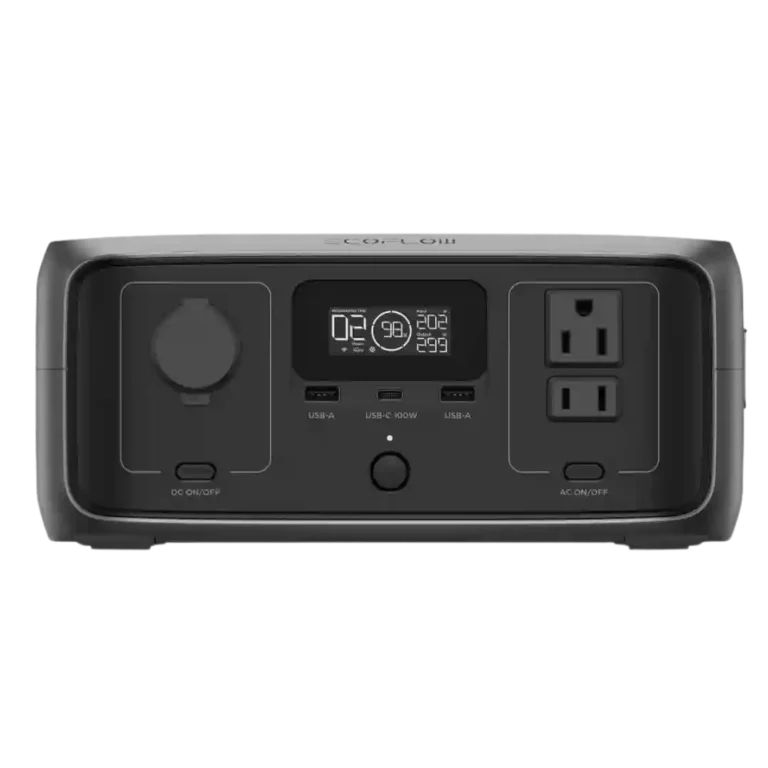
Choose it for quiet, portable backup of routers, laptops, lights, and camping gear. Skip it for high-wattage appliances, expandable capacity, or mission-critical UPS use without thorough testing.
Best for home-office users, campers, travelers, and emergency-preparedness buyers who need silent backup for routers, laptops, phones, lights, CPAP setups, and small appliances.
Not ideal for whole-home backup, heaters, large refrigerators, heavy tools, expandable systems, or anyone needing guaranteed mission-critical UPS behavior without testing the exact load.
The EcoFlow River 3 is a remarkably compact, quiet, and fast-charging power station that fits everyday backup better than its small battery suggests. Reviewers repeatedly praise its one-hour wall recharge, polished app, 100W USB-C output, light weight, and seamless UPS performance with routers, computers, and other low-draw electronics. Its 245Wh battery and 300W continuous output are the defining tradeoff: excellent for portable work, camping, communications, and short outages, but quickly overwhelmed by heaters, larger refrigerators, compressors, and surge-heavy TVs. Most owners report strong build quality and reliability, yet repeated display failures, inconsistent 12V behavior, and a smaller cluster of random UPS shutdowns mean critical setups should be load-tested before relying on it.
Compared with other Generators, this product is above average in weight, water resistance, weather resistance, near average in overall product satisfaction, value for money, below average in self-discharge rate, dual-input charging, high-demand appliance support.
| Attribute | This product | Category average | Difference |
|---|---|---|---|
| self-discharge rate | 1.0 | 3.9 | -2.9 |
| dual-input charging | 2.0 | 4.6 | -2.6 |
| high-demand appliance support | 1.8 | 4.0 | -2.2 |
| voltage regulation | 2.1 | 4.1 | -2.0 |
| charging input compatibility | 1.9 | 3.7 | -1.8 |
| weight | 4.7 | 3.2 | +1.5 |
| output stability | 2.8 | 4.6 | -1.8 |
| display quality | 2.7 | 4.4 | -1.7 |
Choose EcoFlow River 2. It scores 5.0 vs 1.8 for instruction quality, with a 4.0 overall score.
Choose Bluetti Elite 30 V2. It scores 4.8 vs 2.7 for display quality, with a 4.4 overall score.
Choose Anker Solix C1000. It scores 5.0 vs 1.0 for self-discharge rate, with a 4.5 overall score.
Choose Bluetti Elite 200 V2. It scores 5.0 vs 1.8 for high-demand appliance support, with a 4.4 overall score.
Products reviewers directly compared with this model, grouped into quick takeaways.
Most tests and owner reports put a full AC recharge at about one hour, with colder conditions sometimes extending it.
It can run some small, efficient appliances, but the 300W continuous limit and modest battery make full-size refrigerators, heaters, hair dryers, and other high-draw loads poor fits.
Usually yes; many reviewers report seamless transfers for routers, modems, servers, and PCs. A smaller group experienced failed transfers or random AC shutdowns, so test the exact setup before depending on it.
Yes. Near-silent operation is one of the strongest points, and many users could not hear it even while charging or running light loads.
A suitable panel can refill it in roughly three hours under strong sun, but the 110W ceiling, adapter requirements, and isolated solar-fault reports limit flexibility.
It has only one USB-C port, no USB-C input, no wireless charging, and closely spaced AC outlets. Some owners also report unreliable 12V or USB-C ports.
No. The base River 3 is fixed at 245Wh; buyers who need more capacity or higher output should look at a larger River 3 model.
These are a few of the reviews included in our analysis.


We tested the EcoFlow RIVER 3, a lightweight 7.4 lb power station often under $200. See our review, performance results, and exclusive deals.
Released several months ago, the EcoFlow River 3 aims to be an ideal backup home power companion for users who don't need much. While quite...
EcoFlow River 3 reviewed — real tested capacity, honest runtime numbers, and the River 3 vs River 3 Plus confusion cleared up.
We tested an EcoFlow RIVER 3 with 100W USB-C loads, a 270W AC appliance, fast charging, heat, noise, low-power runtime, USB-A, and three UPS...
Looking for info about: ? Read our blog post: EF ECOFLOW Portable Power Station RIVER 3 Review: Is It Right for You? to find out more.

Best for rapid charging, versatile ports, excellent app control, and portable backup for appliances or electronics. Skip it for unattended low-load use or sustained heavy loads unless fan behavior and...
Pros: overall product satisfaction, solar panel compatibility
Cons: long-term reliability, standby power loss

Best for fast-charging, high-output backup power that can run major appliances and roll easily between locations. Skip it if you need frequent lifting, a small footprint, or a screen that...
Pros: overall product satisfaction, recharge speed
Cons: weight, lifting ease

Best for fast charging, strong portable output, and short outage or camping duty. Skip it for quiet rooms, multi-day whole-home backup, or solar-only use with small panels.
Pros: overall product satisfaction, runtime
Cons: noise level, weight

Choose the P280 for high-output home, RV, or off-grid backup with fast charging, strong usable capacity, UPS protection, and expansion. Skip it if you need lightweight portability, polished app control,...
Pros: overall product satisfaction, battery expandability
Cons: weight, built-in light