
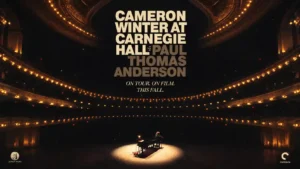
Cameron Winter at Carnegie Hall Feature Scores
Overall Scorata score: 4.7/5
Based on 22 analyzed reviews · View source samples
Explore all 28 feature scores for Cameron Winter at Carnegie Hall, organized into pros and cons.
Scores by Feature
Summary
28 reviewed features-
Very positive 4.5-5.021 (75%)
-
Positive 3.5-4.45 (18%)
-
Neutral 2.5-3.42 (7%)
Pros
Sort
-
The concert feels at once austere and warm, blending Carnegie Hall’s grandeur with near-religious quiet, loneliness and emotional intensity.
-
Warm 16mm and 35mm images, intimate close-ups, roving cameras and distant balcony shots make a lone pianist visually compelling. A few shaky or self-conscious moves prove distracting.
-
Winter’s deep, elastic baritone, falsetto and emotional phrasing are often described as mesmerizing. His eccentric vocal style may take getting used to.
-
The camera moves between extreme facial close-ups, distant balconies and backstage approaches, drawing viewers into the performance. Some roving compositions feel deliberately rough.
-
Grainy celluloid and warm, nearly candlelit colors make the recording feel intimate, timeless and handcrafted rather than glossy.
-
Close-ups and roaming viewpoints give viewers access even the concert audience lacked. The filming captures the room’s mood, although a few live moments lose some force.
-
Paul Thomas Anderson usually lets the music lead while shaping the performance with patience, movement and expressive light. The largely spontaneous shooting sometimes produces distracting rough edges.
-
The intimate views, warm venue ambience and careful preservation of the songs make the film feel like attending an unusually close, hushed live performance.
-
Vigorous, sometimes delicate piano playing gives the stripped-down songs their drama and depth. The instrument feels expressive enough to carry the set alone.
-
A still, mostly silent artist commands attention with intense vocals and piano work. The limited stage movement makes the occasional playful break especially memorable.
-
Pools of amber light, deep shadow and dramatic silhouettes give the bare stage unexpected visual richness. A few dark passages obscure Winter’s face, but the contrasts often heighten the music.
-
The music and images can evoke tears, awe and a sense of shared intimacy. What looks like a simple recital often grows remarkably affecting.
-
The filmmaking and music often seem to work in tandem: animated camera movement complements Winter’s stillness without taking over. Not every improvised choice lands.
-
Elliptical lyrics about longing, faith and mortality can be strange, funny and emotionally potent. Their meaning is often felt more than explained.
-
The piano, resonant voice and auditorium ambience come through with unusual clarity and richness, bringing the listening experience close to the room itself.
-
The concert is preserved as a distinctive artistic moment, with the venue’s character and the performer’s concentration given a lasting visual form.
-
The stripped-down piano songs and expressive vocals provide the film’s chief attraction, with a purity that favors focused listening over spectacle.
-
Long takes and restrained cutting preserve the flow of the performance. Some abrupt, shaky or exploratory edits interrupt the spell for less enthusiastic viewers.
-
For receptive viewers, the spare concert becomes mesmerizing and surprisingly exhilarating. Its eccentric music is an essential caveat.
-
Small, awkward stage-door jokes and wry lyric moments briefly lighten an otherwise solemn concert.
-
A playful title gag and an encore after the credits begin reward staying until the true end; the unusual placement makes the extra song easy to miss.
-
The roughly 72–75-minute length keeps the single-piano format concise, and its brevity helps even some less invested viewers stay with it.
-
The restrained, almost ritualistic mood suits Winter’s introspective songs, though its unrelieved solemnity can grow tiring.
-
Unconventional angles and an unvarnished approach give a familiar concert-film format new character, though the experiment can feel messy.
-
The film strongly favors admirers of Winter and fans of Anderson’s formal filmmaking, rather than viewers expecting a traditional artist documentary.
-
Brief arrivals, ticket scans and room sounds ease the viewer into Carnegie Hall without delaying the performance.
Cons
-
The long, slow, similarly arranged songs often run together; some find this trance-like, while others hear monotony and a lack of contrast.
-
The patient flow encourages deep listening but sometimes makes the similar-sounding songs feel longer or harder to distinguish.
Use Cases
Best for
Sort
-
Nearly the entire runtime belongs to the concert, with little talk or documentary detour. That direct approach is a strength for viewers who want the complete musical experience.
-
Existing admirers get a vivid, carefully recorded version of the intimate solo performance, including close-up details they could not see from the seats.
-
The mix of film stocks, patient takes, close-ups and bold camera placements offers plenty to savor as filmmaking, even with a few rough edges.
-
It offers the immediacy and cinematic invention prized in great performance films, but favors a solitary piano recital over big-stage excitement.
-
Long passages of near-silent audience attention and uninterrupted music are well suited to viewers happy to surrender to a concentrated listening experience.
-
The film is rewarding for listeners open to unconventional, introspective songwriting and a voice-and-piano arrangement. Its slow, spare sound is not universally accessible.
-
The warm filmed images, shared audience response and especially the sound give this modest stage show extra presence on a cinema screen.
-
His camera inventiveness is a draw, but viewers expecting a conventional narrative feature or flawless visual polish may find this smaller experiment less satisfying.
-
Its quiet, unconventional structure and painterly images should appeal to viewers comfortable with a meditative, less accessible cinematic experience.
Conditional or not ideal for
-
Newcomer viewingSome skeptics become converts after seeing the expressive performance, while others may be left outside by the unusual voice, repetitive arrangements and absence of explanation.
-
Biographical insight viewingThe film reveals Winter through his performance rather than interviews or backstory, leaving viewers seeking a fuller personal introduction with little context.
Cast & Creators
-
PerformerWinter commands the recital with a startling voice, expressive piano playing and vulnerability. His subdued presence and unusual songwriting remain an acquired taste.
-
DirectorAnderson transforms a stationary concert into an expressive, immersive film without overshadowing the musician. A few handmade camera and editing choices feel uneven.
-
Camera operator and co-producerHis camera and production involvement contributes to the film’s loose, intimate visual energy, with some particularly adventurous shots.
-
EditorJudicious, restrained cutting keeps attention on Winter and lets the songs unfold without forced visual excitement.
-
Music producerThe concert’s music production is admired for its clear, rich capture of Winter’s voice and piano.