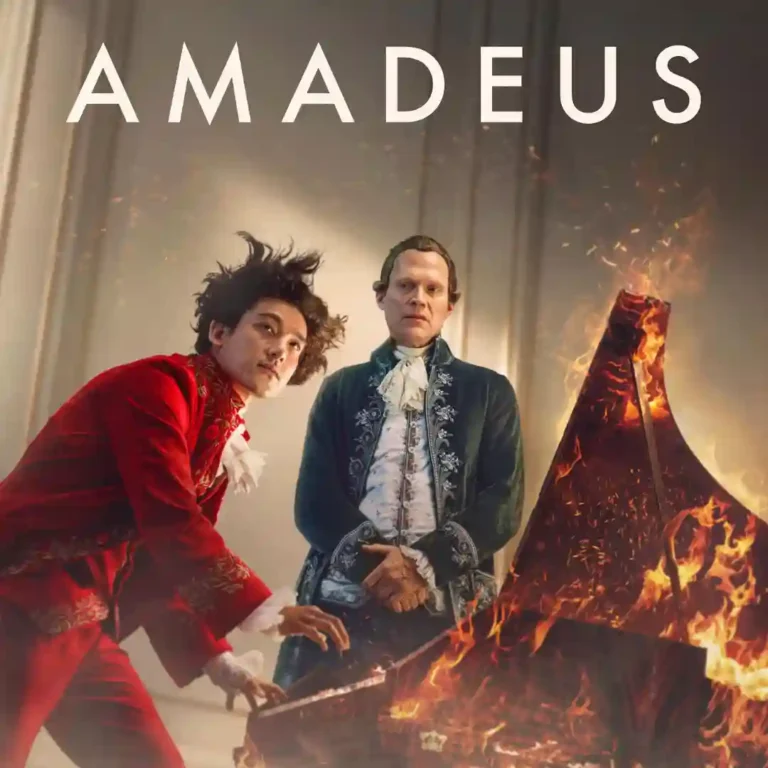
Choose it for commanding performances, lavish design and a bold, provocative rethink of Mozart and Salieri. Skip it if you want tight pacing, restrained adult content, strict history, or Mozart’s music kept firmly at center stage.
Best for
Viewers who enjoy performance-driven historical fiction, bold reinterpretations, opulent period design, sharp rivalry drama and deliberately modern, bawdy energy.
Not for
Viewers seeking a family-friendly Mozart introduction, strict historical fidelity, a tightly compressed narrative, restrained sexuality or a version where the classical music dominates every dramatic choice.
Verdict
Amadeus succeeds most decisively as an acting showcase and visual spectacle. Paul Bettany’s Salieri draws the strongest consensus, while Will Sharpe and Gabrielle Creevy give the rivalry and marriage more psychological texture than some earlier versions allowed. Lavish costumes, production design and sharp dialogue also earn repeated praise. The tradeoff is the five-hour expansion: several critics find the middle stretched, repetitive or tonally uneven, and a recurring complaint is that Mozart’s music can feel secondary to sex, ego and court intrigue. Historical liberties and conspicuously modern choices further divide viewers. For audiences open to a bawdy, stylized reinterpretation, the ambition is often exhilarating; purists may find the same choices distracting or shallow.
entertainment value: 4.0, 10 reviews, low consensus
Overall entertainment value ranges from enthusiastic praise to outright rejection. Several critics find the series lively and compelling, while the harshest detractors say they actively despise the remake.
The music divides critics more than expected. Some say it comes alive thrillingly, while others argue Mozart’s work is pushed into the background when it should dominate the series.
character development: 3.9, 9 reviews, low consensus
The expanded format gives Mozart, Constanze, and Salieri more psychological space, but critics disagree on whether the supporting characters receive enough depth.
Visual presentation is a major strength across many reviews, with lavish frames, colorful period atmosphere, and sumptuous styling; a few critics object to washed-out grading or trailer lighting.
The series wrestles with genius, envy, faith, creative insecurity, and power. Admirers find those ideas timeless; detractors think spectacle sometimes replaces genuine depth.
Opinions split sharply on the need for another Amadeus: some praise the fresh perspective and bold adaptation choices, while others see an unnecessary or infuriating reworking of already-mastered material.
The five-hour expansion is a major tradeoff. Some appreciate the added room for character, while several critics find the story padded, repetitive, or exhausting.
Historical realism is one of the weakest areas for accuracy-minded viewers. Several sources flag major inventions and liberties even when they accept them as deliberate historical fiction.
sexual content level: 2.8, 6 reviews, moderate consensus
The sexual content is deliberately provocative and often very explicit. Some reviewers think it meaningfully exposes character flaws, while others call it gratuitous and limiting for family viewing.
Pacing is one of the most recurring concerns: several critics point to lag or rushed beats in the middle episodes, although others find the series fast and bingeable.
Bettany is the clearest performance consensus: critics repeatedly call his Salieri outstanding, magnetic, controlled, career-best, or the main reason to watch even when they dislike the series.
Creevy’s expanded Constanze earns substantial praise for force, emotional range, and presence, though a minority of critics find the character underwritten or one-note.
Barton’s adaptation is praised for sharp dialogue, bold structural changes, and expanded character material, though some critics question the overall necessity or consistency of the reworking.
Sharpe’s Mozart is widely praised as magnetic, charismatic, wounded, and distinctly his own, though a few critics find him too restrained, too old for the role, or thinly served by the script.
Compared with other TV Shows, this product is above average in dialogue quality, ending satisfaction, fourth-wall narration, near average in visual style, episode pacing, below average in renewal interest, makeup quality, cultural representation.
Comparison summary
39 compared features
Above average0.4+ pts higher
10(26%)
Same as averagewithin 0.3 pts
11(28%)
Below average0.4+ pts lower
18(46%)
Largest category differences
Attribute
This product
Category average
Difference
renewal interest
1.0
4.3
-3.3
makeup quality
1.6
3.8
-2.2
cultural representation
1.7
3.6
-1.9
character appeal
2.0
3.7
-1.7
dialogue quality
5.0
3.3
+1.7
period authenticity
2.3
3.7
-1.5
ending satisfaction
5.0
3.5
+1.5
fourth-wall narration
5.0
3.5
+1.5
Consider This Instead
If you want better cultural representation
Choose Vladimir, Season 1. It scores 5.0 vs 1.7 for cultural representation, with a 3.5 overall score.
Yes. Acting is the clearest strength in the source set, with Paul Bettany repeatedly singled out and Will Sharpe and Gabrielle Creevy also receiving substantial praise.
Is it historically accurate?
Not strictly. Several reviews flag major liberties in the Mozart–Salieri rivalry and other events, while supporters treat the series as intentionally stylized historical fiction.
Does the five-episode format help?
Sometimes. It gives the characters more room, but pacing is one of the most common criticisms, especially through the middle.
Is Mozart’s music a major focus?
The reactions are split. Some reviewers say the music comes alive, while others argue it is surprisingly underused or pushed into the background.
Is it family-friendly?
No. The source reviews repeatedly describe strong profanity, explicit sexual material and adult behavior.
How does it compare with earlier Amadeus versions?
Many critics inevitably compare it with the 1984 film. Some see this series as a worthwhile companion piece with fresh ideas; others find it less focused, less moving and less musically powerful.
Sample Expert Reviews We Analyzed
These are a few of the reviews included in our analysis.
Best for sharp adult humor, magnetic chemistry and a deeply satisfying farewell. Skip it if familiar will-they-won’t-they plotting or deliberately messy leads are dealbreakers.
Choose Widow’s Bay for its dark laughs, richly haunted island and memorable ensemble. Skip it if you need straightforward scares, rapid answers to every mystery or a completely resolved finale.
Choose Season 15 for warm, character-driven comedy, meaningful growth, and a finale that rewards longtime fans. Skip it if the short binge format, uneven replacement voices, or occasional clumsy commentary...
Best for sharply acted, compassionate, high-pressure hospital drama. Skip it if graphic procedures unsettle you or you need a neatly resolved season finale.