Scorata scores summarize analyzed review evidence on a 1–5 scale; they are not laboratory measurements or a simple average of customer star ratings. Feature scores summarize the reviews covering that feature. The overall score averages feature scores within each review, then combines review averages. When both expert and customer evidence are available, those two groups receive equal weight. Products can have different review coverage, so small score gaps do not establish a winner.
Recommendations prioritize important features for the category, with a score of at least 3.5, a gap of at least 0.25 points and at least two supporting reviews per product. Features with widely varying scores or broad connectivity contexts are excluded from recommendations. These safeguards do not establish statistical significance.
Quick verdict
What each product is best for
The review evidence points to a tradeoff: cultural representation and language level versus cinematography and soundtrack quality. Choose according to which strengths matter more to you; the overall score alone does not settle that choice.
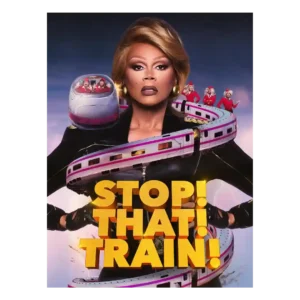
Choose Stop! That! Train! for cultural representation and language level.
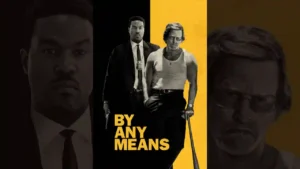
Choose By Any Means for cinematography and soundtrack quality.
Why these recommendations?
Stop! That! Train!
Where It Has the Edge
cultural representation is 4.7 vs 1.3. The movie’s proud queer perspective is a major strength, centering drag performers as heroes and celebrating queer joy...
language level is 4.3 vs 1.0. The comedy mixes bawdy dialogue with cleaner wordplay, and several critics appreciated that some of its biggest laughs...
dialogue quality is 4.8 vs 1.7. The strongest lines use queer wordplay, double meanings, and conversational rhythm rather than relying only on familiar references.
By Any Means
Where It Has the Edge
cinematography is 4.5 vs 1.8. The photography is frequently praised for moody lighting, rich color, controlled tracking shots, and striking period imagery. Even...
soundtrack quality is 5.0 vs 3.3. The soundtrack is a clear strength, blending period artists with a prominent end-credit title song. Reviewers who mention...
production design is 5.0 vs 3.4. The period setting is a standout, with convincing streets, interiors, cars, and décor making 1960s Mississippi feel tangible....
Stop! That! Train!3.5 overall score
By Any Means2.9 overall score
Compare features
Scores are out of 5. Missing scores mean missing review evidence, not a missing feature.
Scored on both products
Other features
Makeup quality
Stop! That! Train!
5.0
By Any Means
1.5
Details and evidence for makeup quality
Stop! That! Train!
The queens are presented with flattering lighting, polished hair, and spectacular makeup that gives the production a more glamorous finish.
Wahlberg’s prosthetic nose and wig are repeatedly singled out as distracting, unnecessary, or outright silly. The period transformation is one of the production’s clearest visual misfires.
The movie often loses credibility when its heroes commit conspicuous violence with few believable consequences. Critics describe several confrontations, body counts, and chase beats as Hollywood fantasy rather than plausible history.
Several critics object to the way the film filters Black civil-rights history through a fictional partnership with a white mobster. Concerns focus on lost political context, white-savior dynamics, and whose story receives the most agency.
At least one enthusiastic critic found the true-crime setup intensely gripping from start to finish, praising the film’s ability to hold the audience in a taut, confrontational mood.
The comedy mixes bawdy dialogue with cleaner wordplay, and several critics appreciated that some of its biggest laughs do not depend on explicit language.
Strong and pervasive language is a clear drawback for reviewers sensitive to profanity. Family-oriented critics specifically flag crude talk, repeated strong language, and rough speech.
The dialogue is a weak spot for several critics, who describe it as exposition-heavy, obvious, or underwritten. The banter can still generate humor, but the script rarely finds the nuance its subject invites.
A family-focused review flags bedroom sensuality and partial nudity as another reason the film is unsuitable for younger or more conservative audiences.
The bright interiors occasionally pop, but flat digital photography, washed-out lighting, and uninspired framing make the movie look less cinematic than its premise deserves.
The photography is frequently praised for moody lighting, rich color, controlled tracking shots, and striking period imagery. Even detractors often single out the camera work as more sophisticated than the script.
The finale keeps enough laughs flowing to remain enjoyable for many viewers, but several critics found the third act rote, prolonged, or unable to stick the landing.
The ending is the most consistent complaint: reviewers repeatedly call it abrupt, anticlimactic, incomplete, or dependent on text cards. Several felt the movie stops just before the payoff its own setup promises.
Despite the conspiracy, violence, and shifting loyalties, one reviewer specifically found the movie easy to follow and always clear about location and motivation.
The blend of sober civil-rights drama, dark comedy, revenge fantasy, and buddy-cop pulp is one of the film’s biggest fault lines. Some enjoy the levity and energy, while others find the modes clash badly.
One reviewer felt the film actually needed more time, particularly to clarify relationships, the investigation, and the ending. The complaint is less about excess length than insufficient development.
The film’s thesis about violence as a route to justice is deeply divisive. Supporters see righteous urgency and historical meaning; detractors view the revenge framing as morally shallow, reductive, or troubling.
The action ranges from crisp, emotionally charged shootouts and chases to sequences some found implausible or dull. Its pulpy violence works best for viewers who embrace the revenge-thriller mode.
The historical drama is considered thoughtful in intent but blunt in execution. Its serious material carries weight, though the movie often pivots toward pulp and buddy-cop mechanics.
The central true-crime premise fascinates many reviewers, but the finished story is often judged simplistic, underdeveloped, or structurally incomplete. Strong performances and visual craft keep some viewers engaged despite those narrative problems.
The screenplay has a strong premise and occasional structure, yet many critics fault shortcuts, weak connective tissue, clichés, and underdeveloped moral questions. The writing is often seen as the main thing holding the movie back.
The Strider–Scarpa pairing is widely seen as a major draw, with prickly banter and contrasting personalities giving the movie energy. A few critics, however, found their bond underdeveloped or unconvincing.
As a crime thriller and buddy-cop movie, it lands unevenly: some praise the muscular, crowd-pleasing pulp, while others see a slog that cannot reconcile action spectacle with serious historical drama.
This is emphatically not family-friendly material, with torture, bloody violence, pervasive rough language, and adult sexual content. Family-focused outlets strongly advise caution or avoidance.
The movie is widely described as familiar, derivative, or by-the-numbers despite its unusual real-world premise. Its mashup of civil-rights drama and buddy-cop revenge thriller rarely feels genuinely new.
The disaster-movie musical cues and retro callbacks help establish the spoof tone, with the Poseidon Adventure-style opening music receiving particular praise.
Terence Blanchard’s jazz-inflected score is frequently praised as tense, atmospheric, and a major mood-setter. One critic finds the emotional scoring overused, but the overall response is strongly positive.
Wayne Strider’s shift from rule-bound agent to violent avenger is the central arc, and some found it compelling and well acted. Others felt his inner life was too thin or inconsistent for the transformation to fully land.
The train setting adds a playful variation, but the story remains an openly familiar patchwork of Airplane!, disaster-movie, and Mean Girls conventions.
The plot follows a familiar buddy-cop and revenge-thriller path, with multiple reviewers saying its turns are predictable or formulaic. The real-life hook is more distinctive than the dramatic structure built around it.
The opening half usually moves at an effective joke-a-minute clip, while repeated bits, side plots, and the final stretch can make the movie feel longer than it is.
Pacing reactions vary from brisk and lively to sluggish and uneven. Several reviewers enjoy the forward momentum once the leads are working together, while others note slow stretches and a narrative that fizzles near the end.
The humor mostly comes from Scarpa’s blunt personality and the mismatched-pair banter. Several critics welcome that relief, though one moral review objects to making his amorality a source of laughs.
Adam Shankman generally keeps the sprawling cast and relentless gag flow under control, though the rushed production limits visual invention and polish.
Elegance Bratton earns strong marks for visual control, clear staging, and energetic crime-thriller craftsmanship. Some critics still feel the execution becomes blunt or paint-by-numbers when handling the larger historical and moral questions.
The film can be genuinely upsetting and powerful, especially when depicting racist terror and Strider’s fear and anger. For supportive critics, that intensity gives the movie urgency even when the storytelling is uneven.
The movie raises potent questions about racism, institutional failure, pacifism, and retaliatory violence, but many critics say it does not explore them deeply enough. A smaller group finds the moral conflict powerful and meaningful.
One critic argues that the film isolates its characters from the wider political and social life of 1966 Mississippi, making the setting feel more like a sealed dramatic vacuum than a fully lived-in community.
The period setting is a standout, with convincing streets, interiors, cars, and décor making 1960s Mississippi feel tangible. Reviewers repeatedly praise the sets and overall period detail.
The costumes, saturated interiors, and retro camp attitude are appealing, but cheap exteriors and flat photography create a visibly uneven presentation.
The movie’s richest strengths are visual: saturated color, moody lighting, period swagger, and carefully composed imagery. A few critics find parts of the look overly contrasty or generic, but the broader response is favorable.
The 1960s wardrobe is a consistent visual highlight, especially Strider’s suits and the film’s pastel period styling. Critics who discussed the clothes found them polished and convincing.
The soundtrack is a clear strength, blending period artists with a prominent end-credit title song. Reviewers who mention the music generally praise its energy, atmosphere, and emotional lift.
The supporting ensemble is generally well regarded, with Nicole Beharie, Giancarlo Esposito, LisaGay Hamilton, David Strathairn, and others adding weight to smaller roles. Some critics wish those players had more to do.
Yahya Abdul-Mateen II receives especially strong praise for grounding Wayne with restraint, intensity, and emotional depth. Mark Wahlberg is more divisive, but many still find his broad mobster performance entertaining.
The cast is one of the film’s clearest strengths, with the two leads repeatedly carrying material that some found thin or formulaic. Even mixed reviews often credit the performances with keeping the movie watchable.
A few viewers enjoyed the movie enough to consider another viewing, but others frame it as a solid one-time watch. Repeat appeal appears strongest for fans of the lead pairing and mob-thriller tone.
Entertainment value is sharply split. Some reviewers found the violent buddy-thriller energetic and satisfying, while others found it dull, simplistic, or not worth the watch.
One strongly negative critic felt the disputed, cheap-looking effects made the theatrical ticket feel insulting, while most others focused less on price.
One strongly negative reviewer explicitly advises audiences not to spend money on the film, viewing its historical and representational choices as reason enough to skip a ticket.
The graphic violence, torture, strong language, and sexual material make this a poor fit for younger viewers. Family-oriented critics strongly caution against it for children and teens.
Reaction depends heavily on tolerance for brutal revenge fare and historical liberties. Mob-film and old-school crime-thriller fans may have a good time, while viewers sensitive to the framing or factual changes may want to skip it.
The violence is exceptionally graphic, with torture, beatings, shootings, and bloody revenge throughout. Some reviewers find that intensity cathartic or narratively justified, but many call it excessive, grueling, or upsetting.
Critical response leaned positive overall, but enthusiasm varies sharply depending on tolerance for camp, Drag Race references, and rapid-fire silliness.
Reviewers broadly agree that the movie takes major liberties with its true-story label, especially through the fictional Wayne Strider and invented interactions. Some accept the dramatization, but many warn against treating it as a straight historical account.
One reviewer felt the movie delivers exactly the familiar thriller promised by its trailer, while another criticized the way its publicity foregrounded certain stars and packaged the story. The promotional framing is therefore contested.