Scorata scores summarize analyzed review evidence on a 1–5 scale; they are not laboratory measurements or a simple average of customer star ratings. Feature scores summarize the reviews covering that feature. The overall score averages feature scores within each review, then combines review averages. When both expert and customer evidence are available, those two groups receive equal weight. Products can have different review coverage, so small score gaps do not establish a winner.
Recommendations prioritize important features for the category, with a score of at least 3.5, a gap of at least 0.25 points and at least two supporting reviews per product. Features with widely varying scores or broad connectivity contexts are excluded from recommendations. These safeguards do not establish statistical significance.
Quick verdict
What each product is best for
The review evidence points to a tradeoff: rapid trigger support and analog input support versus connectivity and value for money. Choose according to which strengths matter more to you; the overall score alone does not settle that choice.
Choose Wooting 60HE+ for rapid trigger support and analog input support.
Choose Epomaker P65 for connectivity and value for money.
Why these recommendations?
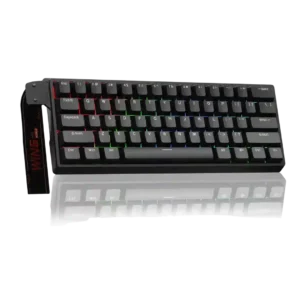
Wooting 60HE+
Where It Has the Edge
rapid trigger support is 5.0 vs 2.0. Rapid Trigger is one of the keyboard’s clearest competitive advantages, making repeated movement inputs reset faster and feel...
analog input support is 4.7 vs 2.0. Analog key travel works well for progressive throttle, braking, steering, and variable movement. It adds unusual versatility, though...
noise level is 5.0 vs 3.3. Typing volume is low for a gaming keyboard and generally office-friendly. Reviewers repeatedly describe it as discreet, quiet,...
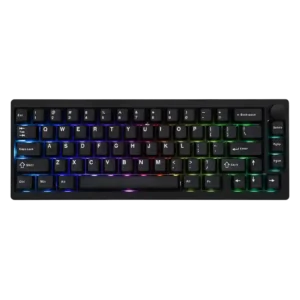
Epomaker P65
Where It Has the Edge
connectivity is 4.9 vs 2.3. Bluetooth, 2.4GHz wireless and wired USB-C provide flexible everyday use, with convenient external mode switching and dongle storage.
value for money is 4.9 vs 3.3. At roughly $120 and often less on sale, the P65 is widely considered exceptional value for a prebuilt...
materials quality is 5.0 vs 3.9. CNC aluminum, PBT caps, a polycarbonate plate and layered internal materials create a premium construction uncommon at this...
Wooting 60HE+4.4 overall score
Epomaker P654.2 overall score
Compare features
Scores are out of 5. Missing scores mean missing review evidence, not a missing feature.
Scored on both products
Comfort and build
Ergonomics
Wooting 60HE+
2.6
Epomaker P65
2.6
Details and evidence for ergonomics
Wooting 60HE+
Ergonomics are a recurring weakness because the board has a fixed incline and no included wrist rest. The stock angle works for some people, but long sessions can cause fatigue and several reviewers want height adjustment.
The fixed six-degree angle and tall front edge divide opinion. Typing can still be comfortable, but users who want adjustable feet may need a wrist rest or another board.
Materials depend heavily on configuration. Aluminum builds feel premium, while the stock ABS case is sturdy but can seem less luxurious than similarly priced competitors.
The 60% footprint is ideal for gamers who want maximum mouse room, but it can frustrate users who rely on dedicated editing, navigation, or function keys. One reviewer specifically preferred waiting for the 80% model.
Comfort varies by setup: the switches can work well for everyday typing, but the upright fixed angle may tire some users. After adaptation, at least one reviewer found the compact board very comfortable for office work.
The chassis feels durable, and the contactless Hall Effect design plus four-year warranty inspire confidence in long service life. Long-term failure data is limited, so the strongest durability claims remain prospective.
Looks are subjective: custom aluminum colorways and RGB can feel gorgeous and premium, while the stock black plastic board strikes some reviewers as generic. The detachable strap adds personality but is not universally liked.
Build quality is generally strong: the prebuilt plastic chassis feels sturdy and flex-resistant, while the aluminum custom case feels genuinely premium. A few reviewers still think plastic is underwhelming at this price.
The heavy CNC-aluminum chassis is the product’s clearest strength, repeatedly described as tank-like, premium and far more substantial than typical plastic boards.
The limited reliability feedback is positive: one reviewer reports the software behaving consistently without odd failures or startup problems. There is not enough long-term ownership data here to make a broader durability claim.
Most reviewers experienced stable operation, but isolated reports of a failed 2.4GHz dongle, scratched caps and intermittent wiring create some quality-control concern.
Rapid Trigger is one of the keyboard’s clearest competitive advantages, making repeated movement inputs reset faster and feel much snappier. Reviewers consistently found it useful in shooters and other reaction-heavy games.
Analog key travel works well for progressive throttle, braking, steering, and variable movement. It adds unusual versatility, though one reviewer notes that learning to control partial key travel takes practice.
Value depends heavily on who is buying it. Competitive gamers often say the performance, software, warranty, and customization justify the premium, while casual users and keyboard enthusiasts can find cheaper alternatives with better sound, materials, or wireless features.
Details and evidence for ease of switch replacement
Wooting 60HE+
Replacing switches is straightforward because no soldering or desoldering is required. Reviewers describe removal and replacement as quick, though compatible switch types remain limited.
The compact footprint, low weight, and carry strap make the board easy to transport, though one reviewer considers it heavy for a 60% model. Overall it is well suited to tournaments, offices, and travel.
Compatibility is strong in several areas, including major operating systems, consoles through rollover settings, and universal 60% cases. A cable-related stability caveat shows that not every accessory combination is equally flexible.
Beyond Rapid Trigger, features such as Dynamic Keystroke, Mod Tap, Toggle Key, Tachyon mode, and SOCD-style controls add substantial competitive flexibility. Reviewers see these as genuinely useful rather than mere extras.
The 60% layout removes dedicated arrows, function keys, and navigation controls, but Wootility layers and remapping can restore much of that functionality. Some users love the efficiency; others still find the adjustment annoying for productivity.
The 1000 Hz polling rate looks modest beside newer 8K boards, but reviewers say the keyboard still feels exceptionally fast. Only the most demanding competitive or rhythm-game players are likely to care about the ceiling.
Per-key RGB control is easy to access and useful for both aesthetics and function. Several reviewers use it to highlight game controls, layers, and active profiles.
The board usually sounds muted, mellow, and well damped rather than sharp or rattly. Several reviewers love the sound, but enthusiasts note that better-sounding custom keyboards exist and the stock spacebar can stand out.
Reviewers consistently praise the rich, thocky or creamy sound, with the aluminum case, gasket mount and foam producing a refined profile without metallic ping.
The included braided cable generally feels high quality, and its distinctive yellow-and-black look is easy to identify on a crowded desk. Some aftermarket cables may not preserve full performance.
Latency is a major strength, with reviewers measuring or perceiving near-instant response and class-leading performance. Tachyon mode can trim response further, while the 1000 Hz polling ceiling rarely hurts real-world play.
Overall sentiment is overwhelmingly positive, with reviewers repeatedly calling it one of the best gaming keyboards available. Most reservations concern price, wired-only operation, ergonomics, and whether the 60% layout fits the buyer’s workflow.
Most reviewers strongly recommend the P65 for its premium feel, sound and value, though a small number report setup issues, damaged parts or component failures.
Spacing is well judged for such a compact board, giving fingers enough separation without wasting space. The only caution is that highly sensitive actuation can make accidental grazes more consequential.
Profiles are easy to create, switch, download, and tailor for different games or work. Per-app settings and onboard storage make it practical to carry tuned configurations between systems.
RGB is usually bright, vibrant, evenly diffused, and attractive, especially through the PBT legends. One reviewer found the colors less crisp and another noticed a slight red tint in white, so lighting quality is not unanimously perfect.
Typing is smoother and more satisfying than many gaming keyboards, with soft bottom-out and well-lubed linear switches. Some users initially find the feel mushy or overly sensitive, but several report warming to it after an adjustment period.
Adjustable Hall Effect actuation produces highly repeatable inputs, from conflict-free multi-key presses to consistent superglides and counter-strafing. Reviewers found per-key tuning especially useful for balancing speed with accuracy.
Stabilizers are mostly well tuned and often arrive pre-lubed, with several reviewers praising controlled large-key sound. A few units show spacebar rattle or hollowness, so consistency is not perfect.
The doubleshot PBT keycaps are widely praised for their texture, thickness, grip, and durable matte finish. They feel premium enough for long gaming and typing sessions.
Thick double-shot PBT keycaps feel textured, durable and premium, although isolated units arrived scratched and one reviewer noticed inconsistent legend printing.
Lekker switches are widely praised for exceptionally smooth, light linear travel, especially in gaming. A few reviewers prefer other boards for sound or tactile feedback, but the stock feel is still rated well above mainstream gaming keyboards.
Both Zebra and Wisteria linears are smooth and responsive, with Zebra feeling lighter and Wisteria slightly heavier. Stock choice is limited to linear options.
The tiny footprint is a consistent win, freeing substantial room for large mouse movements and oversized mousepads. Competitive gamers especially appreciate how little desk space it consumes.
Inputs feel extremely immediate, with reviewers repeatedly describing movements and abilities as snappy or nearly delay-free. Very aggressive actuation settings can become too sensitive and cause accidental presses until tuned.
The magnetic-switch ecosystem is the main limitation: standard 3- or 5-pin mechanical switches are not supported, and tactile or clicky choices are scarce. Hot-swapping compatible magnetic alternatives still leaves room to tune feel and sound.
Buyers can choose Zebra or Wisteria linears, but there are no stock tactile, clicky or silent choices; hot-swap support partly offsets that limitation.
The chassis is impressively rigid, with reviewers reporting no meaningful deck flex, creaking, or structural give. The aluminum configuration is especially solid.
Stability is generally acceptable, but some Lekker switches show noticeable side-to-side wobble and one reviewer found minor movement on larger unstabilized keys. Most say it is not distracting during normal play or typing.
Onboard memory keeps profiles and settings on the keyboard itself, so configurations follow the board to another computer without background software. Reviewers see this as a major convenience.
Wootility is one of the most consistently praised parts of the product: fast, intuitive, browser-accessible, cross-platform, and largely free of bloat. Reviewers especially like how easily it exposes advanced Hall Effect controls.
VIA itself is powerful and clean, but onboarding varies sharply: some reviewers loaded the JSON file in under a minute, while others struggled with recognition and vague instructions.
Customization is a defining strength, spanning per-key actuation, remapping, profiles, RGB, cases, plates, keycaps, and compatible magnetic switches. Reviewers consistently describe the board as unusually mod-friendly for a performance gaming keyboard.
Switches can be replaced without soldering, which makes experimentation and maintenance easy. The catch is that the PCB is limited to compatible Hall Effect switches rather than the full mechanical-switch ecosystem.
Macro support is flexible through Wootomation and related software tools, letting users assign macros without dedicated macro keys. The software approach is seen as straightforward and useful for productivity.
Lighting can be changed extensively through Wootility, including presets, effects, colors, and per-key control. Most reviewers love the flexibility, although one found effect layering more limited than rival software.
There is no wireless mode, and that absence is one of the most repeated complaints. Reviewers particularly miss Bluetooth because the compact keyboard would otherwise be easy to travel with.
Typing volume is low for a gaming keyboard and generally office-friendly. Reviewers repeatedly describe it as discreet, quiet, and unlikely to bother nearby people.
The backlight is consistently described as very bright and easy to see, even in daylight or poor room lighting. Brightness is a standout part of the RGB presentation.
Lighting impressions vary: some reviewers found it bright and attractive, while others said the south-facing glow is muted behind the non-shine-through caps.
Shine-through legends remain clear from different angles and in low light, making the board easy to read during late-night use. Reviewers also expect the doubleshot legends to wear well.
Gaming performance is the dominant strength: reviewers repeatedly praise faster movement, low-latency inputs, Rapid Trigger, and per-key actuation control. The gains are most meaningful for competitive players, but reviewers also stress that the keyboard will not replace practice or skill.
Foam, silicone, and other internal dampening work well, keeping keypresses quiet and satisfying with little ping or rattle. This tuning is a major reason the board sounds better than many gaming keyboards.
Battery life ranges from several days with RGB enabled to much longer with lighting off. Most found it acceptable, though one reviewer wanted at least a full week.
Packaging and presentation are consistently praised as thoughtful and enjoyable, with personalized touches that make opening the board feel more premium than a typical gaming keyboard.
The optional Wooting rest is praised as smooth, washable, and pleasant, but the keyboard does not include one. Reviewers who type for long periods say the lack of a rest can contribute to fatigue.