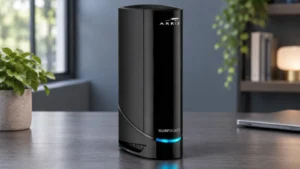
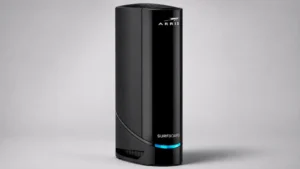
ARRIS SURFboard G18
Where It Has the Edge
No clear scored advantage over the other product.

Scorata scores summarize analyzed review evidence on a 1–5 scale; they are not laboratory measurements or a simple average of customer star ratings. Feature scores summarize the reviews covering that feature. The overall score averages feature scores within each review, then combines review averages. When both expert and customer evidence are available, those two groups receive equal weight. Products can have different review coverage, so small score gaps do not establish a winner.
Recommendations prioritize important features for the category, with a score of at least 3.5, a gap of at least 0.25 points and at least two supporting reviews per product. Features with widely varying scores or broad connectivity contexts are excluded from recommendations. These safeguards do not establish statistical significance.
Quick verdict
The available evidence supports the recommendation below, but does not establish an overall winner. Check the remaining features against your priorities.
There is not enough comparable review evidence to recommend ARRIS SURFboard G18 over the other product.
Choose ARRIS SURFboard G20 for size and footprint.
No clear scored advantage over the other product.
Scores are out of 5. Missing scores mean missing review evidence, not a missing feature.
Long-range coverage is not a standout strength, and the G34 is a more practical option for households that need stronger reach.
Long-distance wireless performance compares favorably with a more powerful gateway in expert testing.
Wireless latency is a comparative strength against the G34 and some other routers, although it is not the best in every comparison.
Wireless latency is competitive with several alternatives but not exceptional; some owners report substantial lag.
The G18 is a sensible compact gateway for basic needs, but the G34 has a modest overall advantage.
Satisfaction is sharply divided: some owners love the simple, fast gateway, while many return it after setup failures or recurring outages.
Limited built-in ports and the absence of native mesh expansion make upgrades less straightforward. A separate switch can help with wired connections.
Native mesh expansion is absent, but an owner successfully connected external extenders and wireless cameras.
The older Wi-Fi standard and limited connectivity leave less room to take advantage of newer wireless devices.
Wi-Fi 6 and DOCSIS 3.1 are useful upgrades, but lack of newer bands and the need to replace the entire combo limit future flexibility.
Major cable providers are supported subject to approval of the exact model, account and plan; confirm compatibility before purchase.
Experiences with cable providers vary considerably: successful connections and good speeds coexist with failed activations and intermittent service.
Range is decent, but the advertised 1,250-square-foot coverage is not a guarantee. Layout and construction can change the practical reach.
Coverage is impressive in some single-story homes, yet other households struggle to get a usable signal even in small areas.
The two gigabit Ethernet connections limit wired flexibility compared with gateways that offer faster or more numerous ports.
Gigabit-limited Ethernet restricts wired performance compared with faster multi-gigabit alternatives.
Two gigabit Ethernet ports are enough for a minimal wired setup but fill up quickly. More direct connections require another gateway or extra networking equipment.
Two gigabit Ethernet connections are restrictive for households needing several wired devices or faster networking.
A single gateway may cover a modest home, but larger or difficult layouts need careful planning and may benefit from a separate mesh system.
Some owners reach rooms their old gateway could not, while others still have bedrooms and bathrooms without adequate coverage.
Combining a cable modem and wireless router simplifies installation layouts and reduces equipment clutter. The convenience is most useful when the provider approves the model and the built-in ports are sufficient.
Combining the modem and router saves room and reduces cables. Some owners still need a separate router to get the functionality they want.
Wireless performance is respectable for a compact entry-level gateway, with good speed and decent reach.
Wireless performance is strong in expert comparisons, but some households encounter unusable Wi-Fi or sluggish devices even when Ethernet works.
Files can download quickly over Wi-Fi, making ordinary downloads a strength.
Download speeds can match a subscribed plan, but a problematic unit delivered only 37 Mbps on an 800 Mbps service.
Filtering covers sites, applications, keywords, port ranges and protocols. The lack of ready-made categories increases setup work.
Website blocking is useful, but the lack of preset filtering categories makes it less convenient.
Wi-Fi 6 provides useful everyday performance, though newer client devices cannot use their full wireless capabilities.
Wi-Fi 6 provides a noticeable speed improvement over older equipment in favorable conditions.
Parental controls can block a wide variety of traffic, but parents must enter restrictions manually instead of using preset categories.
Parental controls are a strong point, with schedules, website and device blocking, and simple family profiles.
Access restrictions are flexible enough to block sites, apps, keywords and network protocols.
The gateway offers useful controls for blocking websites, apps and devices.
Good peak Wi-Fi speeds support 4K streaming and quick downloads, although several alternative routers are faster.
Peak Wi-Fi speeds can be excellent, and several owners see faster connections than with older gateways. Others report slower-than-expected performance.
Combining two devices and potentially avoiding ISP rental fees makes the gateway a useful value option.
Avoiding modem rental charges can make the gateway a good investment, but buyers who experience failures feel their money was wasted.
The slim vertical enclosure is easy to tuck away and is smaller than the G34.
The small upright housing is easy to fit in tight spaces and avoids the bulk of two separate devices.
The controls can be intuitive after setup, but many buyers find installation and basic configuration frustrating.
Additional DFS channels give the router more options in crowded wireless environments.
Basic network customization is possible, but settings that will not save and limited advanced controls frustrate some owners.
DFS channels provide extra room to avoid congestion in crowded apartment complexes.
Family profiles simplify device management, although unnamed devices can be tedious to identify manually.
Time controls are appreciated, but daily usage caps are specifically reported as unavailable in expert testing.
Some rooms remain beyond reliable coverage, particularly in a larger single-level home.
Some external routers connect seamlessly, but individual computers may fail to join the network even when phones connect.
Devices often appear as unknown, forcing users to match MAC addresses manually.
The firewall blocked some websites without enough fine-tuning options to resolve the problem.
One owner experienced cycling firmware and an unusable network despite successful activation.
Missing manuals, quick-start instructions and device information make offline troubleshooting difficult.
Parents appreciate being able to turn internet access on and off when needed.
Some connections slow down unpredictably or require a reboot to recover normal speed.
Smart-home device connectivity varies: wireless cameras can work well, while Alexa may suffer from unstable signals.
Provider registration ranges from seamless to hours of unsuccessful calls; even supported providers can be difficult to activate with.
Wireless latency and jitter are typical of standalone Wi-Fi 6 routers rather than exceptional.
Recurring resets and repeated attempts to restore service make the gateway burdensome to maintain.
There is no native mesh expansion, making it unsuitable for scalable coverage across larger spaces.
Replacing a rental gateway can produce substantial monthly savings, with one buyer saving $14 a month.
The companion app makes viewing and monitoring the network convenient when it works.
Wi-Fi and Ethernet can both be dependable when the gateway is working properly.
Port forwarding failed to function properly for an owner who needed more advanced networking.
The short power adapter cable can make it difficult to position the gateway where desired.
Previously registered or used units can arrive with another owner’s settings, preventing activation or warranty registration.
Repeated manual resets and spontaneous restarts are recurring complaints; one owner only needed a reset after a provider outage.
One buyer appreciated fast delivery on a weekend.
The administration panel offers a useful selection of security controls.
A buyer disputes the advertised compatibility with Comcast, making provider confirmation important.
A normal-looking status light can be misleading when the gateway is unable to pass traffic or connect to the internet.
A perceived support paywall frustrated an owner who needed help completing setup.
There is no digital voice support for modem-based telephone service, which rules it out for cable plans that depend on that capability.
Troubleshooting can be difficult when provider activation and manufacturer support are separate, especially without a printed manual.
Defective units, missing information labels and inconsistent behavior between replacements raise quality-control concerns.
Parents can schedule internet access and manage when family devices are allowed online.
Signal strength varies widely: some homes get good reception, while others see weak bars just feet from the gateway.
One buyer experienced repeated 2.4 GHz signal drops and very slow downloads.
One problematic unit could not establish its 5 GHz network at all.
The lack of a 6 GHz band limits newer devices and leaves faster wireless options unavailable.
Some owners get their subscribed speeds exactly, while others report throughput far below the service they pay for.
The modem portion can perform well even when the app or router functions are troublesome.
Several units work well initially but develop recurring problems or fail within weeks, months or around a year.
Simultaneous 4K streams can run smoothly, although some households experience device connection failures.
Upload optimization is a strength, with one owner matching a 150 Mbps upload plan and an expert praising faster transfers.
Ethernet can be more reliable than Wi-Fi, although one unit struggled to negotiate a link and repeatedly disconnected.
Login and account-recognition failures can block setup and settings changes, sometimes requiring a full reset.
Some connections remain rock solid, but frequent disconnects, buffering and interruptions are a major source of frustration.
Helpful agents sometimes walk customers through installation for free; others encounter unhelpful advice, long calls, paywalls or unanswered requests.
DFS support is useful in busy wireless neighborhoods because it opens up additional channels.
Unexpected failures, defective units and repeated reboots undermine confidence in the hardware, despite some trouble-free ownership.
One buyer received a power cord that would not work with the device.
Installation can be quick and painless, but failed activation, app freezes and lengthy troubleshooting are common complaints.
Missing troubleshooting instructions and a lack of offline support information make installation harder than it needs to be.
Some owners see meaningful speed or coverage improvements, but others prefer their old equipment after reliability problems.
Failures near or after the warranty cutoff, validation problems and disputed warranty dates leave some owners without useful protection.
The app-guided setup is easy for some buyers, but failed Wi-Fi detection, cloud problems and account issues derail it for others.
Reliance on a smartphone app for setup frustrates owners when the app cannot connect or sign in.
Repeated freezing during setup prevented one buyer from getting online.
The app offers convenient family controls and network management, but many owners find it buggy, outdated or difficult to use.
The app’s perceived lack of updates leaves some owners unable to configure basic settings.
The web interface can expose more settings than the app, but login failures and changes that will not save limit its usefulness.
Wi-Fi calling failed for an owner who needed it because cellular reception was unavailable.
Wi-Fi 6 is adequate for everyday networking but cannot fully exploit Wi-Fi 6E or Wi-Fi 7 clients.
The housing feels sturdy and well constructed, though not as premium as higher-end gear.
The stylish tower consolidates modem and router functions without adding another box.
One unit failed to negotiate an Ethernet link automatically, even at lower speeds.

Choose the R95 for a busy home that needs fast Wi-Fi 7, strong range, multi-gig ports, and low-lag gaming. Skip it for a small, lightly connected space or if advanced...
Pros: Wi-Fi 7 support, Wi-Fi speed

Best for frequent travel, fast VPNs, dual 2.5GbE and resilient multi-WAN. Skip it if you need full 6GHz/320MHz Wi‑Fi 7, mesh, or desktop-class USB storage and long-range indoor coverage.
Pros: VPN client support, value for money
Cons: 6 GHz performance, USB storage sharing

Exceptional VPN speeds, strong Wi-Fi 6 coverage and extensive OpenWrt controls make the Flint 2 a compelling value. Its advanced setup, missing 6GHz band and firmware-specific caveats matter if you...
Pros: setup ease, configuration flexibility
Cons: Wi-Fi 7 support, USB storage sharing
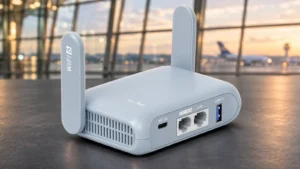
The Beryl AX packs exceptionally flexible VPN and networking tools into a pocket-sized router. It is a great travel companion, but hotel login issues, limited whole-home range and a single...
Pros: Overall satisfaction, size and footprint
Cons: Captive portal handling, Ethernet port count