
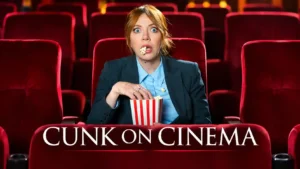
Cunk on Cinema Feature Scores
Overall Scorata score: 4.0/5
Based on 26 analyzed reviews · View source samples
Explore all 34 feature scores for Cunk on Cinema, organized into pros and cons.
Scores by Feature
Summary
34 reviewed features-
Very positive 4.5-5.015 (44%)
-
Positive 3.5-4.413 (38%)
-
Neutral 2.5-3.43 (9%)
-
Negative 1.5-2.43 (9%)
Pros
Sort
-
Diane Morgan's almost bored, utterly sincere delivery turns nonsensical comments into a distinct comic performance. Her timing remains one of the series' least disputed strengths.
-
A near-constant rush of absurd puns, mangled film names and wildly misguided questions delivers frequent laughs. A minority find the gag formula increasingly repetitive or hit-and-miss.
-
The script often hides clever observations beneath deliberately stupid wordplay, and its film references show real familiarity with the subject. Some critics think the less inspired punchlines are becoming too common.
-
The movie-business satire is often affectionate and surprisingly well informed, with particular bite when it turns to Hollywood's creative future. Not every critic thinks its broader critique is especially sharp.
-
Recreations of classic silent-film stunts, especially the falling-house gag, give the usually verbal comedy a memorable physical payoff.
-
Its steady supply of ridiculous humor makes it a cheerful, easy recommendation for most comedy fans. The strongest reservations concern freshness and how much material the short series ultimately delivers.
-
Cinema's evolution gives Philomena Cunk an unusually fertile subject for inaccurate pronouncements, with the narrower focus strengthening the historical jokes.
-
Surprisingly solid introductions to film history emerge between the intentional falsehoods. It is most successful as a light primer, not an authoritative or exhaustive film course.
-
Philomena Cunk's imperturbable ignorance remains strangely lovable and entertaining. Even some critics tiring of the jokes still enjoy spending time with her.
-
The concluding Hollywood sequence is a surprising highlight, delivering an emotional and topical finish alongside the jokes.
-
Experts and celebrities politely confronting impossible questions produce some of the sharpest exchanges. Others find these interviews less spontaneous, less probing or simply less funny than earlier outings.
-
The fake prestige-documentary presentation and real expert interviews still make an effective comedy engine. Some find that guests now recognize the character too readily, leaving the shtick more predictable.
-
Morgan's central performance is the show's reliable anchor, using a completely sincere deadpan to carry even weaker jokes.
-
The finale is praised for drawing the playful cinema history into a stronger reflection on the industry's future and human creativity.
-
Real filmmakers, critics and historians lend substance to the subject even when the host misunderstands them. Their patient attempts to explain film history are often part of the joke.
-
AI-generated nonsense becomes a running gag and, in the finale, a more serious worry about replacing artists. The emphasis is divisive: some appreciate its urgency, while others find the repetition irritating.
-
A broad sweep from silent cinema through major artistic movements to the streaming era supplies genuine background. The brevity keeps the treatment introductory rather than comprehensive.
-
More polished documentary-style production and a clever Buster Keaton recreation are noticeable improvements to the presentation.
-
Wordplay, mispronunciations and stray one-liners can be remarkably inventive. The weaker exchanges depend too heavily on familiar name mangling or jokes that never quite land.
-
Beyond the gags, the later reflection on movie-making and the people behind it brings an unexpected emotional note.
-
The host's absolute sincerity in asking patently foolish questions is essential to the appeal. She turns the conventions of earnest documentary presentation upside down.
-
Its portrait of a confidently misinformed presenter feels particularly apt amid current online misinformation and generative AI.
-
The ultra-dry vocal presentation sells the ludicrous character with remarkable confidence.
-
The voiceover combines assured documentary authority with deliberately ridiculous observations and is notably effective even where the interviews falter.
-
The scattergun pace creates a reliable flow of jokes and prevents the premise from dragging, but can end interesting conversations prematurely.
-
Morgan's regional, no-nonsense vocal style helps make the character's ludicrous pronouncements sound wonderfully matter-of-fact.
-
The shift from relentless jokes to a more heartfelt finale adds welcome dimension without entirely abandoning the established style.
-
Its compact run invites a quick binge, but the jokes can become exhausting or feel insufficiently developed when watched all at once.
Cons
Sort
-
The total runtime divides opinion: its brevity keeps the high-density jokes lively, but critics who want more film-history detail find the series far too short.
-
The intentionally ignorant interview format remains distinctive, but the passage of time has made it familiar. Several critics think the character is still funny even when the basic trick is wearing thin.
-
One of the sharper complaints is that the same gags and themes recur, reducing the surprise of later exchanges.
-
Recapping earlier installments is frustrating when episodes are already only about a quarter-hour long.
-
Short installments make the rapid-fire humor easy to take in small doses, especially on Netflix. Several critics nevertheless wish individual episodes had more space to develop their film-history ideas.
-
The setup sometimes resembles a prank interview, yet guests are usually treated generously rather than maliciously. Its playful discomfort works better than outright humiliation.
Use Cases
Best for
Sort
-
Film enthusiasts get extra pleasure from the allusions to Soviet montage, silent comedy, French New Wave and blockbuster culture. The affection for cinema is clear, though anyone hoping for sustained deep analysis may want more.
-
This is an especially good match for viewers who enjoy elaborately stupid observations delivered with total seriousness. The increasingly absurd detours are the point rather than a distraction.
-
British deadpan, absurd malapropisms and spoof-documentary mannerisms are the defining attractions. Fans of that tradition will find plenty to enjoy.
-
Comedy lovers have an exceptionally high gag rate and a memorable central character to enjoy, even if not every joke hits equally well.
-
The surprisingly accurate film-history framework makes this a fun introductory history lesson. Viewers must still distinguish the deliberate nonsense from the genuine facts.
-
Its short episodes make a weekend binge practical, but the nonstop jokes can be overwhelming when consumed in one sitting. Some find it an effortlessly enjoyable marathon, others would space it out.
-
The series provides playful commentary on Hollywood, misinformation and technological upheaval without losing its absurdist voice.
-
Some of the strongest lines reward a moment of thought before the joke clicks. Viewers who enjoy densely written, literate nonsense get more than simple one-liners.
-
Bodily-fluid gags and cheeky wordplay make it a good fit for audiences who enjoy intentionally rude, taboo-breaking comedy.
-
Roughly quarter-hour installments make it a low-commitment choice when viewers have only a brief window.
-
Close attention pays off: some of the sharpest asides are over almost as soon as they begin.
-
The premise is easy to grasp, and casual newcomers can enjoy the absurd questions without knowing earlier Cunk specials.
Conditional or not ideal for
-
Advanced filmmaking studyThis is an amusing primer rather than a deep filmmaking course. Fast transitions and broad jokes leave little room for extended technical or historical analysis.
-
Background viewingThe jokes are dense and sometimes disappear in seconds, making it easy to miss clever details while multitasking.
Cast & Creators
-
Philomena CunkMorgan's utterly sincere deadpan remains the program's strongest asset, keeping Philomena Cunk funny even when jokes are repetitive. Her concluding monologue also earns praise for moving beyond pure silliness.
-
CreatorBrooker's dense, carefully turned absurdities and film-literate wordplay draw considerable praise, though a few topical political lines feel less natural for the character.
-
ActorCumberbatch is a willing straight man for Cunk's ridiculous questions, but reactions vary: some find him ideal, while others think his perplexity feels staged.
-
DirectorBay earns credit for being a game, often bewildered guest, with his attempts to handle Cunk's questions providing entertaining moments.
-
WriterDe Souza's patient, baffled participation fits the show's comic interview style and makes his appearance an enjoyable part of the guest lineup.
-
CriticKermode's straight-faced corrections and sharply delivered response to Cunk's bogus film titles make for a notably amusing exchange.