Compare Rivage vs Faraway

Rivage

Rivage

Overall score 3.5 / 5

Based on 18 scored reviews

vs
Faraway

Faraway

Overall score 3.8 / 5

Based on 11 scored reviews

How we score

Scorata scores summarize analyzed review evidence on a 1–5 scale; they are not laboratory measurements or a simple average of customer star ratings. Feature scores summarize the reviews covering that feature. The overall score averages feature scores within each review, then combines review averages. When both expert and customer evidence are available, those two groups receive equal weight. Products can have different review coverage, so small score gaps do not establish a winner.

Recommendations prioritize important features for the category, with a score of at least 3.5, a gap of at least 0.25 points and at least two supporting reviews per product. Features with widely varying scores or broad connectivity contexts are excluded from recommendations. These safeguards do not establish statistical significance.

Quick verdict

What each product is best for

The review evidence points to a tradeoff: content variety and level design versus onboarding experience. Choose according to which strengths matter more to you; the overall score alone does not settle that choice.

Choose Rivage for content variety and level design.

Choose Faraway for onboarding experience.

Why these recommendations?

Rivage

Where It Has the Edge

  • content variety is 5.0 vs 2.5. A broad mix of logic, mechanical, auditory and environmental puzzles keeps the small station busy.
  • level design is 4.8 vs 3.5. A.R.E.S. is compact but distinctive, with rooms that reveal the people who occupied them.
  • user interface design is 4.3 vs 3.5. K9’s retained passwords, cards and screenshots are useful across loops, though console navigation and simultaneous controls can be...

Faraway

Where It Has the Edge

  • onboarding experience is 4.0 vs 1.5. The simple interface and gradual introduction can make early success welcoming. Even introductory shapes may require several attempts...
Rivage 3.5 overall score
Faraway 3.8 overall score

Compare features

Scores are out of 5. Missing scores mean missing review evidence, not a missing feature.

Scored on both products

Other features

Polish
Rivage
2.0

Critics point to uneven puzzle implementation and PS5 technical roughness around an otherwise carefully built station.

Faraway
5.0

One especially enthusiastic assessment calls the game technically perfect despite acknowledging subjective frustrations and a confusing menu.

Content variety
Rivage
5.0

A broad mix of logic, mechanical, auditory and environmental puzzles keeps the small station busy.

Faraway
2.5

Handcrafted stages and procedural runs provide some variation within a narrow design. The same central mechanic and restrained visuals can eventually feel monotonous.

Onboarding experience
Rivage
1.5

The game introduces its central loop with little explanation, leaving the first steps more confusing than they need to be.

Faraway
4.0

The simple interface and gradual introduction can make early success welcoming. Even introductory shapes may require several attempts before their execution becomes clear.

Game length
Rivage
5.0

Reported completion times vary with puzzle skill, but reviewers who discuss duration generally find it worthwhile.

Faraway
3.0

The available challenges can be seen in a couple of hours once the mechanics click. Further longevity comes from improving records rather than discovering much more content.

Exploration quality
Rivage
2.7

The station rewards inspection, though unclear objectives and power limits can turn discovery into backtracking.

Faraway
4.0

Searching the void for another group of stars adds a welcome spark of excitement under the countdown.

Writing quality
Rivage
2.7

Written logs can give the crew and their isolation texture, but other critics find the characterization and time-loop premise underdeveloped.

Faraway
4.0

Brief, funny storytelling adds character, although its playful presentation can interfere with clarity in the menu.

Core gameplay loop
Rivage
2.8

Saving knowledge between loops can make each reset purposeful, but power limits also cause repeated routes and wasted attempts.

Faraway
3.9

Linking stars, extending a run, and pursuing better scores can be exceptionally compelling. Repetition and execution frustrations prevent that appeal from landing equally well for everyone.

Graphics quality
Rivage
3.7

Many praise the station’s looks, while critics report grainy or blurry rendering that makes text difficult to read.

Faraway
4.8

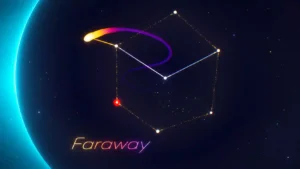
The sparse cosmic presentation is well suited to the game, with neon trails and soft particles looking particularly attractive on a large display.

HUD clarity
Rivage
3.0

Saved screenshot access helps on PC, but console overlay controls and small details can hamper clue reading.

Faraway
4.0

The star field is easy to read, and previewed orbits help identify useful release points.

Fun factor
Rivage
3.8

Players who enjoy patient deduction often find the game absorbing; repeated searches and resets frustrate others.

Faraway
3.0

Creating a successful constellation delivers clear satisfaction. Some players remain mentally engaged without finding the repeated failures or limited variety consistently enjoyable.

Immersion
Rivage
4.8

Detailed rooms, first-person inspection and the isolated soundscape draw players into the station despite interface friction.

Faraway
4.3

The combination of motion, light, and music can make the cosmos easy to sink into. That absorption is powerful for some players but fleeting for others.

Innovation
Rivage
4.5

Randomized codes resist copied solutions, while the time loop and clue tracking give the familiar station mystery its own identity.

Faraway
5.0

The expanding one-button puzzle concept feels fresh and exciting, even to a player frustrated by its steep learning demands.

Learning curve
Rivage
2.0

Prior comfort with demanding narrative puzzles helps; players who rely on clear direction may struggle.

Faraway
2.5

Simple inputs take time to become reliable technique. Guided challenges help some players find their rhythm, while others remain confused or frustrated after hours of attempts.

Pacing
Rivage
2.7

Unhurried deduction suits the setting, while extra puzzle steps and frequent resets disrupt momentum for others.

Faraway
3.0

Fast restarts encourage another attempt, and slower constellation work can create a useful pause after travel. Lengthy score calculations interrupt the flow for one account.

Narrative quality
Rivage
3.3

The missing-crew mystery draws some players onward, but pacing, character depth and the ending divide opinion.

Faraway
3.0

Poetic framing leaves room to find personal meaning without much exposition. Anyone expecting frequent story hooks may find the narrative too thin.

Emotional impact
Rivage
4.0

Solving difficult puzzles can create a welcome sense of achievement amid the isolation.

Faraway
4.2

Completed constellations can feel intensely rewarding, while reactive light and the star’s gradual fading lend the journey emotional weight. Frustration can share space with that sense of achievement.

Difficulty balance
Rivage
3.4

The puzzles can be gratifyingly demanding, but their steepest barriers will test anyone who wants consistent guidance.

Faraway
3.6

The demanding skill ceiling is rewarding for some and discouraging for others. Slower settings help with orientation, but even the easiest setting does not remove the need for precise execution.

Art direction
Rivage
4.5

The station has a clean, consistent sci-fi identity, though one critic finds some visual details suspect.

Faraway
4.3

Bold neon trails and clean geometric shapes create an attractive, readable cosmos. The concentrated style serves the mechanics well, although some find it visually undynamic over time.

Atmosphere
Rivage
4.6

The empty station balances lived-in warmth with eerie isolation; its strange phenomena deepen the mystery.

Faraway
4.7

Hypnotic space imagery and well-matched electronic music establish a soothing, enveloping mood. Several enthusiastic accounts describe it as a major reason to return.

Originality
Rivage
5.0

Randomized codes give each playthrough its own answers, an uncommon choice for a puzzle game.

Faraway
5.0

The design earns praise for inventive minimalism and an unusually fresh puzzle approach.

Comfort and build

Mission design
Rivage
1.7

Poor signposting is a recurring complaint, particularly when the next clue or puzzle trigger is obscure.

Faraway
4.0

Handcrafted puzzle stages complement endless runs by asking for deliberate decisions about spacing, timing, and economical lines.

Level design
Rivage
4.8

A.R.E.S. is compact but distinctive, with rooms that reveal the people who occupied them.

Faraway
3.5

Performance-responsive procedural worlds can keep runs fresh and challenging. Dense formations and awkward arrival angles can also expose limits in the movement system.

User interface design
Rivage
4.3

K9’s retained passwords, cards and screenshots are useful across loops, though console navigation and simultaneous controls can be awkward.

Faraway
3.5

A basic interface supports easy entry, but the visually pleasing menu can make the main mode unnecessarily confusing to find.

Puzzle design
Rivage
3.6

The best puzzles connect machinery, clues and station spaces in satisfying ways; guesswork and obscure steps make the quality uneven.

Faraway
3.9

Planning uncrossed routes and building loops gives constellation creation satisfying depth. The best solutions feel rewarding, although timing pressure and execution difficulty can interfere with the pleasure of solving them.

Sound design
Rivage
4.5

Quiet machinery and other restrained effects support isolation, with sound-based puzzles adding variety.

Faraway
4.3

Responsive cues, natural audio transitions, and arcade-like connection sounds reinforce actions without overwhelming the experience.

Ownership and support

Replay value
Rivage
3.7

The mystery loses some surprise after one run, but alternate endings and low-loop challenges offer a reason to return.

Faraway
4.4

The urge to improve personal records is a strong draw for many players. Others find that a single central mechanic cannot sustain their attention over the long term.

Value for money
Rivage
4.5

Players who enjoy lengthy logic puzzles generally consider the asking price fair for the content.

Faraway
4.0

The low entry price strengthens the recommendation, especially for players who keep returning to improve their scores.

Performance

Soundtrack quality
Rivage
3.7

Some admire the music, while another finds it too soft during long puzzle stalls.

Faraway
4.3

Catchy synth music and cosmic electronic textures consistently earn praise. Adaptive layers support constellation building and give movement a sense of significance.

Controls and connectivity

Controls responsiveness
Rivage
2.1

Keyboard and mouse suit computer puzzles better; controller object manipulation and text entry often feel fiddly.

Faraway
2.5

One-button play is immediately simple, but automatic star selection divides opinion. Unwanted targets and missed captures can spoil carefully planned constellations.

Menu usability
Rivage
2.0

K9 is useful as a reference but awkward to navigate while moving through the station on a controller.

Faraway
2.0

The attractive menu makes the main mode harder to identify than it should be, with playful framing obscuring navigation.

Evidence available for one product

Other features

Ease of use
RivageNo score yet
Faraway
4.6

A single button and a basic interface make the initial interaction easy to grasp. That welcoming simplicity conceals considerable depth.

Accessibility options
Rivage
1.0

Color based puzzles create a serious barrier without color blind settings, a gap noted in both PC and Xbox coverage.

FarawayNo score yet
Achievement list quality
Rivage
5.0

The achievement list rewards steady puzzle progress and adds optional goals, including a run under 25 loops.

FarawayNo score yet
Animation quality
RivageNo score yet
Faraway
4.0

Level openings and the gradual dimming of a dying star give the sparse presentation expressive movement.

Character development
Rivage
2.8

Some find the crew more human as their histories unfold, while others see thin, one-note personalities.

FarawayNo score yet
Content completeness
RivageNo score yet
Faraway
3.0

The tightly focused package executes a particular idea well, but its sparse systems and story can leave players wanting a fuller experience.

Death mechanics
RivageNo score yet
Faraway
5.0

A failed run ends with the shooting star slowly becoming another light in the sky, making failure feel graceful and unusually beautiful.

Economy and resource balance
Rivage
1.7

Door and machine power forces route planning, yet its scarcity can make exploration feel constrained or stressful.

FarawayNo score yet
Environmental detail
Rivage
5.0

Personal rooms, notes and everyday objects give A.R.E.S. a convincing history and often carry useful clues.

FarawayNo score yet
Flying mechanics
RivageNo score yet
Faraway
3.3

Slingshotting between stars can feel thrilling and fair when trajectories work as intended. Automatic capture and limited speed control leave other players wishing for more precise steering.

Frame rate stability
Rivage
2.0

One PS5 assessment reports inconsistent frame rates in parts of the station.

FarawayNo score yet
Gameplay mechanics
RivageNo score yet
Faraway
4.3

The one-button orbital system hides considerable creative depth. Its focused design earns strong admiration, though control restrictions and quickly understood fundamentals limit its appeal for some.

Generative AI concerns
Rivage
1.5

A few critics say uncertainty about early AI use undermined their trust in the presentation; the reviews do not establish whether generated assets remain.

FarawayNo score yet
Haptic feedback integration
RivageNo score yet
Faraway
4.0

Subtle DualSense haptics and adaptive triggers add a gentle physical accompaniment to slingshot movement.

Hint system
Rivage
3.0

The absence of hints preserves the challenge for some, but leaves others stranded after missing a small clue.

FarawayNo score yet
Horror tension
Rivage
4.0

Subtle horror colors some discoveries without making this an overt horror game.

FarawayNo score yet
Humor
RivageNo score yet
Faraway
4.0

Light, simple storytelling includes an amusing touch that adds personality to the minimalist presentation.

Mission variety
RivageNo score yet
Faraway
4.0

Separately accessible handcrafted puzzles provide a useful change of pace from the endless score challenge.

Movement feel
RivageNo score yet
Faraway
3.0

Movement earns praise for fluid, weightless travel and thrilling slingshots. Restricted turning and the lack of direct braking can instead make it feel awkward and aggravating.

Overall quality
RivageNo score yet
Faraway
4.0

Enthusiastic assessments call it a standout indie achievement, while less convinced players find its limited scope and frustrating controls hold it back. Its appeal depends heavily on enjoying mastery of one concentrated idea.

Physics quality
RivageNo score yet
Faraway
4.0

Orbital movement can feel fair and support a satisfying flow once learned. Other experiences describe unfair-feeling failures that weaken confidence in execution.

Practice mode quality
RivageNo score yet
Faraway
4.0

Echoes and Ascent provide focused opportunities to learn shapes, test optimization, and rehearse advanced techniques. Their value is clear, though they do not make mastery straightforward for everyone.

Progression system
RivageNo score yet
Faraway
4.3

Higher scores introduce more demanding formations and unlock challenges that develop technique. At its best, new ideas arrive as the player becomes ready for them.

Sandbox freedom
RivageNo score yet
Faraway
2.0

The constellation concept invites creativity, but limited steering and automatic star choice can make that freedom feel constrained.

Side character depth
Rivage
3.0

Crew portrayals divide opinion: some see rounded personalities emerging from the logs, others find them thin.

FarawayNo score yet
Tutorial quality
RivageNo score yet
Faraway
3.8

Short introductions and focused technique missions can teach useful patterns effectively. Some players still want clearer explanations before the game’s deeper demands become enjoyable.

Visual effects quality
RivageNo score yet
Faraway
4.5

Glowing orbits, neon trails, and soft particles make the minimalist cosmos feel responsive and alive.

World interactivity
Rivage
4.5

Many station objects can be picked up and examined, often linking small details to later puzzles.

FarawayNo score yet

Performance

Performance optimization
Rivage
1.0

One PC assessment reports grainy rendering that resists settings changes.

FarawayNo score yet

Ownership and support

Platform-specific feature support
RivageNo score yet
Faraway
4.0

PlayStation 5’s subtle DualSense haptics and adaptive triggers complement the movement without dominating it.

Controls and connectivity

Voice acting
Rivage
3.5

One reviewer praises the exhausted audio performances, another finds logs stilted, and a PS5 assessment calls the work serviceable.

FarawayNo score yet

Comfort and build

World-building
Rivage
5.0

Personal rooms and everyday clutter make A.R.E.S. feel like a place people lived in.

FarawayNo score yet

Other Top Video Games to Consider

#1 Well Dweller
4.7

Best for fluid traversal, rewarding exploration, striking art, and forgiving quality-of-life features. Skip it if you want deep combat, radical genre innovation, or consistently demanding bosses.

Pros: difficulty balance, boss design

Cons: innovation, sandbox freedom

#2 Hades II

4.5

Best for superb combat, inventive builds, and richly voiced characters. Skip it if repeated runs, resource gathering, or visually busy battles outweigh the appeal of steady progress.

Pros: overall quality, combat system

Cons: pacing, grind level

#3 Valheim

4.5

Good if you want a beautiful, demanding survival sandbox built around exploration, building, progression, and memorable co-op. Skip it if long resource runs, harsh death recovery, and deliberate pacing sound...

Pros: town-building system, exploration quality

Cons: grind level, fast travel convenience

#4 Clair Obscur: Expedition 33
4.5

Choose Clair Obscur if you want a story-rich RPG with thrilling timed combat, gorgeous art, and standout music. Skip it if poor maps, tight parry timing, or occasional bugs and...

Pros: narrative quality, combat system

Cons: map and navigation design, menu usability