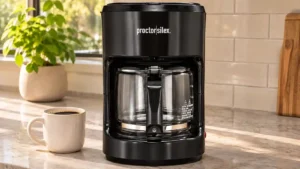
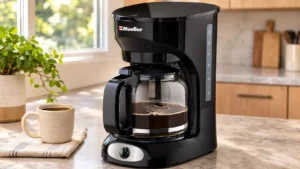
Proctor Silex 10-Cup Coffee Maker
Where It Has the Edge
- Value and Price is 5.0 vs 4.8. Multiple recommendations highlight strong value for an inexpensive ten-cup machine. Buyers sacrifice programming and premium materials rather than...

Scorata scores summarize analyzed review evidence on a 1–5 scale; they are not laboratory measurements or a simple average of customer star ratings. Feature scores summarize the reviews covering that feature. The overall score averages feature scores within each review, then combines review averages. When both expert and customer evidence are available, those two groups receive equal weight. Products can have different review coverage, so small score gaps do not establish a winner.
Recommendations prioritize important features for the category, with a score of at least 3.5, a gap of at least 0.25 points and at least two supporting reviews per product. Features with widely varying scores or broad connectivity contexts are excluded from recommendations. These safeguards do not establish statistical significance.
Quick verdict
The review evidence points to a tradeoff: Value and Price versus Capacity. Choose according to which strengths matter more to you; the overall score alone does not settle that choice.
Choose Proctor Silex 10-Cup Coffee Maker for Value and Price.
Choose Mueller 12-Cup Coffee Maker for Capacity.
Scores are out of 5. Missing scores mean missing review evidence, not a missing feature.
The absence of a visible water gauge or reservoir volume markings is a repeated drawback. It is harder to judge the correct fill level at a glance.
The water-level markings are useful for measuring the batch, but one account finds them hard to read under low lighting.
The machine is repeatedly credited with brewing dependable, good-tasting coffee, including praise for smoothness across medium and dark roasts. Its simple brewing process draws more praise than its precision.
Most cups are described as good, hot everyday drip coffee with respectable extraction. Some measurements and taste comparisons find the brew less nuanced or weaker than pricier alternatives.
Cleanup is consistently praised thanks to a removable brew basket and dishwasher-safe glass carafe. These accessible pieces are a standout convenience for daily maintenance.
The reusable filter is easy to dump and rinse, and the glass carafe is simple to wash. Everyday cleanup requires little effort compared with more elaborate machines.
The absence of automatic shutoff is the main convenience and safety complaint: the hot plate can remain on until someone turns it off. A few people see manual control as useful for keeping coffee warm.
A two-hour automatic shutoff is praised as reassuring where it works as described, but accounts conflict: some report missed shutoffs or say their units never switch off automatically.
Several sources describe the coffee as satisfyingly hot, though one notes it may fall short for people who prefer an especially hot cup.
Most coffee is delivered hot enough for enjoyable everyday drinking. Several tests measured brewing temperatures near the lower end of recommended ranges, potentially weakening extraction.
Ten coffee-maker cups are a practical middle ground for couples, small families, and shared pots. People who regularly need more than ten servings at once may find it undersized.
The roughly 60-ounce carafe makes enough for multiple drinkers in one batch. Keep in mind that 12 coffee-maker cups are smaller than typical mugs.
The coffee is repeatedly described as hot and tasty, with one hands-on account reporting smooth cups without bitterness from two roasts. It produces straightforward drip coffee rather than espresso drinks.
The permanent filter can yield a richer, fuller-bodied cup, especially for conventional drip drinkers. More demanding palates may find the flavor merely decent, with lighter roasts losing some complexity.
The brewer is described as sufficiently quick for a daily routine, with one account putting a full ten-cup brew at roughly five minutes. Auto Pause & Pour can deliver the first cup earlier.
Many find brewing brisk and convenient for a full pot, although one test took about 13 minutes and found it slower than some rivals.
Auto Pause & Pour is one of the most consistently liked extras, allowing a cup to be poured mid-brew with less dripping and mess. It makes waiting for a full pot less frustrating.
Pulling out the carafe midway through brewing usually stops the drip cleanly, letting you grab an early cup without soaking the warming plate.
The glass pot has a sturdy handle and easy-lift lid, while a protective lid design may help reduce chipping at the rim. Pouring and routine handling stay uncomplicated.
The glass carafe often pours cleanly and feels easy to handle, especially compared with ordinary budget glass. Occasional complaints involve leakage around the lid or condensation after brewing.
The biggest appeal is how little effort it takes to make a standard pot: fill, switch on, and pour. Owners and roundups repeatedly praise the practical simplicity despite missing automatic functions.
A one-switch workflow makes everyday brewing easy to understand without menus or a learning curve. That simplicity is central to its appeal, even though users who want more controls will find it limiting.
At a reported weight of about four pounds, the brewer is easy to move aside for cleaning or storage. That is helpful when counter space is shared.
Its short, fairly narrow body can fit below typical cabinets, making it easier to store in a compact counter setup.
A compatible smart plug can add scheduled starts and remote power control without a complicated built-in app. The plug must be purchased separately, and the brewer has no native Wi-Fi.
It has no native app interface, but the mechanical switch can cooperate with a smart plug for scheduled brewing. That workaround is helpful, though it is not built-in smart control.
There are no built-in brew-strength presets or precise temperature adjustments. You can change the amount or type of ground coffee, but drink customization remains basic.
Its no-frills operation avoids complicated menus but offers little or no brew-strength and heat adjustment. Some competing budget models provide richer programming options.
The warming plate's surface coating may deteriorate or flake after extended use. This is a durability concern even though the machine remains simple to operate.
The water-tank or filter-basket lid can be stiff, fiddly to seat, or prone to opening and splashing. It becomes easier with practice, but some units have more troublesome fit issues.
Its compact, lightweight body fits easily on ordinary or crowded countertops, with understated styling that blends into most kitchens. The appearance is practical rather than decorative.
The compact, unobtrusive design and straightforward appearance work well on typical kitchen counters. The basic plastic finish feels less premium to some buyers.
Owners and guides frequently call the glass carafe durable and the design dependable, including a positive account of lengthy household use. The basic plastic body feels cheaper, and the warming-plate coating may wear.
The heat-resistant borosilicate carafe draws praise for its resistance to sudden temperature changes. The main machine is more divisive: some find it solid, while others report early failure and lightweight construction.
Multiple recommendations highlight strong value for an inexpensive ten-cup machine. Buyers sacrifice programming and premium materials rather than essential drip-brewing capability.
An unusually low purchase price combines with a reusable filter and generously sized carafe to make this an attractive bargain. Long-term breakdown reports keep the value case from being risk-free.
One evaluation views the stated three-year warranty favorably. Warranty duration is not consistently established across these accounts, so buyers should check the exact listing before purchase.
A limited warranty provides some reassurance, though coverage and the risk of early failure are worth checking before purchase.
The filter and measuring scoop are useful included accessories, so buyers can start using ordinary ground coffee without buying filter paper.
The short power cord restricts outlet placement and can force the machine to stay in one spot or need an extension. Check where the outlet sits before choosing a counter position.
The plain on/off switch is widely appreciated for simplicity, but the inexpensive-feeling controls can lack the polish of costlier machines.
Non-slip feet hold the machine stable, including on a wet counter and when the carafe is full.
One comparison raises a concern about conflicting voltage information; checking the exact unit label before connecting it is prudent.
The two-hour shutoff is welcomed as a way to conserve power after brewing, with less worry about a forgotten hot plate.
The heating element is credited with making a full pot reasonably quickly and bringing water to useful brewing temperatures.
The warming plate generally keeps coffee pleasantly hot for a couple of hours without a burnt taste. Some owners and testers report stale or scorched coffee when it sits too long, and shutoff claims are inconsistent.
People who enjoy switching the brewer on themselves and keeping a hands-on morning ritual will appreciate its minimalist controls.
A substantial volume of generally positive owner feedback helps support its reputation as a worthwhile basic brewer.
ETL safety certification contributes to confidence in its basic appliance safeguards.
The finished coffee can lose heat faster than on pricier machines, so freshly poured cups fare better than prolonged holding.
The reservoir's lack of volume markings makes measuring fills less precise, and one account warns about water running down the sides. Filling is more fiddly than the one-switch brewing operation.
The fixed reservoir is usually straightforward, but lid access and internal water markings can make refilling trickier than expected.
An account that found no functioning auto-shutoff challenges the implied safety promise, so the shutoff behavior deserves confirmation.
The included permanent mesh filter saves recurring paper-filter purchases and can add body to the coffee. Fine sediment and a cleaner-tasting paper-filter option are the main tradeoffs.
The machine generally brews quietly, with a steady hum rather than distracting beeps. It can work in a noise-sensitive kitchen without creating much disturbance.
The illuminated on/off switch is valued as a clear reminder that the brewer is still running. It matters because the machine does not turn itself off.
Alexa, Google Home, or Siri commands can switch the brewer on or off through a compatible smart plug. The arrangement is inexpensive and flexible, but it offers only power control, not native brew customization.
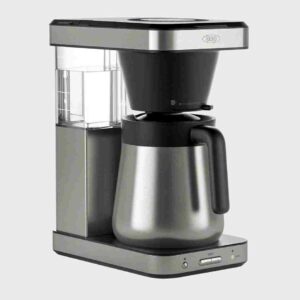
Choose the OXO Brew 8-Cup if you want fast, consistent drip coffee in small or full batches. Skip it if you need programming, app controls, a larger pot, or the...
Pros: Brewing performance and consistency, Overall user experience
Cons: Design flaws
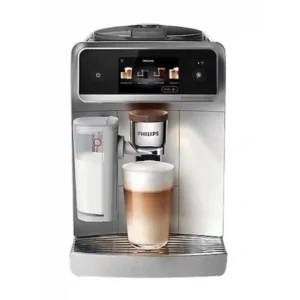
Best for effortless, highly personalized hot and cold coffee in a busy multi-drinker home. Skip it if counter space is tight, you demand silky adjustable microfoam, or the premium price...
Pros: Automation and sensors, Overall user experience
Cons: Design flaws, Mess-free used-puck disposal
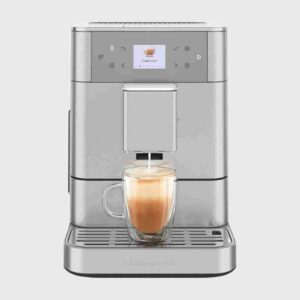
Choose the KitchenAid KF6 for rich espresso, quiet operation, easy cleaning, and strong value in a super-automatic. Skip it if dense cappuccino foam, plant-milk presets, touchscreen controls, or an included...
Pros: Water system, maintenance and descaling, Overall user experience
Cons: Accessories, Design flaws
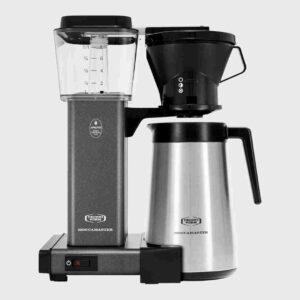
Choose the Moccamaster KBT for fast, excellent drip coffee, durable build, and a thermal carafe that keeps coffee hot. Skip it if you need programmability, a compact footprint, or a...
Pros: Brewing performance and consistency, Espresso and beverage quality
Cons: Automation and sensors, Design flaws