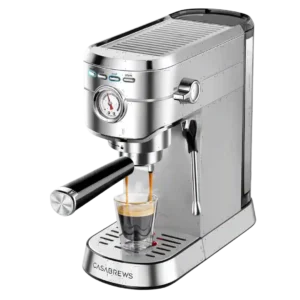
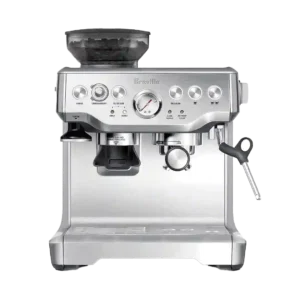
CASABREWS CM5418 Espresso Machine 20 Bar
Where It Has the Edge
- Portability and travel-friendliness is 4.6 vs 4.2. The compact, lightweight form earned strong portability marks, with reviewers explicitly seeing it as workable for small kitchens,...

Scorata scores summarize analyzed review evidence on a 1–5 scale; they are not laboratory measurements or a simple average of customer star ratings. Feature scores summarize the reviews covering that feature. The overall score averages feature scores within each review, then combines review averages. When both expert and customer evidence are available, those two groups receive equal weight. Products can have different review coverage, so small score gaps do not establish a winner.
Recommendations prioritize important features for the category, with a score of at least 3.5, a gap of at least 0.25 points and at least two supporting reviews per product. Features with widely varying scores or broad connectivity contexts are excluded from recommendations. These safeguards do not establish statistical significance.
Quick verdict
The review evidence points to a tradeoff: Portability and travel-friendliness versus Accuracy of marketing claims and Accessories. Choose according to which strengths matter more to you; the overall score alone does not settle that choice.
Choose CASABREWS CM5418 Espresso Machine 20 Bar for Portability and travel-friendliness.
Choose Breville Barista Express Espresso Machine for Accuracy of marketing claims and Accessories.
Scores are out of 5. Missing scores mean missing review evidence, not a missing feature.
Two reviewers challenged the 20-bar pressure messaging, calling higher-pressure claims misleading or marketing-focused rather than meaningful for better espresso.
Marketing accuracy was mixed-positive: one lab-style review confirmed the under-a-minute claim, while another cautioned that 15-bar marketing sounds better than it is.
The stock pressurized baskets are beginner-friendly but limit espresso quality; several reviewers recommended single-wall, bottomless, or standard basket upgrades.
Water-filter sentiment was positive because reviewers saw it as useful for taste, scale control, and protecting the machine.
Reviewers generally found brewing performance better than expected for the price, with consistent shots and credible extraction, while some noted limits from stock baskets and budget hardware.
Evidence praised pre-infusion, PID control, extraction yield, and forgiving shot behavior, with most comments pointing to reliable brewing when the user dials in grind and dose.
Accessories were usually a drawback, especially the flimsy tamper, stock portafilter, pressurized baskets, missing pitcher, and extra tools required for better results.
Accessory coverage was consistently praised, with reviewers noting useful baskets, cleaning tools, milk pitchers, tampers, filters, and included setup extras.
Used-puck handling was repeatedly criticized because baskets can loosen or fall out, and cheaper-machine dripping makes puck removal less clean.
Reviewers liked dry, intact pucks and easier puck removal when the process was dialed in, with the dry-puck feature called smart.
Capacity suits solo or small-space use better than groups; reviewers noted the small tank, small tray, and overload risk when making several milk drinks.
Capacity was praised for the 2-liter water tank, large drip tray, and workable hopper size, with only minor refill-handling caveats.
Programmability and automation are limited: shot presets, temperature control, customization, and reprogramming drew mixed-to-negative comments despite basic useful controls.
Pressure gauges, cleaning indicators, dosing behavior, and purge features were useful aids, especially for beginners learning extraction and maintenance.
Cup and tray handling was a weaker area: reviewers liked the removable tray concept, but found narrow clearance, poor cup-warming, cup vibration, or steam-wand drips problematic.
The drip tray and cup handling were generally praised for capacity and design, though one reviewer disliked base nodules that block taller cup workarounds.
Heating performance was mixed: reviewers praised quick thermoblock warm-up, but criticized slow steam heat-up, underpowered steaming, or below-ideal espresso temperature.
Fast thermocoil heat-up and quick readiness were praised, especially compared with slower boiler machines, though steam power is not class-leading.
Reviewers repeatedly treated a good grinder as an extra cost or space requirement, saying the machine benefits from proper grinding despite having no built-in grinder or hopper.
The built-in grinder is convenient and good enough for many beginners, but multiple reviewers called it the main compromise because adjustment precision and mess can limit growth.
The pressure gauge and pump feedback were useful to some reviewers, but several criticized the lack of bar markings or the gap between 20-bar marketing and measured/usable pressure.
Pressure feedback and newer nine-bar OPV support were valued, but several reviews warned that high pressure or puck flaws can still cause channeling.
Hot-water feedback was limited to one reviewer, who found the output adequate for Americanos but not necessarily hot enough for tea.
The hot-water outlet was viewed as a useful extra for Americanos, tea, rinsing, and broader drink flexibility.
The compact, lightweight form earned strong portability marks, with reviewers explicitly seeing it as workable for small kitchens, campervans, RVs, or tight storage.
Portability was rarely discussed, but reviewers who did mention it said the machine is movable and even practical for car trips or camping.
Popularity evidence was limited but positive, with one review citing Amazon ratings and another saying the machine deserved its TikTok fame.
Popularity evidence was very strong, with multiple reviewers calling it a leading or best-selling all-in-one home espresso machine.
All ten reviews found the CM5418 capable of good espresso or milk-drink bases, though several tied the best flavor to better beans, grinder setup, or non-pressurized basket upgrades.
Reviewers repeatedly found the machine capable of rich, café-style espresso and milk drinks once dialed in, though one beginner-focused review showed poor early shots before technique improved.
Milk steaming earned broad praise for producing silky or velvety texture, but several reviewers found it slow, underpowered, or awkward when making multiple drinks.
Milk steaming drew strong praise for microfoam quality and latte-art potential, while slower steam pressure and warm-up were the most common caveats.
Heat-up and drink prep were often fast for the price, but speed dropped when steaming milk, making multiple back-to-back drinks more frustrating.
Heat-up and shot speed were often praised, but milk-drink workflow slows because grinding, tamping, steam warm-up, and single-boiler sequencing take time.
The single thermoblock setup helps compactness and speed, but reviewers noted the tradeoff that espresso brewing and milk steaming cannot happen simultaneously.
Single thermocoil design was accepted as normal at the price, but reviewers consistently noted it cannot brew and steam at the same time.
Cleaning was usually described as simple, with easy daily rinsing and descaling guidance, but reviewers noted cleaning-tablet purchases, water-tank filling quirks, and routine drip-tray/steam-wand upkeep.
Maintenance is manageable and sometimes improved by indicators, filters, and faster descale cycles, but reviewers still described cleaning as routine work or a hassle.
Overall experience was generally easy and beginner-friendly, but reviewers flagged frustrations from quirks, overheating, accessories, and cheaper alternatives.
Overall experience was positive for hands-on learners and home baristas, but less so for users who expected push-button simplicity.
Build impressions were split: one reviewer found sturdy metal finishing, but most noted cheap parts, plastic/aluminum compromises, paint chips, vibration, leaks, or uncertain durability.
Build quality was a clear strength, with repeated praise for stainless-steel feel, heft, durability, and long-term reliability.
Design flaws clustered around the portafilter, vague pressure gauge, vibrations, narrow tank/tray layout, paint damage, leaks, and steam-wand positioning.
Design drawbacks centered on mess, lack of a front water-level indicator, grinder compromise, high-pressure sensitivity, and beginner intimidation.
Reviewers strongly agreed the CM5418 is compact and attractive for small counters, with mixed notes on budget styling and Dedica-like design refinement.
The machine was widely seen as attractive, professional-looking, and space-efficient for an all-in-one, though not tiny.
Warranty and support confidence were limited: one review called the warranty merely standard, while others worried about replacement parts and long-term brand support.
Warranty and support evidence was mixed: reviewers appreciated basic coverage and repairability, but the one-year warranty was repeatedly flagged as short.
Value was the strongest theme, with reviewers repeatedly calling it inexpensive, budget-friendly, and worth the price, though some preferred cheaper or better-performing alternatives.
Value sentiment was very strong: reviewers repeatedly said the all-in-one package gives serious espresso capability for far less than higher-end setups.
Setup and first use were mostly beginner-friendly and quick, though one reviewer had a rougher priming experience and another described a short learning period.
Setup ranged from very easy out of the box to straightforward but time-consuming; beginner reviewers emphasized priming, flushing, and learning the workflow.
App evidence was limited to setup help, where the BILT/visual setup guidance was described as straightforward and useful.
Packaging sustainability was only discussed once, and the reviewer criticized the use of environmentally unfriendly styrofoam.
The magnetic tamper was convenient and usable, but several reviewers said it is basic, light, or less comfortable than an upgraded tamper.
Recognition evidence came from editorial awards and top-ranked review positioning, supporting strong external validation.
Only one review gave opinionated evidence for internal storage, calling the small behind-tray space a smart way to keep tools at hand.
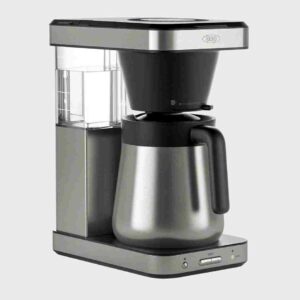
Choose the OXO Brew 8-Cup if you want fast, consistent drip coffee in small or full batches. Skip it if you need programming, app controls, a larger pot, or the...
Pros: Brewing performance and consistency, Overall user experience
Cons: Design flaws
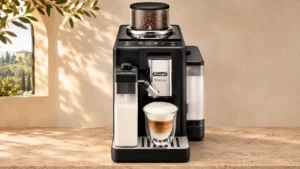
Swappable bean hoppers, intuitive controls and silky automatic milk foam make the Rivelia unusually convenient for varied coffee routines. The premium price, grinder-clearing step and optional cold-foam upgrade are worth...
Pros: Grinder, hopper and dosing system, Espresso and beverage quality
Cons: Iced / cold-brew function quality, Capacity
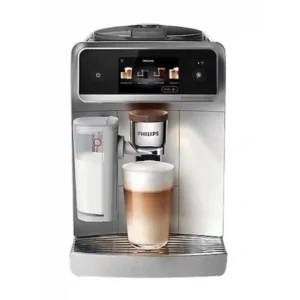
Best for effortless, highly personalized hot and cold coffee in a busy multi-drinker home. Skip it if counter space is tight, you demand silky adjustable microfoam, or the premium price...
Pros: Automation and sensors, Overall user experience
Cons: Design flaws, Mess-free used-puck disposal
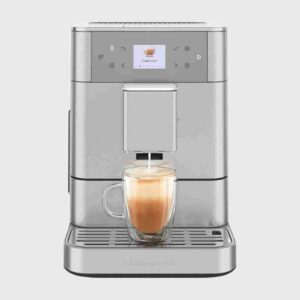
Choose the KitchenAid KF6 for rich espresso, quiet operation, easy cleaning, and strong value in a super-automatic. Skip it if dense cappuccino foam, plant-milk presets, touchscreen controls, or an included...
Pros: Water system, maintenance and descaling, Overall user experience
Cons: Accessories, Design flaws