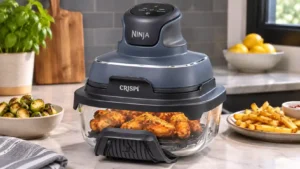
Ninja Crispi FN101GY
Where It Has the Edge
No clear scored advantage over the other product.

Scorata scores summarize analyzed review evidence on a 1–5 scale; they are not laboratory measurements or a simple average of customer star ratings. Feature scores summarize the reviews covering that feature. The overall score averages feature scores within each review, then combines review averages. When both expert and customer evidence are available, those two groups receive equal weight. Products can have different review coverage, so small score gaps do not establish a winner.
Recommendations prioritize important features for the category, with a score of at least 3.5, a gap of at least 0.25 points and at least two supporting reviews per product. Features with widely varying scores or broad connectivity contexts are excluded from recommendations. These safeguards do not establish statistical significance.
Quick verdict
The available evidence supports the recommendation below, but does not establish an overall winner. Check the remaining features against your priorities.
There is not enough comparable review evidence to recommend Ninja Crispi FN101GY over the other product.
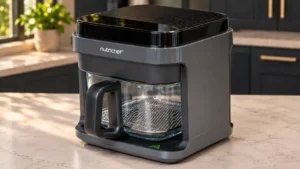
Choose NutriChef 5.8 Quart NCAF539TB for ease of use and customization options.
No clear scored advantage over the other product.
Scores are out of 5. Missing scores mean missing review evidence, not a missing feature.
Four modes and a simple timer suit straightforward cooking, but removing the hot pod and remembering to flip food add hands-on steps.
The presets and wipeable touchscreen make everyday operation fairly simple, although learning manual settings and seating the bowl can take care.
Frying odors can spread through the kitchen and linger, so the glass bowl is not a substitute for ventilation.
One account reports no lingering oil smell compared with traditional deep frying.
The timer is adjustable, but its minute-to-second countdown confuses some users about how much time remains.
Adjustable cooking times make it easy to extend a preset or customize a manual cooking cycle.
You cannot select exact cooking temperatures, a frequent frustration when recipes call for a specific heat level.
Fine temperature adjustment is appreciated for tailoring cooking to specific foods and recipes.
The starter guide is useful for learning recipes and modes, yet some cooking times prove optimistic or unclear.
Preset instructions could be more helpful, particularly for users who find the control panel frustrating.
The glass bowl catches grease and juices neatly, but buildup around the heating unit can be awkward to remove.
The enclosed bowl reduces bacon spatter, and cooking without deep-frying oil simplifies grease disposal.
The interchangeable bowls work well for portions and snacks, but shallow cooking surfaces limit larger meals and batches.
The 5.8-quart bowl fits modest family portions, but usable single-layer space is more limiting than the capacity suggests.
Recommended timings do not always match real results, so unfamiliar dishes can require extra checking and adjustment.
Thickness and quantity can change cooking times, and slow heat recovery can make timing less predictable.
Lifting the heating pod automatically pauses operation, a welcome convenience when checking or turning food.
The fryer pauses when the bowl is pulled out and resumes the previous time and temperature when reinserted, a convenient safety feature.
Cooking starts quickly without a lengthy preheat, making small snacks and warm-ups convenient.
Preheating is quicker than a conventional oven in some accounts, but slower than competing air fryers. It can require a separate manual cycle.
Heat-resistant feet help keep the hot bowls and pod off the counter, but some users remain cautious about sensitive surfaces.
Some accounts praise anti-slip stability, but the front-heavy bowl can make the appliance tilt when pulled out.
Physical buttons are easier to operate reliably than a touch-only control panel, particularly when hands are wet or messy.
Some users praise the clear touchscreen layout, while others find the unlit buttons difficult to see.
Most non-electric pieces go straight into the dishwasher, a major convenience after messy meals.
Dishwasher-friendly removable parts make post-cooking cleanup more convenient.
Golden browning is achievable on wings, vegetables and sandwiches, but some foods brown patchily or darken too quickly at the top.
Golden fries are possible, but laboratory testing found uneven browning, especially with homemade fries.
Its unusual glass design wins enthusiastic support for compact, everyday cooking, but not everyone would replace a traditional fryer.
Overall satisfaction is strongest among cooks who prioritize visibility, easy cleanup and quiet operation. Performance-focused shoppers have stronger alternatives.
Recrisp is a particular highlight for leftover pizza and snacks; other modes are useful but vary in consistency.
Food-specific presets simplify routine cooking and provide useful starting points that can be adjusted for portion size or recipe.
Automatic pausing and raised feet offer some protection, offset by exposed hot parts and reported overheating or glass concerns.
The basket interlock and shutoff are valued, but correct seating is important and the hot, heavy bowl warrants caution.
Running costs can be modest for small portions, with measured electricity use supporting its efficiency for shorter cooks.
Quick heating compared with an oven and automatic pausing during bowl removal are cited as energy-saving conveniences.
Fan speeds are tied to the preset modes rather than independently selectable, limiting finer control of delicate dishes.
The relatively low maximum fan speed limits airflow and flexibility compared with stronger air fryers.
Some reheating modes are poorly explained in the booklet, leaving cooks to guess starting times.
The manual is criticized for not explaining the presets clearly.
Ceramic-coated inserts appeal to some shoppers, but scratch resistance and coating transparency are not universally reassuring.
Food residue can release readily, but any coated insert requires gentle cleaning to preserve its surface.
The four simple programs cover common tasks, yet the small selection omits the flexibility of lower-temperature specialty modes.
Eight presets are helpful for common foods, though only two distinct cooking methods are identified in the detailed lab review.
The system nests into a cupboard and can keep leftovers in the same containers, though there are several pieces to organize.
The relatively compact shape is convenient to store, but the heavy glass bowl can make lifting it into a cupboard awkward.
Shaking or flipping is sometimes needed to even out cooking, and removing the hot pod makes that less effortless than a drawer fryer.
Some cooks report good results without flipping, but others still find hotspots or uneven cooking even after shaking or rotating food.
Chicken and vegetables often finish evenly, but bread, fries and some bakes can show substantial differences between top, edges and center.
Evenness is a significant question mark: several accounts praise uniform results, while lab testing found substantial variation even after shaking.
The glass bowls, adapter and removable heating unit can become very hot, demanding careful placement and handling.
The exterior and handle are described as cool in some accounts, but the glass gets hot and the handle may warm during longer cycles.
Roasting, air frying, reheating and occasional baking work in the same modular system, although the fixed settings narrow its flexibility.
Food-specific presets and manual settings cover common meals, but the limited temperature and fan-speed range makes it less versatile than some alternatives.
Wings, potatoes and some leftovers develop satisfying crunch, while frozen fries and certain dense dishes can turn out inconsistent.
Bacon and some smaller portions can get nicely crisp, but fries and crowded batches may turn out unevenly or lack crunch.
The available heat range works well for rapid crisping but offers too little low-temperature flexibility for gentle recipes.
The temperature ceiling limits high-heat crisping and searing, and the minimum is too high for effective dehydration in lab testing.
Food often comes out crunchy and well-browned without added oil, making quick lower-oil versions of fried favorites especially appealing.
Several sources describe satisfying crispness and flavor with little or no added oil, although overall frying consistency remains disputed.
Two bowls, crisper plates, lids and an adapter give the system a practical starting kit, though the many loose pieces need storage.
The raised mesh insert, extra handle and silicone trivet are appreciated for practical cooking and safe handling.
The heating pod is capable with many small dishes, but some cooks find its crisping power behind larger traditional models.
The 1,200-watt heater is described as adequate for everyday cooking, but comparison tests found it underpowered and slow to recover heat.
Small items and many proteins finish quickly, but some batches take longer than competing basket models or the printed guidance suggests.
Some foods cook quickly compared with an oven, but the 1,200-watt system is slow against competing air fryers, especially for thicker foods and repeated batches.
Juicy meats, crunchy coatings and tender vegetables are common successes, but dryness and overbrowning appear when timing is off.
Some cooks describe juicy interiors and crisp exteriors, but controlled testing found proteins can lose moisture and turn dry.
Temperature varies within preset ranges, but some tests find those fluctuations modest rather than disruptive.
Temperature stability is disputed: some accounts describe steady heat, while lab testing found major fluctuations and slow recovery after food was added.
Most cooking sessions work as expected, but repeated overheating faults in one account are a serious reliability caveat.
One roundup describes the fryer as reliable for routine cooking, although long-term reliability is not well established.
The price sits above many standard fryers; compact glass convenience helps justify it for some, but not as a family workhorse.
Several sources call it an affordable route to glass cooking, though lab testing questions its value against faster, more capable alternatives.
Setup involves fitting bowls, plates and the adapter, but most users can get cooking quickly after a brief familiarization.
Initial setup and choosing the first cooking settings are described as straightforward.
Cooking is largely restricted to four fixed temperature-based modes, frustrating anyone who likes tailoring exact settings.
Manual time and temperature adjustment is a welcome option, including the ability to modify presets instead of accepting their defaults.
A small set of mode and time buttons is easy to learn, but it offers much less control than a conventional dial-based air fryer.
Presets and adjustable time and temperature earn praise, but manual settings can take several steps and unlit controls can be hard to see.
The compact glass-and-pod design looks modern and attractive, with several color choices that fit into a kitchen rather than dominating it.
The understated finish and modern touchscreen give the appliance a clean, attractive countertop appearance.
Dishwasher-safe bowls are straightforward to wash, though narrow gaps around the fixed handles and grease inside the pod are harder to reach.
The smooth glass bowl is repeatedly praised for easy washing and minimal stuck-on residue. The flat controls are also easy to wipe down.
Transparent bowls make it easy and satisfying to check progress without repeatedly lifting the heating unit.
The clear glass bowl is the standout feature: you can check browning and cooking progress without opening the fryer and losing heat.
The cooking fan generally runs at a modest, unobtrusive noise level, often quieter than larger Ninja fryers.
Quiet operation is one of the most consistent strengths, with several cooks describing it as quieter than other air fryers.
Many meals cook very well, particularly vegetables and proteins, although controlled frozen-fry testing reveals notable unevenness.
Frying results are sharply disputed. Some cooks report excellent results, but controlled testing found many fries and spring rolls undercooked or burnt.
The compact timer display is readable at a glance, though its switch to seconds can make remaining time less obvious.
Display legibility varies by account: some praise the bright panel, while others struggle to see the setting buttons.
Some measured cooking temperatures differ from expectations, so precise heat control is less dependable than with a temperature dial.
One test praises well-calibrated settings, but another finds actual temperatures fall below the selected target.
The glass containers generally feel solid and substantial, creating a premium impression despite concerns about some smaller components.
The housing and materials generally feel solid and well constructed.
A small countertop footprint and nesting containers make storage easier than with many full-size air fryers.
The appliance makes efficient use of counter space for its stated capacity, although its glass bowl is relatively heavy.
The substantial glass containers appeal to shoppers avoiding conventional coated baskets, though smaller plastic and silicone parts deserve attention.
Glass and metal construction receive favorable comments, though the exact food-contact materials are described inconsistently across sources.
Several tests found sturdy glass, but reported silicone-bumper failures and hot-part wear raise questions about long-term durability.
Construction feels sturdy, but glass and coated accessories require careful handling and long-term durability is less established.
Built-in bowl handles help with carrying hot dishes, although limited clearance and warmth call for cautious lifting.
The extra handle helps lift the heavy bowl, although the main handle may become warm during longer cooking sessions.
Interchangeable glass bowls and the detachable pod make cooking and storage flexible, though adapters and removable plates add handling steps.
The transparent bowl and raised insert are practical design touches. The heavy bowl requires careful alignment and handling.
Crisper-plate positioning can be limiting for tall food, because the raised surface reduces headroom near the heating element.
The raised insert allows air underneath food, and several accounts praise circulation. Crowded portions and weak airflow in lab tests can leave food unevenly cooked.
The rear exhaust can blast noticeably hot air toward nearby objects and the cord, so clearance matters.
Audible completion beeps are difficult to tailor because there is no convenient mute option.
The square basket offers room to lay food out, but larger portions can still overlap and reduce crisping.
The glass bowl is noticeably heavy, particularly when full. The second handle helps, but two-handed lifting and careful placement may be needed.
The coating on the crisper plates can be difficult to identify from supplied information, disappointing shoppers seeking exact material details.
The fan-and-pod system can cook without generating noticeable smoke in some kitchens, although hot exhaust still needs clearance.
Inserting, leveling and extracting the crisper inserts can be fiddly, especially after they become hot.
The flat control panel avoids crevices where dust and oil could otherwise accumulate.
The glossy touchscreen can collect fingerprints and grease, although it is relatively easy to wipe clean.
Positive accounts praise flavorful, satisfying food with little oil, particularly crisp wings and fries.
The Keep Warm mode can hold completed components while other dishes finish, making staggered meals easier.
Frying aromas can linger in the home after cooking, so the glass design does not eliminate kitchen smells.
Packaging generally protects the many separate glass and electric parts well during delivery.
The detachable pod and lidded bowls travel more easily than a full-size drawer fryer, although their weight and need for an outlet limit portability.
The short power cord can make positioning the removable pod awkward and limit places it can be used.
One account praises clear preheat indicators, though another describes preheating as a separate manual cycle rather than a dedicated function.
The glass cooking containers double as serving dishes, cutting transfers and washing up for small meals.
Watching food through glass is helpful, yet uneven top-down heating often requires attention rather than true set-and-forget cooking.
Glass surfaces and removable parts make cleanup a recurring strength, with little scrubbing needed in many accounts.
Strong downward airflow can lift loose bread or breadcrumbs toward the heating element, complicating light-food recipes.
The smaller snap-on lid holds liquids securely and makes transporting prepared portions less messy.
Warranty coverage is less reassuring than some competitors for heavy daily users seeking long-term protection.
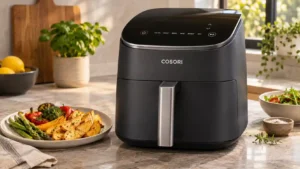
A roomy basket, crispy results, quiet fan, and easy cleanup make the TurboBlaze a versatile everyday choice. Inconsistent cooking on some foods, no shake reminder, and a single basket are...
Pros: crisping ability, cooking speed
Cons: Finish resistance to smudges, Shake reminder
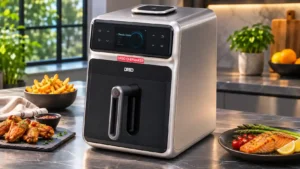
Its probe-guided, moisture-assisted programs can deliver remarkably juicy meat and fish with little guesswork. The premium cost, sometimes overenthusiastic manual heat, and single basket make it a specialist rather than...
Pros: food texture quality, app connectivity
Cons: basket capacity, temperature accuracy
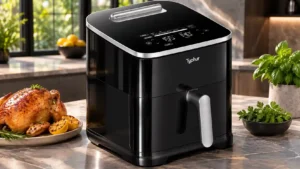
The built-in meat probe, generous basket and easy cleaning make family roasts impressively convenient. Allow plenty of counter depth, and expect a few crisping and app-control compromises.
Pros: Meat thermometer convenience, basket capacity
Cons: footprint size, Setup simplicity
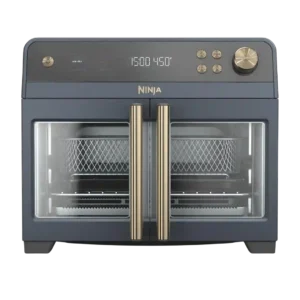
Best for fast, even air frying, family-sized capacity, and a genuinely useful mix of oven functions. Skip it if you need cool sides, effortless dishwasher cleanup, or independent two-level cooking.
Pros: ease of cleaning, ease of use
Cons: exterior heat management, dishwasher-safe parts