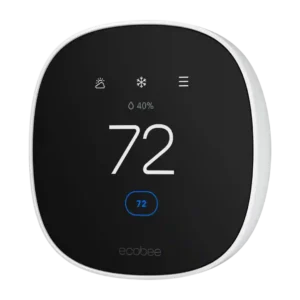
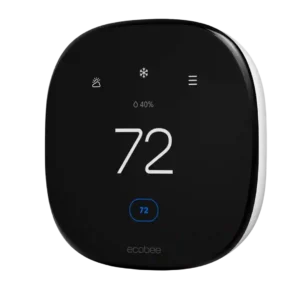
ecobee Smart Thermostat Essential
Where It Has the Edge
- voice control quality is 4.8 vs 4.5. Voice control quality is strong where tested, with one review reporting instant responses and another praising voice commands...

Scorata scores summarize analyzed review evidence on a 1–5 scale; they are not laboratory measurements or a simple average of customer star ratings. Feature scores summarize the reviews covering that feature. The overall score averages feature scores within each review, then combines review averages. When both expert and customer evidence are available, those two groups receive equal weight. Products can have different review coverage, so small score gaps do not establish a winner.
Recommendations prioritize important features for the category, with a score of at least 3.5, a gap of at least 0.25 points and at least two supporting reviews per product. Features with widely varying scores or broad connectivity contexts are excluded from recommendations. These safeguards do not establish statistical significance.
Quick verdict
The review evidence points to a tradeoff: voice control quality versus C-wire requirement flexibility and display readability. Choose according to which strengths matter more to you; the overall score alone does not settle that choice.
Choose ecobee Smart Thermostat Essential for voice control quality.
Choose ecobee Smart Thermostat Enhanced for C-wire requirement flexibility and display readability.
Scores are out of 5. Missing scores mean missing review evidence, not a missing feature.
The C-wire workaround is a weakness because the power extender kit is described as sold separately and required for homes without a C wire.
The included power extender kit was specifically praised as a helpful addition for homes without an existing common wire.
C-wire flexibility is mixed: reviewers found installation straightforward when the wiring is present, but missing C-wire setups add adapter cost, setup steps, or professional help.
The common-wire requirement was softened by the ability to use the included power extender kit when no C-wire is present.
Learning and auto-schedule effectiveness is mixed: one reviewer credited habit learning, while another said it does not create a personalized learned schedule.
Auto-scheduling was viewed as a nice convenience for users who do not want to build schedules manually.
Humidity sensing received direct praise in the same review that said humidity readings were handled accurately.
Humidity sensing was useful as part of Eco+ because it can adjust comfort around how the room actually feels.
Scheduling flexibility is mixed: reviewers praised schedule adherence and easy setup in some cases, but others found the options limited or prone to setup surprises.
Scheduling was a major convenience win, with reviewers valuing both manual setup and the ability to define schedules exactly.
Room Sensor support is a tradeoff: reviewers like that remote sensors are supported, yet repeatedly note they are sold separately, not cheap, or not included out of the box.
Room Sensor evidence was positive for usefulness but mixed because the Enhanced model supports sensors without including one in the box.
Wall fit is context-dependent: one review warned uncovered holes can look bad, while another liked the trim kit’s ability to keep the wall neat.
Wall mounting was mostly acceptable, with one reviewer finding the bracket sturdy and another preferring the cleaner look without a back plate.
Energy-saving recommendations are mixed, with one review praising helpful savings options and another saying there are not many energy-saving features.
Energy-saving recommendations and Eco+ features were generally liked, though the evidence focused on practical savings rather than measured bill reductions.
Compatibility is broad but not universal: one reviewer cautioned that the stated coverage still leaves some users likely to face HVAC compatibility issues.
Reviewers found it suitable for typical systems but cautioned that more complex HVAC setups may be better served by the Premium model.
On-device control usability is one of the strongest themes, with reviewers repeatedly describing the thermostat as easy to use, flexible, and simple to adjust.
On-device controls were repeatedly described as simple, intuitive, and part of a better user experience.
Presence-based automation depends on optional sensors, but one reviewer described the resulting empty-room energy avoidance as useful.
Presence-based automation was praised for adjusting when people leave, restoring comfort, and helping avoid unnecessary heating or cooling.
Multi-room balancing is promising when optional sensors are added, with one reviewer saying they help avoid heating or cooling empty spaces.
Multi-room balancing was praised as useful for seeing uneven heating or cooling and improving comfort where people actually are.
Away mode effectiveness was praised in one review as a practical way to reduce wasted energy while away.
Away mode was presented as useful for saving energy while restoring comfort when someone returns.
Manual hold and override flexibility is a strength in one review because the thermostat allows fine-tuning while still putting a schedule on hold.
Manual holds and overrides were praised as part of strong user control over household temperature.
Display readability is mostly adequate, with at-a-glance information easy to read, but one reviewer criticized the lower-resolution text as not crisp.
Display readability was one of the strongest areas, with reviewers praising the larger, clearer screen and easy-to-read interface.
DIY installation is generally viewed positively, with several reviewers calling it simple, fast, or manageable, though low-voltage wiring and C-wire needs add caveats.
Installation was generally viewed as easy, ranging from a breezy guided app process to a quick 15-20 minute install.
Setup guidance received clear praise in one review for including helpful pictures that make the adapter path less intimidating.
Setup guidance was considered clear and straightforward, with step-by-step app instructions called out as helpful.
Remote control reliability is viewed favorably: one reviewer said app commands executed promptly, and others treated remote app adjustment as a meaningful convenience.
Remote control was valued because changing temperature from the phone helped prevent wasted heating or cooling when away.
Alexa support is positive in the reviews that tested or evaluated it, especially where setup and voice-command integration were trouble-free.
Alexa support was rated highly where tested through compatible voice-assistant hardware rather than built-in Alexa on the thermostat.
Google Home or Google Assistant support is treated positively as part of the thermostat’s broad smart-home compatibility.
Google Home support was included in the reviewer’s positive report that voice-assistant control worked without issues.
Value for money is strong, with reviewers repeatedly framing the thermostat as an excellent or good-value budget choice.
Value for money was generally positive because reviewers liked the feature set and lower price, though one felt Premium adds a lot for the extra cost.
Adaptive recovery intelligence received a strong score from one review for heating or cooling ahead so the room reaches the set temperature on time.
Adaptive preheating or precooling was described as useful for shifting energy use to lower-cost periods.
Apple Home/HomeKit support is consistently positive, with reviewers citing individual support, easy syncing, and trouble-free account setup.
Apple Home/HomeKit support received especially strong praise from the Apple-focused reviewer.
Room prioritization controls are supported through optional sensors, which one reviewer framed as a way to focus comfort where it is needed most.
Room prioritization controls were viewed positively because sensors can help heat or cool the room being occupied.
Voice control quality is strong where tested, with one review reporting instant responses and another praising voice commands for temperature and status checks.
Voice control quality was strong overall, with reviewers praising broad assistant compatibility and no reported issues in use.
App usability is positive where tested, with prompt app commands and useful remote adjustments mentioned as practical benefits.
The app was praised for being seamless, intuitive, and very easy for mobile temperature management.
Smart-home ecosystem compatibility is a major strength, with reviewers repeatedly praising broad or seamless integration across mainstream platforms.
Smart-home compatibility was viewed positively because the thermostat worked well across major voice assistant ecosystems.
Touchscreen responsiveness is a strength across reviewers, who described the screen as responsive and useful for quick on-device control.
Temperature adjustment on the screen earned strong marks because reviewers found scrolling smoother and the updated controls easier to use.
Design and finish quality is divided: some reviewers liked the sleek, minimal look, while others found it cheap-feeling or less premium than higher-end models.
Design drew positive comments for the sleek updated look, but finish quality was mixed because Premium’s materials were considered nicer.
Comfort consistency is strong overall, with reviewers describing flawless performance, timely target temperatures, accurate operation, and satisfying real-world performance.
Comfort consistency evidence centered on room sensors helping keep the occupied area at the proper temperature.
A reviewer with a furnace and air conditioner framed conventional HVAC wiring as straightforward and low-friction.
Energy reports quality is mixed: one review called the reporting helpful, while another said energy expertise is limited to periodic usage updates.
Equipment diagnostics usefulness was supported through the reviewer’s praise for maintenance reminders that protect the HVAC system.
Heat pump support was described positively for standard heat pump systems, with the reviewer saying it should work fine for that use.
HVAC maintenance alerts were viewed as helpful because tune-up reminders could extend system life.
Filter reminders were praised as useful app-based prompts for users who might forget maintenance tasks.
Occupancy detection was viewed as improved and mostly accurate, though one reviewer noted occasional misses.
Temperature accuracy received direct praise in one review that said the thermostat handled temperature readings accurately.
Matter support is a notable limitation because one reviewer preferred the Google Nest Thermostat partly because it supports Matter.
Utility demand-response support was a weak spot for one reviewer because their utility provider was not available.
One reviewer reported no Wi-Fi problems, giving the thermostat strong evidence for connection stability in that setup.
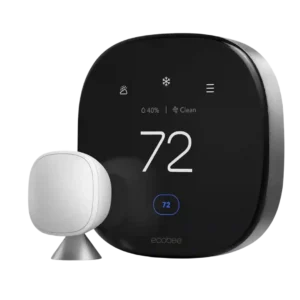
Best for polished design, easy controls, strong sensors, and useful energy data. Skip it if you want the cheapest thermostat or do not need premium extras like air quality, voice...
Pros: Room Sensor, value for money
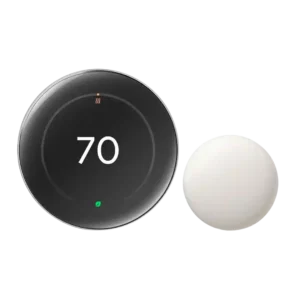
Choose it if you want a premium-looking thermostat with Matter, strong learning, room sensors, and polished controls. Skip it if the price, Google-account dependence, or occasional setup/presence-sensing hiccups outweigh the...
Pros: design and finish quality, display readability
Cons: touchscreen responsiveness
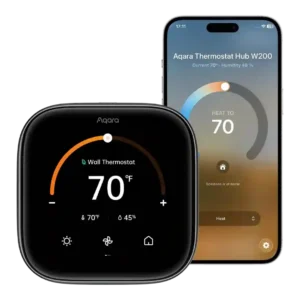
Choose the Aqara W200 if you want Apple Home-first climate automation, Matter hub extras, easy installation, and strong value. Skip it if you need advanced heat-pump controls, multi-sensor averaging, included...
Pros: smart-home ecosystem compatibility, occupancy detection accuracy
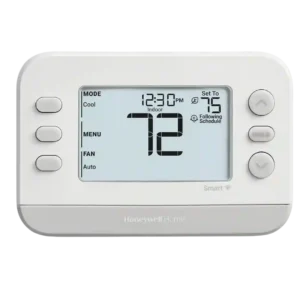
Best for affordable Wi-Fi control, easy installation, clear physical controls, and flexible scheduling. Skip it if you need room sensors, polished voice integrations, detailed energy analytics, quiet relay operation, or...
Pros: app usability, DIY installation ease
Cons: C-wire requirement flexibility, smart-home ecosystem compatibility