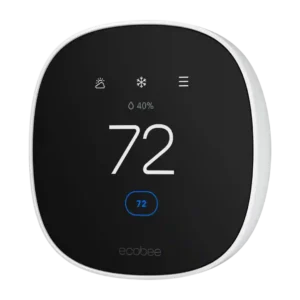
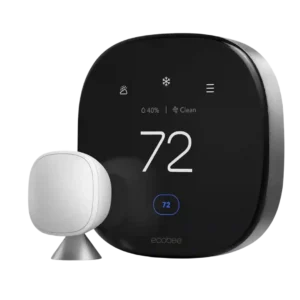
ecobee Smart Thermostat Essential
Where It Has the Edge
- voice control quality is 4.8 vs 4.0. Voice control quality is strong where tested, with one review reporting instant responses and another praising voice commands...

Scorata scores summarize analyzed review evidence on a 1–5 scale; they are not laboratory measurements or a simple average of customer star ratings. Feature scores summarize the reviews covering that feature. The overall score averages feature scores within each review, then combines review averages. When both expert and customer evidence are available, those two groups receive equal weight. Products can have different review coverage, so small score gaps do not establish a winner.
Recommendations prioritize important features for the category, with a score of at least 3.5, a gap of at least 0.25 points and at least two supporting reviews per product. Features with widely varying scores or broad connectivity contexts are excluded from recommendations. These safeguards do not establish statistical significance.
Quick verdict
The review evidence points to a tradeoff: voice control quality versus Room Sensor and display readability. Choose according to which strengths matter more to you; the overall score alone does not settle that choice.
Choose ecobee Smart Thermostat Essential for voice control quality.
Choose Ecobee Smart Thermostat Premium for Room Sensor and display readability.
Scores are out of 5. Missing scores mean missing review evidence, not a missing feature.
Presence-based automation depends on optional sensors, but one reviewer described the resulting empty-room energy avoidance as useful.
One reviewer had a poor experience using the occupancy sensors for Home automations, saying their tests did not work.
The C-wire workaround is a weakness because the power extender kit is described as sold separately and required for homes without a C wire.
Reviewers liked that Ecobee includes a power extender/C-wire adapter option, especially for setups without a common wire.
Compatibility is broad but not universal: one reviewer cautioned that the stated coverage still leaves some users likely to face HVAC compatibility issues.
Reviewers describe broad HVAC compatibility as a strength, including one case where Ecobee solved a furnace problem and another noting expanded wiring capability for more systems.
C-wire flexibility is mixed: reviewers found installation straightforward when the wiring is present, but missing C-wire setups add adapter cost, setup steps, or professional help.
The power extender support was viewed positively because it helps installs where a common wire is not already present.
Room Sensor support is a tradeoff: reviewers like that remote sensors are supported, yet repeatedly note they are sold separately, not cheap, or not included out of the box.
The included Room Sensor is one of the most consistently praised features, helping with room-level temperature readings and comfort control.
Wall fit is context-dependent: one review warned uncovered holes can look bad, while another liked the trim kit’s ability to keep the wall neat.
One reviewer liked the included trim plate for covering wall blemishes behind the thermostat.
Scheduling flexibility is mixed: reviewers praised schedule adherence and easy setup in some cases, but others found the options limited or prone to setup surprises.
Scheduling is repeatedly praised as flexible, customizable, and easy to tune for different times, days, and energy goals.
Energy-saving recommendations are mixed, with one review praising helpful savings options and another saying there are not many energy-saving features.
Energy-saving recommendations and automation are praised for reducing runtime, saving energy costs, and keeping the home comfortable economically.
Energy reports quality is mixed: one review called the reporting helpful, while another said energy expertise is limited to periodic usage updates.
Energy reports are a standout strength for data-minded reviewers, helping explain bills, track usage, and identify energy patterns.
Learning and auto-schedule effectiveness is mixed: one reviewer credited habit learning, while another said it does not create a personalized learned schedule.
Auto-schedule evidence is mixed: one review praises seamless adaptation, another describes pattern-based scheduling, and one says Nest's learning schedule is smarter.
Away mode effectiveness was praised in one review as a practical way to reduce wasted energy while away.
Away mode evidence is mixed, with reviewers praising occupancy-based adjustment but one reviewer saying the thermostat falsely treated the home as empty.
On-device control usability is one of the strongest themes, with reviewers repeatedly describing the thermostat as easy to use, flexible, and simple to adjust.
On-device controls are repeatedly described as simpler, more modern, and easier to navigate than older interfaces.
Humidity sensing received direct praise in the same review that said humidity readings were handled accurately.
Humidity sensing is viewed as a useful input for comfort and energy behavior, with reviewers calling it handy and effective.
Multi-room balancing is promising when optional sensors are added, with one reviewer saying they help avoid heating or cooling empty spaces.
Multi-room balancing is praised when sensors are placed well, but one reviewer found it limited by sensor range and the need for more Ecobee sensors.
Matter support is a notable limitation because one reviewer preferred the Google Nest Thermostat partly because it supports Matter.
Matter support is treated as a future-looking plus, with one reviewer calling the possible Thread/Matter path exciting and more future-proof.
Setup guidance received clear praise in one review for including helpful pictures that make the adapter path less intimidating.
Setup guidance is generally praised as clear and detailed, but one reviewer faulted the instructions for not warning about an additional switch that caused an installation mistake.
DIY installation is generally viewed positively, with several reviewers calling it simple, fast, or manageable, though low-voltage wiring and C-wire needs add caveats.
Most reviewers found installation easy or straightforward, though one warned that the app missed an important power switch in their home and another said wiring can be tricky for newcomers.
Remote control reliability is viewed favorably: one reviewer said app commands executed promptly, and others treated remote app adjustment as a meaningful convenience.
Remote control is praised as convenient and dependable, especially for changing temperature from elsewhere in the home or while away.
Google Home or Google Assistant support is treated positively as part of the thermostat’s broad smart-home compatibility.
Google Home support is part of the praised broad assistant compatibility in one review.
Value for money is strong, with reviewers repeatedly framing the thermostat as an excellent or good-value budget choice.
Value opinions are mostly positive for users who will use the premium features, but one reviewer says the added features may not justify the price for everyone.
Alexa support is positive in the reviews that tested or evaluated it, especially where setup and voice-command integration were trouble-free.
Alexa support is viewed positively, with reviewers praising built-in Alexa, easy pairing, and voice-assistant compatibility.
Display readability is mostly adequate, with at-a-glance information easy to read, but one reviewer criticized the lower-resolution text as not crisp.
Reviewers consistently praised the larger, brighter, higher-quality display for being easier to see and read.
Temperature accuracy received direct praise in one review that said the thermostat handled temperature readings accurately.
Temperature accuracy is praised through SmartSensor control and room-specific readings that reduce mismatch between hallway and room temperatures.
Design and finish quality is divided: some reviewers liked the sleek, minimal look, while others found it cheap-feeling or less premium than higher-end models.
Design and finish quality are among the strongest positives, with repeated praise for the premium feel, zinc/metal body, and modern look.
Comfort consistency is strong overall, with reviewers describing flawless performance, timely target temperatures, accurate operation, and satisfying real-world performance.
Reviewers generally found comfort consistent and easy to maintain, with praise for fewer manual changes and dependable operation.
Room prioritization controls are supported through optional sensors, which one reviewer framed as a way to focus comfort where it is needed most.
Room prioritization is praised by reviewers who use a bedroom sensor at night instead of relying only on the thermostat's hallway reading.
Voice control quality is strong where tested, with one review reporting instant responses and another praising voice commands for temperature and status checks.
Voice control gets mixed but mostly positive feedback: reviewers like having Siri/Alexa access, while one criticizes the built-in speaker as weak.
Touchscreen responsiveness is a strength across reviewers, who described the screen as responsive and useful for quick on-device control.
Touchscreen feedback is strongly positive, with reviewers calling the new interface easier and more responsive.
Smart-home ecosystem compatibility is a major strength, with reviewers repeatedly praising broad or seamless integration across mainstream platforms.
Reviewers strongly value the broad smart-home compatibility, especially support across HomeKit, Alexa, Google, Siri, and broader smart-home ecosystems.
App usability is positive where tested, with prompt app commands and useful remote adjustments mentioned as practical benefits.
The app is a major strength across reviews, with praise for intuitive controls, remote access, schedule setup, and consistent design with the thermostat UI.
Apple Home/HomeKit support is consistently positive, with reviewers citing individual support, easy syncing, and trouble-free account setup.
HomeKit support is mostly praised as useful and seamless, though one reviewer found the initial HomeKit pairing process unclear.
Adaptive recovery intelligence received a strong score from one review for heating or cooling ahead so the room reaches the set temperature on time.
One reviewer credited Ecobee with making a furnace work properly after a previous thermostat failed with the system.
Fan controls are considered useful and easy to access, with one reviewer emphasizing that turning the fan on or off takes only a couple of taps.
The Premium model is recommended for users with HVAC accessories such as humidifiers or air purifiers, suggesting added value for those systems.
Manual hold and override flexibility is a strength in one review because the thermostat allows fine-tuning while still putting a schedule on hold.
Shared household access is positively noted as a way to give additional family members control.
Occupancy detection is split: reviewers praise the radar sensor's accuracy, but one found presence detection unreliable without enough sensors.
Time-of-use support is praised by one reviewer as a way to save money by shifting AC use around peak pricing.
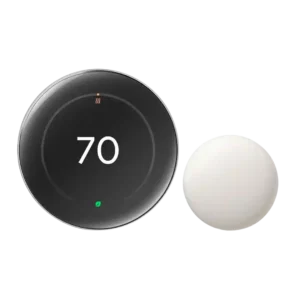
Choose it if you want a premium-looking thermostat with Matter, strong learning, room sensors, and polished controls. Skip it if the price, Google-account dependence, or occasional setup/presence-sensing hiccups outweigh the...
Pros: design and finish quality, display readability
Cons: touchscreen responsiveness
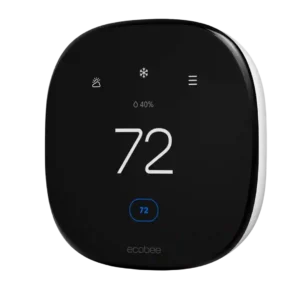
Good if you want an easy, clear smart thermostat with strong app, display, scheduling, and ecosystem support. Skip it if you need Premium-only sensors, built-in Alexa, air-quality monitoring, or deeper...
Pros: display readability, value for money
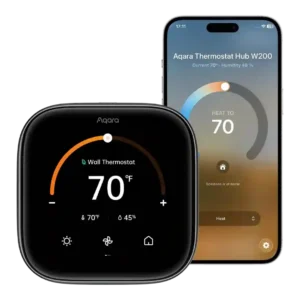
Choose the Aqara W200 if you want Apple Home-first climate automation, Matter hub extras, easy installation, and strong value. Skip it if you need advanced heat-pump controls, multi-sensor averaging, included...
Pros: smart-home ecosystem compatibility, occupancy detection accuracy
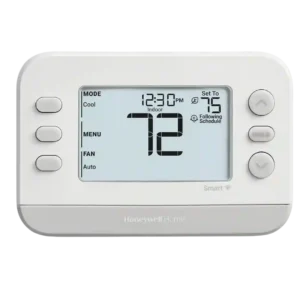
Best for affordable Wi-Fi control, easy installation, clear physical controls, and flexible scheduling. Skip it if you need room sensors, polished voice integrations, detailed energy analytics, quiet relay operation, or...
Pros: app usability, DIY installation ease
Cons: C-wire requirement flexibility, smart-home ecosystem compatibility