
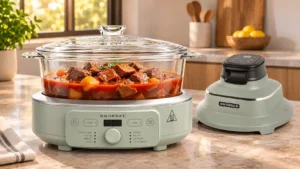
Chefman Multifunctional Air Fryer+ 10-Quart
Where It Has the Edge
- preset usefulness is 3.9 vs 3.0. Food-specific settings provide quick starting points, but preset temperatures and times sometimes need correction for thickness, load, or...

Scorata scores summarize analyzed review evidence on a 1–5 scale; they are not laboratory measurements or a simple average of customer star ratings. Feature scores summarize the reviews covering that feature. The overall score averages feature scores within each review, then combines review averages. When both expert and customer evidence are available, those two groups receive equal weight. Products can have different review coverage, so small score gaps do not establish a winner.
Recommendations prioritize important features for the category, with a score of at least 3.5, a gap of at least 0.25 points and at least two supporting reviews per product. Features with widely varying scores or broad connectivity contexts are excluded from recommendations. These safeguards do not establish statistical significance.
Quick verdict
The review evidence points to a tradeoff: preset usefulness versus footprint size and dishwasher-safe parts. Choose according to which strengths matter more to you; the overall score alone does not settle that choice.
Choose Chefman Multifunctional Air Fryer+ 10-Quart for preset usefulness.
Choose Magnifique Glass Air Fryer and Slow Cooker for footprint size and dishwasher-safe parts.
Scores are out of 5. Missing scores mean missing review evidence, not a missing feature.
Once familiar, the presets and automatic door pause simplify routine cooking. Fiddly racks, tipping, and occasional control quirks detract from the experience.
Simple buttons and visible food make many everyday steps approachable, but lifting a hot lid, juggling power cords and adjusting around preset temperatures add friction.
An all-surface PFAS-free claim is not documented for this version, leaving shoppers who prioritize that assurance without clear confirmation.
A materials-focused evaluation praises Magnifique for unusually detailed written disclosure of its food-contact components, rather than vague coating claims.
An owner specifically likes the timer, which adds convenience to routine meals and staged cooking.
The automatic grain modes do not show a clear time-to-finish countdown, making it difficult to judge when rice is done.
The substantial oven-shaped body is difficult to move around frequently or stash in a small cabinet, favoring a permanent counter position.
The separable units can tuck into drawers, while the glass bowl stores leftovers and the appliance saves cupboard space. Multiple lids can still clutter a counter.
Although it uses racks rather than a pull-out basket, the tall 9.8-quart cavity offers ample usable cooking area for several portions at once.
The 4.5-quart pot is smaller than some family-size slow cookers. Those preparing bigger meals may need a larger vessel.
One account appreciates its restrained beeps, while another finds the panel alerts loud and impossible to mute.
The cooking finish signal was difficult to hear or absent in two tests. That made it too easy to leave rice on the warming setting.
One unboxing finds the instructions straightforward, but another account says recipes and settings need more detailed explanation.
An early version of the instruction booklet offered scant guidance on water ratios and cooking times. The tester had to seek a recommended brown-rice ratio directly.
Guided presets offer a starting point, but detailed directions can fall short when adapting recipes or arranging several racks.
One early manual provided too little help with liquid ratios and cooking durations. That forces cooks to experiment or seek additional instructions.
Many cooks appreciate being able to start quickly, but independent testing found slower-than-average warm-up and one long-term owner prefers adding a brief preheat.
There is no dedicated air-fryer preheat mode, but a tester found it straightforward to run a short empty high-heat cycle manually.
Some owners would happily buy it again for its functions and size; other direct comparisons reject it because the racks and door are inconvenient or unsafe.
Most testers recommend the inventive, good-looking glass cooker for versatile meals, low-coating food contact and space savings. Fixed temperatures and fussy lid handling temper the enthusiasm.
Food-specific settings provide quick starting points, but preset temperatures and times sometimes need correction for thickness, load, or rack position.
Automatic grain programs can produce good results, yet their completion cues and remaining-time information are poor. Close monitoring helps avoid overcooked rice.
Removable racks, drip tray, and rotisserie pieces can go in the dishwasher. Several testers still needed substantial scrubbing for baked-on food.
The glass cooking vessel and lid wash in a dishwasher, and several testers value the reduced cleanup. A few also report that handwashing the glass is simple.
Automatic shutoff is welcome, but multiple hands-on tests report tipping when the door opens, and hot surfaces or sharp racks demand care.
The lid’s automatic shutoff reassures one cook, but another warns about sharp edges on the crisper insert. Handling hot, heavy glass still requires care.
Air frying, baking, dehydration, roasting, and rotisserie make the appliance more useful than a simple drawer fryer, though limited fan control prevents it from excelling at every method.
This is the central strength: air frying, slow cooking, steaming, braising, rice cooking and other programs share one glass pot. The flexibility is especially useful when replacing separate kitchen machines.
Wings, fries, and breaded foods often achieve appealing crunch; the main inconsistency is how much of an entire multi-rack batch reaches that texture.
Chicken skin, steak bites, tater tots and other foods developed appealing crusts in successful tests. The MaxCrisp setting is particularly good for potatoes, though some foods need turning.
Three wire racks, rotisserie hardware, retrieval tools, and a drip tray make the package flexible from the start, although some tools require care.
A video tester particularly likes the glass lid for refrigerating a prepared meal in the same vessel. Other included racks support the various cooking functions.
The handle and front housing can become uncomfortably hot, and tight ventilation clearances can worsen practical safety concerns.
The glass and removable air-fryer hood become hot during cooking. Testers advise making room for the heated lid and handling it carefully.
The interface presents many food-specific choices under three principal modes. Shoppers get convenient variety, even if the headline preset count overstates the number of distinct programs.
The dozen combined cooking modes are presented as a notable benefit, providing far more options than a single-purpose air fryer.
Many accounts like the crisp exterior achieved with little added oil, especially for breaded foods and potatoes.
One cook air-fried beef chunks without adding oil and was happy with the crust that developed.
Some fries and wings develop attractive color, but the upper rack often browns ahead of the lower racks and can overcook delicate food.
Top-exposed surfaces can brown before the undersides, and a few tofu pieces stayed softer than the rest. Stirring or turning improves the consistency.
Quick frozen snacks and weeknight meals are a strong point for many owners. However, controlled testing found the cooking pace merely adequate once slower preheating is included.
Chicken, potatoes and chickpeas finished quickly in several tests. The air-frying function can be considerably faster than using a conventional oven for small foods.
Low settings make dehydration viable, but the 400°F maximum and limited fan control restrict high-heat browning and certain alternate methods.
The air-fryer hood tops out at 450°F, which is ordinary for the category but can be restrictive for certain recipes.
The stacked-rack layout usually requires turning food individually or exchanging rack positions. Some simple fries turn out well untouched, but larger loads demand attention.
Results conflict by food and test: one cook found the crisper disk browned all around, but others got soggy chicken bottoms or uneven fries. Plan to turn or stir ingredients for dependable crispness.
Top-to-bottom consistency is a recurring weakness. For large loads, rotating racks halfway through helps prevent burned tops and pale or undercooked bottoms.
Results vary: a steak-bite test praised circulating heat, while chicken and fries cooked less evenly under the top heater. Turning or stirring is frequently needed.
Opening the door automatically stops the cooking cycle, and closing it resumes cooking without resetting the program.
Lifting the air-frying hood interrupts heating automatically, a useful safeguard and convenient way to check or turn food. The setting can be resumed afterward.
The 1700-watt draw calls for care when sharing an outlet with another high-power appliance, or the circuit may trip.
The top and bottom heaters use separate plugs and cannot be powered together. Reviewers find the arrangement inconvenient and warn against overloading the electrical outlet.
One favorable account credits the smaller heated cavity and short warm-up for using less energy than a full conventional oven on modest meals.
A concise pros-and-cons assessment singles out energy efficiency as an advantage, although it gives no measured electricity consumption.
Especially for chicken, several accounts describe a tender or juicy inside with a crisp, browned outside.
Successful meals featured juicy chicken under crisp skin, tender beef and well-cooked mushrooms and potatoes. The best textures depend on appropriate mode changes and attention.
Sharp, thin, or poorly finished rack wire is a repeated complaint, contrasting with favorable comments about the sturdier outer body.
The glass bowl and stainless-steel food-contact surfaces receive some of the strongest and most consistent praise. The uncoated construction is central to the product’s appeal.
The tower has a relatively narrow base for its capacity, yet its height, door clearance, and space needed around the vents can make it bulky in practice.
Despite two heating systems, the compact modular appliance takes relatively little counter space. It is smaller than many standalone appliances or a separate fryer-plus-slow-cooker setup.
Three roomy racks replace a pull-out basket, but several testers find them sharp, awkward to slide, and troublesome for flipping individual pieces.
The pot-and-hood arrangement lacks the pull-out basket that makes tossing fries quick and easy. Stopping to remove the lid is less convenient than shaking a drawer.
One long-term-focused comparison notes that Chefman sells replacement parts for the appliance, a useful advantage when accessories eventually wear.
One reviewer could not buy the glass bowl separately at the time of testing, limiting replacement or extra-vessel options.
The basic rack-and-door layout is approachable, but first-time rotisserie mounting may take a few tries to master.
The independently wrapped components were unpacked and ready for use within a few minutes, making initial setup straightforward.
For those using the rotisserie, rack capacity, and dehydration, it can replace several devices at an appealing price. Better-performing basket fryers challenge its value for frying alone.
Several reviewers think the multifunctional cooker offers good value compared with buying separate appliances. Its payoff is strongest for cooks who need both air-frying and slow-cooking functions.
Time and temperature can be changed manually, but touch-panel quirks and limited fan control reduce fine-tuning precision.
Fixed heat levels prevent users from dialing in arbitrary air-frying temperatures. That is a significant compromise for delicate dishes and recipes requiring specific settings.
The glossy black, compact tower design appeals visually, although some reports mention scratches on arrival.
The glass bowl and muted color options look stylish enough to display in a modern kitchen. Even a tester who preferred to stow appliances called this one better-looking than typical pod fryers.
Some users find the touchscreen straightforward and responsive, while hands-on comparisons describe fussy buttons and awkward temperature wraparound.
Button labels and slow-cooker controls are generally simple to follow. The air-frying hood feels restrictive, however, because its cooking temperatures cannot be set freely.
Illuminated selections help, but the low-positioned labels can be tricky to see, and some users would prefer time and temperature shown together.
The cooking screen omits actual air-frying temperature information, making it harder to see precisely what heat is being applied.
The fan is described as pleasantly restrained by some, but others find higher-temperature operation moderately noisy.
One video tester found the fan reasonably quiet at high speed, although not as quiet as the quietest air fryer they own.
Results range from acceptable to very good depending on food and loading. Controlled tests found too many underdone or overdone pieces to call the frying uniformly excellent.
Chicken, steak bites, tofu and frozen potatoes can come out well browned and appealingly crisp. Several tests still required turning food, especially for chicken breasts and thin fries.
The big glass door and interior light are standout strengths, allowing frequent progress checks without interrupting the cook.
The clear glass bowl lets cooks watch browning and doneness without removing the hood. Reviewers repeatedly call this a useful advantage over opaque baskets.
Reports of protective shutdowns and aging door hinges create uncertainty, balanced by a long-term owner whose fan and heat performance remained strong.
One buyer reports a trouble-free arrival, but other accounts mention scratched finishes or accessories that seem flimsy right out of the box.
The one-year limited warranty is considered ordinary for the price, but not generous for a frequently used appliance.
Removing the whole hot, fairly heavy hood to stir or flip food frustrates several cooks; a drawer-style basket is easier. One tester likes the built-in feet that let the removed hood rest on the counter.
Precise touch placement can be frustrating; two testers found that buttons do not always register unless tapped exactly right.
Lifting the air-fryer hood temporarily interrupts cooking without losing the remaining time, making the return to the recipe smoother.
Several hands-on tests describe the lightweight oven tipping forward when its door opens; holding the body steady becomes an unwelcome safety precaution.
The three racks all share one temperature and timer. There is no independent-zone coordination for two foods needing different schedules.
Its narrow fan-speed range limits gentle cooking and contributes to weaker frying and broiling flexibility compared with adjustable-fan rivals.
One test cooked wings and fries on separate racks without noticeable flavor transfer, even though these are racks rather than independent baskets.
The removable bottom drip tray collects juices and is generally easy to clean, though greasy food can leave deposits around the door hinge.
There is no established built-in probe feature for this version, so shoppers who require integrated doneness monitoring should look elsewhere.
The wire racks and cavity are hard to clean when food sticks, although the coated drip tray wipes down more easily. Claims about other nonstick surfaces are inconsistent.
A light-feeling, slightly loose door and reports of hinge wear make this part less reassuring than the main oven body.
One account reports neatly wrapped parts and a complete set of accessories ready to unpack.
The power lead was judged short by an owner during unboxing, restricting convenient counter placement.
The transparent glass vessel transitions from cooking to the dining table without needing a separate bowl. It can also hold the leftovers afterward.
This is the clearest recurring limitation: air-frying heat is tied to presets rather than being freely adjustable. More exacting cooks will miss selecting a precise temperature.
The main housing feels solid in some accounts, while criticism centers on thin racks, lighter door construction, and occasional fit problems.
Concerns include doors loosening, hinges wearing, and fragile-feeling accessories. One long-term owner reports excellent operation after nearly two years, so experiences vary.
The small door handle can become very hot, making oven mitts or a stabilizing hand necessary during cooking.
The removable door, drip tray, and dishwasher-safe pieces help, but sharp wire racks trap food and grease, making cleanup a major point of disagreement.
The smooth glass pot usually washes with little scrubbing and can go in the dishwasher. The uncoated surface can take a little more work than nonstick, and the metal insert needs care.
The fixed airflow makes lightweight items harder to manage during dehydrating than on fryers that can slow their fans substantially.
The rotating spit can deliver juicy, browned chicken and cuts of meat. Initial setup and strict size limits make it less foolproof than the feature list suggests.
The oven was measured about five degrees below its setting in one test and otherwise reasonably stable, although another account observed wider cycle swings.
A short pros list calls the appliance’s AI functions intuitive, but does not explain how those features behave in practice.

A roomy basket, crispy results, quiet fan, and easy cleanup make the TurboBlaze a versatile everyday choice. Inconsistent cooking on some foods, no shake reminder, and a single basket are...
Pros: crisping ability, cooking speed
Cons: Finish resistance to smudges, Shake reminder
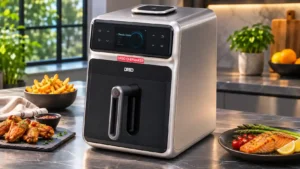
Its probe-guided, moisture-assisted programs can deliver remarkably juicy meat and fish with little guesswork. The premium cost, sometimes overenthusiastic manual heat, and single basket make it a specialist rather than...
Pros: food texture quality, app connectivity
Cons: basket capacity, temperature accuracy

The built-in meat probe, generous basket and easy cleaning make family roasts impressively convenient. Allow plenty of counter depth, and expect a few crisping and app-control compromises.
Pros: Meat thermometer convenience, basket capacity
Cons: footprint size, Setup simplicity
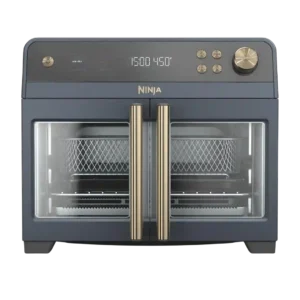
Best for fast, even air frying, family-sized capacity, and a genuinely useful mix of oven functions. Skip it if you need cool sides, effortless dishwasher cleanup, or independent two-level cooking.
Pros: ease of cleaning, ease of use
Cons: exterior heat management, dishwasher-safe parts