

Chefman Multifunctional Air Fryer+ 10-Quart
Where It Has the Edge
- visibility while cooking is 4.7 vs 2.0. The big glass door and interior light are standout strengths, allowing frequent progress checks without interrupting the cook.

Scorata scores summarize analyzed review evidence on a 1–5 scale; they are not laboratory measurements or a simple average of customer star ratings. Feature scores summarize the reviews covering that feature. The overall score averages feature scores within each review, then combines review averages. When both expert and customer evidence are available, those two groups receive equal weight. Products can have different review coverage, so small score gaps do not establish a winner.
Recommendations prioritize important features for the category, with a score of at least 3.5, a gap of at least 0.25 points and at least two supporting reviews per product. Features with widely varying scores or broad connectivity contexts are excluded from recommendations. These safeguards do not establish statistical significance.
Quick verdict
The review evidence points to a tradeoff: visibility while cooking versus handle comfort and control accessibility. Choose according to which strengths matter more to you; the overall score alone does not settle that choice.
Choose Chefman Multifunctional Air Fryer+ 10-Quart for visibility while cooking.
Choose Ninja Max XL AF161 for handle comfort and control accessibility.
Scores are out of 5. Missing scores mean missing review evidence, not a missing feature.
Once familiar, the presets and automatic door pause simplify routine cooking. Fiddly racks, tipping, and occasional control quirks detract from the experience.
The pull-out basket and uncomplicated functions make routine cooking approachable even for beginners. Getting exact times right takes a little practice.
Precise touch placement can be frustrating; two testers found that buttons do not always register unless tapped exactly right.
Readable digital controls and plainly labeled cooking modes are friendly to newcomers, including people unfamiliar with air fryers.
Its narrow fan-speed range limits gentle cooking and contributes to weaker frying and broiling flexibility compared with adjustable-fan rivals.
Its broad fan-speed range supports both intense crisping and gentler dehydrating, though preset modes control much of that variation.
Guided presets offer a starting point, but detailed directions can fall short when adapting recipes or arranging several racks.
The recipe guide and quick-start instructions help with initial settings, although cooks may still need to adjust times and shake food for even browning.
Opening the door automatically stops the cooking cycle, and closing it resumes cooking without resetting the program.
A manual pause button is useful for checking food, but simply removing the drawer may leave the timer running, and shutdown behavior can frustrate batch cooks.
An all-surface PFAS-free claim is not documented for this version, leaving shoppers who prioritize that assurance without clear confirmation.
The ceramic basket is promoted as free of conventional PTFE materials, making the surface choice easier to understand.
Top-to-bottom consistency is a recurring weakness. For large loads, rotating racks halfway through helps prevent burned tops and pale or undercooked bottoms.
Wings, fries and vegetables frequently cook uniformly when spaced out. Crowding the deep basket or skipping a shake can leave unevenly browned pieces.
The substantial oven-shaped body is difficult to move around frequently or stash in a small cabinet, favoring a permanent counter position.
The relatively lightweight upright body is movable, but its height and short cord can complicate placement under cabinets.
Low settings make dehydration viable, but the 400°F maximum and limited fan control restrict high-heat browning and certain alternate methods.
A 450°F ceiling is a significant advantage for frozen foods, while lower settings enable gentler cooking and dehydrating.
The wire racks and cavity are hard to clean when food sticks, although the coated drip tray wipes down more easily. Claims about other nonstick surfaces are inconsistent.
The ceramic-coated basket usually releases stuck-on food easily. Scratches and coating wear are possible with heavy use or harsh tools.
One unboxing finds the instructions straightforward, but another account says recipes and settings need more detailed explanation.
The owner’s guide earns praise for clear buttons, recipes and cooking charts. Advice about shaking and high-heat timing is not always sufficient.
The handle and front housing can become uncomfortably hot, and tight ventilation clearances can worsen practical safety concerns.
The housing can feel warm and hot air exits through the vents, so clearance around the fryer remains important.
Although it uses racks rather than a pull-out basket, the tall 9.8-quart cavity offers ample usable cooking area for several portions at once.
Although labeled 5.5 quarts, the deep circular basket offers less usable single-layer space than many square competitors. It suits modest portions better than big family batches.
One account appreciates its restrained beeps, while another finds the panel alerts loud and impossible to mute.
The single beep is less repetitive than some competitors but still irritating to at least one regular user.
Several hands-on tests describe the lightweight oven tipping forward when its door opens; holding the body steady becomes an unwelcome safety precaution.
The feet can lose traction on smooth countertops after extended use, so a stable placement matters.
One account reports neatly wrapped parts and a complete set of accessories ready to unpack.
Sturdy packaging keeps the initial unboxing orderly.
Some fries and wings develop attractive color, but the upper rack often browns ahead of the lower racks and can overcook delicate food.
Its powerful airflow can give food an attractive golden finish, but the hottest preset occasionally burns patches while lower settings sometimes underbrown fries.
Some owners would happily buy it again for its functions and size; other direct comparisons reject it because the racks and door are inconvenient or unsafe.
Most assessments are highly favorable, especially from regular users who prize speed and convenience. Reservations center on the older round-basket design and price versus newer models.
Many cooks appreciate being able to start quickly, but independent testing found slower-than-average warm-up and one long-term owner prefers adding a brief preheat.
A short warm-up, often around two or three minutes, makes spur-of-the-moment meals easy; several cooks skip preheating for routine foods.
Food-specific settings provide quick starting points, but preset temperatures and times sometimes need correction for thickness, load, or rack position.
Max Crisp is a standout shortcut for frozen foods, with other labeled modes simplifying everyday settings. Its high fixed temperature is not ideal for every ingredient.
The stacked-rack layout usually requires turning food individually or exchanging rack positions. Some simple fries turn out well untouched, but larger loads demand attention.
Small or loosely spaced foods can cook evenly without constant turning, but full batches often need shaking for uniform browning.
Removable racks, drip tray, and rotisserie pieces can go in the dishwasher. Several testers still needed substantial scrubbing for baked-on food.
Both the basket and crisper plate can go in a dishwasher, a practical perk for frequent use. Gentle hand-washing may prolong the coating.
The removable bottom drip tray collects juices and is generally easy to clean, though greasy food can leave deposits around the door hinge.
The raised crisper plate lets fat collect below food, reducing splatter. Pouring out a batch can still spill pooled grease or dislodge the insert.
Three wire racks, rotisserie hardware, retrieval tools, and a drip tray make the package flexible from the start, although some tools require care.
The included crisper plate, recipe booklet and, in some accounts, broiling rack are handy. Additional stacking accessories may cost extra.
Air frying, baking, dehydration, roasting, and rotisserie make the appliance more useful than a simple drawer fryer, though limited fan control prevents it from excelling at every method.
Seven modes cover air frying, roasting, broiling, reheating, baking and dehydrating. The single round basket limits larger dishes and simultaneous cooking.
An owner specifically likes the timer, which adds convenience to routine meals and staged cooking.
A visible countdown, sometimes to the second, makes cooking duration easy to follow and adjust.
The interface presents many food-specific choices under three principal modes. Shoppers get convenient variety, even if the headline preset count overstates the number of distinct programs.
Seven distinct programs add more flexibility than a basic air fryer, including roast, broil, bake, reheat and dehydrate.
Wings, fries, and breaded foods often achieve appealing crunch; the main inconsistency is how much of an entire multi-rack batch reaches that texture.
The 450°F Max Crisp mode produces particularly crunchy fries, wings and frozen snacks. It can also overbrown delicate food or thinner pieces if left unchecked.
Quick frozen snacks and weeknight meals are a strong point for many owners. However, controlled testing found the cooking pace merely adequate once slower preheating is included.
Quick heat-up and short cooking times make this a useful alternative to firing up a full oven. Some lower-temperature or fresh-fries tests needed extra minutes.
Especially for chicken, several accounts describe a tender or juicy inside with a crisp, browned outside.
Strong crisp exteriors usually come with moist chicken, fluffy fries and tender vegetables. Max Crisp can dry or overbrown smaller items if used too long.
The 1700-watt draw calls for care when sharing an outlet with another high-power appliance, or the circuit may trip.
Its 120V configuration complicates use in 220V regions without appropriate power conversion.
One favorable account credits the smaller heated cavity and short warm-up for using less energy than a full conventional oven on modest meals.
Fast, compact cooking can use less energy than heating a full electric oven for the same meal.
Many accounts like the crisp exterior achieved with little added oil, especially for breaded foods and potatoes.
Fries and wings develop crunchy exteriors with very little added oil, offering the familiar fried texture without deep-frying.
The power lead was judged short by an owner during unboxing, restricting convenient counter placement.
The roughly 2.6-foot cord restricts where the fryer can sit, especially in kitchens with distant outlets.
Reports of protective shutdowns and aging door hinges create uncertainty, balanced by a long-term owner whose fan and heat performance remained strong.
Long-term owners frequently report consistent cooking over months or years of use, making the core appliance feel dependable.
The basic rack-and-door layout is approachable, but first-time rotisserie mounting may take a few tries to master.
Getting started is largely a matter of unpacking, rinsing the parts and selecting a program; even first-time owners can begin quickly.
One long-term-focused comparison notes that Chefman sells replacement parts for the appliance, a useful advantage when accessories eventually wear.
Replacement plates, baskets and optional racks can be obtained separately, helping extend usefulness and adjust capacity.
The one-year limited warranty is considered ordinary for the price, but not generous for a frequently used appliance.
The one-year limited warranty provides baseline protection, though the term itself is not unusually generous.
For those using the rotisserie, rack capacity, and dehydration, it can replace several devices at an appealing price. Better-performing basket fryers challenge its value for frying alone.
At a steep discount, its crisping and versatility are compelling. At full price, newer square-basket alternatives can be better buys.
The small door handle can become very hot, making oven mitts or a stabilizing hand necessary during cooking.
A grippy, easy-to-hold handle helps with shaking and checking food, and it generally stays comfortable while cooking.
The tower has a relatively narrow base for its capacity, yet its height, door clearance, and space needed around the vents can make it bulky in practice.
The upright, relatively narrow body saves counter width compared with many big air fryers. Its depth and height still need measuring in tighter kitchens.
Three roomy racks replace a pull-out basket, but several testers find them sharp, awkward to slide, and troublesome for flipping individual pieces.
The drawer is easy to pull out and its flat crisper plate keeps food above drippings. The round base wastes usable area, and some find the insert insecure or its openings too large.
Concerns include doors loosening, hinges wearing, and fragile-feeling accessories. One long-term owner reports excellent operation after nearly two years, so experiences vary.
Regular users report years of dependable operation, while the ceramic lining and decorative finish can scratch, wear or flake over time.
Sharp, thin, or poorly finished rack wire is a repeated complaint, contrasting with favorable comments about the sturdier outer body.
The ceramic cooking surface is useful, but the plastic housing and silver-coated trim feel less substantial than stainless alternatives.
The main housing feels solid in some accounts, while criticism centers on thin racks, lighter door construction, and occasional fit problems.
The drawer generally slides smoothly and the appliance feels sturdy, although the plastic body and trim fall short of a premium metal finish.
The big glass door and interior light are standout strengths, allowing frequent progress checks without interrupting the cook.
There is no viewing window, so checking browning means pulling out the basket instead of watching food cook.
Illuminated selections help, but the low-positioned labels can be tricky to see, and some users would prefer time and temperature shown together.
Clear, visible cooking settings make it easy to check time and temperature while standing at the counter.
Results range from acceptable to very good depending on food and loading. Controlled tests found too many underdone or overdone pieces to call the frying uniformly excellent.
Hot-air frying is the main attraction: fries, wings and breaded foods often emerge crisp and well cooked. High settings demand some monitoring.
The fixed airflow makes lightweight items harder to manage during dehydrating than on fryers that can slow their fans substantially.
Strong airflow can curl thin bacon or lift unweighted liners, making light foods harder to keep in place.
The fan is described as pleasantly restrained by some, but others find higher-temperature operation moderately noisy.
The fan is noticeable and sometimes described as loud, around the mid-60-decibel range. Others find it tolerable or fairly quiet.
The oven was measured about five degrees below its setting in one test and otherwise reasonably stable, although another account observed wider cycle swings.
The heating system delivers strong temperatures, but some meals cook hotter than expected, especially in Max Crisp mode. Recipe temperatures may need adjustment.
Some users find the touchscreen straightforward and responsive, while hands-on comparisons describe fussy buttons and awkward temperature wraparound.
Large labeled buttons and a direct time-and-temperature interface are easy to operate. A minority found touch responsiveness or the fixed Max Crisp setting less convenient.
The glossy black, compact tower design appeals visually, although some reports mention scratches on arrival.
Some like the sleek gray gloss and rounded body; others find the old-fashioned shape and silver trim dated compared with newer designs.
Time and temperature can be changed manually, but touch-panel quirks and limited fan control reduce fine-tuning precision.
Most cooking modes allow straightforward time and temperature adjustments, but Max Crisp locks the heat at 450°F, limiting fine control.
Perforated parchment or a suitable silicone liner can make cleanup easier, provided airflow stays clear and paper is weighed down.
Package directions and default presets may run too long, especially at 450°F. Check early until familiar with the basket and food size.
The three racks all share one temperature and timer. There is no independent-zone coordination for two foods needing different schedules.
The glossy body wipes clean, but water streaks and marks stand out more than on matte finishes.
One test cooked wings and fries on separate racks without noticeable flavor transfer, even though these are racks rather than independent baskets.
The powerful heater and fan achieve rapid browning and short cooking cycles. High heat calls for attention with delicate foods.
There is no established built-in probe feature for this version, so shoppers who require integrated doneness monitoring should look elsewhere.
A temporary new-plastic smell is among the reported early-use annoyances; it is not described as an ongoing issue by most long-term accounts.
A light-feeling, slightly loose door and reports of hinge wear make this part less reassuring than the main oven body.
Mostly cardboard packing makes disposal through recycling more convenient.
Automatic shutoff is welcome, but multiple hands-on tests report tipping when the door opens, and hot surfaces or sharp racks demand care.
A missing halfway reminder means cooks must remember to shake or turn food themselves.
The cooking temperature stays comparatively steady, making recipes more predictable than with less consistent rivals.
The most intense mode can overbrown food if left alone, so checking earlier than the suggested time is wise.
One buyer reports a trouble-free arrival, but other accounts mention scratched finishes or accessories that seem flimsy right out of the box.
The removable door, drip tray, and dishwasher-safe pieces help, but sharp wire racks trap food and grease, making cleanup a major point of disagreement.
The smooth nonstick drawer and removable plate make cleanup generally quick; stubborn residue and coating care are the main caveats.
The rotating spit can deliver juicy, browned chicken and cuts of meat. Initial setup and strict size limits make it less foolproof than the feature list suggests.

A roomy basket, crispy results, quiet fan, and easy cleanup make the TurboBlaze a versatile everyday choice. Inconsistent cooking on some foods, no shake reminder, and a single basket are...
Pros: crisping ability, cooking speed
Cons: Finish resistance to smudges, Shake reminder
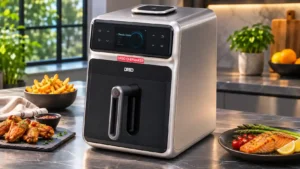
Its probe-guided, moisture-assisted programs can deliver remarkably juicy meat and fish with little guesswork. The premium cost, sometimes overenthusiastic manual heat, and single basket make it a specialist rather than...
Pros: food texture quality, app connectivity
Cons: basket capacity, temperature accuracy
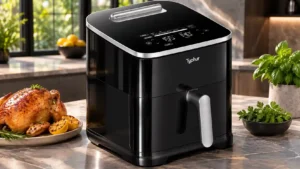
The built-in meat probe, generous basket and easy cleaning make family roasts impressively convenient. Allow plenty of counter depth, and expect a few crisping and app-control compromises.
Pros: Meat thermometer convenience, basket capacity
Cons: footprint size, Setup simplicity
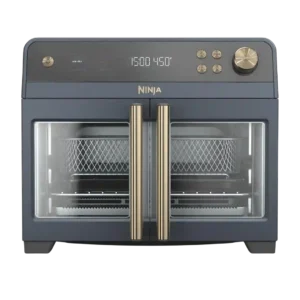
Best for fast, even air frying, family-sized capacity, and a genuinely useful mix of oven functions. Skip it if you need cool sides, effortless dishwasher cleanup, or independent two-level cooking.
Pros: ease of cleaning, ease of use
Cons: exterior heat management, dishwasher-safe parts