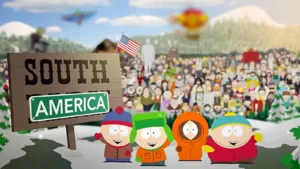

South Park, Season 29
Where It Has the Edge
- franchise connection is 4.8 vs 4.5. Reviewers repeatedly describe the premiere as a return to form that reconnects with classic South Park: the boys...

Scorata scores summarize analyzed review evidence on a 1–5 scale; they are not laboratory measurements or a simple average of customer star ratings. Feature scores summarize the reviews covering that feature. The overall score averages feature scores within each review, then combines review averages. When both expert and customer evidence are available, those two groups receive equal weight. Products can have different review coverage, so small score gaps do not establish a winner.
Recommendations prioritize important features for the category, with a score of at least 3.5, a gap of at least 0.25 points and at least two supporting reviews per product. Features with widely varying scores or broad connectivity contexts are excluded from recommendations. These safeguards do not establish statistical significance.
Quick verdict
The review evidence points to a tradeoff: franchise connection versus renewal interest and entertainment value. Choose according to which strengths matter more to you; the overall score alone does not settle that choice.
Choose South Park, Season 29 for franchise connection.
Choose It’s Always Sunny in Philadelphia, Season 18 for renewal interest and entertainment value.
Scores are out of 5. Missing scores mean missing review evidence, not a missing feature.
One reviewer objects to the stereotyped Chinese-accent jokes, questioning whether their shock value is worth the tradeoff.
The show’s harsh satire is praised for exposing cruelty and social ugliness rather than presenting the Gang’s behavior as admirable.
The return to a six-episode season disappointed the one reviewer who addressed the length directly, especially after expecting a longer run.
The ten-episode run is welcomed as a useful expansion after several shorter seasons and gives the show more room to play.
Most reviewers love putting Stan, Kyle, Cartman, and Kenny back at the center while letting Randy support rather than dominate. One dissenting review still felt immediate Randy fatigue.
One review felt the early episodes juggle too many separate schemes at once, which pulls focus from the Bonnie tribute and leaves subplots rushed.
The disguised-Kenny reveal split reviewers: some were genuinely fooled and delighted, while others said they knew who the masked rider was immediately and found the payoff predictable.
The Renaissance Faire episode is praised for taking unexpected turns and landing as a genuine surprise.
The Cartman-Liane dynamic is praised for reflecting how their relationship has evolved over the years rather than simply resetting to an older version.
Callbacks and returning history are often rewarding and accessible, but several reviewers think Season 18 leans on past episodes a little too heavily.
Most reviewers see a strong, character-led story that uses e-bikes and local chaos to carry the satire. One reviewer found the result merely okay and wanted more comedic impact.
Story quality varies sharply by episode: the strongest entries are called series-level standouts, while weaker ones are criticized as contrived, under-executed, or simply less engaging.
One reviewer specifically appreciated the premiere’s calmer, back-to-basics tone, finding it fitting after the more exhausting political focus of recent seasons.
Season 18 stays confidently filthy, dark, and emotionally abrasive, and reviewers generally see that commitment as a strength rather than late-series desperation.
The boys-first, mostly standalone construction is one of the premiere’s most praised choices. Even a lukewarm reviewer liked the back-to-basics format.
Splitting the Gang into competing combinations remains a winning Sunny structure, though one later recap found only the Mac-and-Charlie branch of its episode engaging.
Mike Judge’s return for Kenny drew strong approval, with the reviewer hoping the choice becomes permanent.
Carol Kane is singled out as a particularly strong addition, matching Danny DeVito’s eccentric energy without simply duplicating Frank.
Interest in the rest of the season is high, with multiple reviewers saying they are excited or cannot wait to see what comes next. Even the most lukewarm review remains curious about the direction.
The strongest reviews explicitly want the series to keep going, arguing that the Gang still has enough comic life left for more seasons.
Reviewers repeatedly describe the premiere as a return to form that reconnects with classic South Park: the boys are central, familiar character rhythms are back, and old running gags matter again.
Returning characters and callbacks often delight longtime fans, especially the McPoyles, but the broader season sometimes relies on that history more than reviewers would like.
Cartman’s manipulation and warped logic feel recognizably classic, while Randy’s sudden cycling obsession is repeatedly described as exactly the kind of fixation he would develop.
Reviewers repeatedly praise how firmly Season 18 understands the Gang’s established personalities, even when the world around them changes.
Reviewers liked small signs of growth within familiar dynamics, including Cartman using a softer manipulation tactic with Liane and Stan buying bikes for his friends.
The season finds fresh facets in familiar characters without fundamentally reforming them, a balance one reviewer considered a creative strength.
Several reviewers praise the layered metaphor and social commentary, especially the way the rename and e-bike conflict open into broader ideas. Others call the political metaphor vague or the deeper reading messy.
The better episodes use mortality, nostalgia, and social change for more than jokes, while A Virtual Insanity is criticized for raising issues without developing them deeply enough.
The strongest consensus is that the premiere handles politics better by keeping the satire metaphorical and woven into a local story. A few reviewers still warn that the South America gag could grow stale or feel vague.
Season 18 often uses current issues effectively, especially workplace change and nostalgia, but the homelessness-focused episode is criticized for stopping at fairly basic commentary.
Kenny’s death lands with more weight than the old recurring gag, helped by the other boys visibly grieving and the episode treating the loss as consequential.
The Bonnie tribute and other moments of attachment add genuine feeling, with several reviewers impressed that the show can be moving without becoming sentimental.
Most reviewers laughed at the classic character comedy, misdirects, and subtler satire. One strong dissent found the same jokes repeated too often and said they only chuckled a couple of times.
The broad consensus is that Season 18 is still very funny, but the hit rate varies by episode; some critics see near-classic comedy while others find more predictable chuckles and a few weaker outings.
Reviewers mostly praise the writing for balancing character comedy, topical ideas, and subtle commentary. The clearest negative says the central joke repeats too often and makes the episode feel underwritten.
The writing remains strong when it trusts character dynamics and sharp satire, but weaker episodes are faulted for contrivance, repetition, or ideas that are better than their execution.
The main pacing complaint is concentrated at the end: one review says the climax feels rushed and unsatisfying despite liking the overall approach.
The early tribute episodes can feel rushed when too many Mac, Dennis, Dee, and Bonnie-related threads compete for limited time.
One reviewer disliked Kenny’s unusually clear voice in an early scene, calling it a minor nitpick rather than a major flaw.
The core cast is still viewed as a major strength, with reviewers praising how completely the performers inhabit characters they have played for decades.
Mike Judge’s return to voice Kenny was received enthusiastically, with the reviewer hoping his contribution continues beyond the premiere.
The core ensemble remains one of the season’s safest strengths, with reviewers praising their command of tiny reactions, bickering rhythms, and decades-old character dynamics.
Cartman remains endlessly watchable for one reviewer, while another still calls Randy a great character even while tiring of how often he drives the plot.
The Gang remains intentionally awful, yet one reviewer says their monstrous codependence is still exactly why viewers cannot get enough of them.
Coverage describes strong anticipation around the return and treats reaching a 29th season as an impressive sign of the show’s enduring pull.
Longtime fans have little reason to leave, and early verified audience response was strongly positive even as the show remains deliberately abrasive.
Most reviewers found the premiere highly enjoyable and repeatedly called it a strong or brilliant return. The main outlier found it only 'mostly okay,' while the new intro itself was warmly received.
Even more cautious reviews still find plenty to enjoy, while stronger notices call individual episodes surprising, delightful, or immediately attention-grabbing.
The new intro’s cardboard-like look earned enthusiastic praise for preserving the handmade visual identity associated with classic South Park.
Sunny’s usual grim look still fits, while the Gilligan’s Island episode stands out for a more overtly playful and innovative visual homage.
The South America rename works as more than surface branding: one reviewer praised how it changes the town’s logic and directly affects how the story unfolds.
Paddy’s Pub and the surrounding Philadelphia neighborhood still feel like lived-in places, which helps even absurd plots stay anchored in the show’s familiar world.
Season 18’s satire is praised for refusing to vindicate the Gang’s cruelty, keeping their worst impulses framed as the target rather than the lesson.
The deliberately simple animation is part of the joke again, with reviewers praising small physical gags like Cartman waddling and the cyclists’ movement.
Short episodes and familiar character dynamics make the season easy to move through quickly, especially for viewers already invested in the larger series.
The Gang’s chemistry remains one of the season’s clearest strengths, particularly when the cast is split into smaller pairings that sharpen their dysfunctional dynamics.
The season keeps Sunny’s grim, functional visual language, which one reviewer considers a perfect fit rather than something that needs glossy reinvention.
The Chinese-accent material drew a clear complaint, with one reviewer questioning whether those gags are too hacky to be worthwhile.
The dialogue-heavy ACL episode is praised for turning insular bickering, movie-watching rules, and recurring sarcasm into a particularly funny set piece.
Heath Cullens is praised for helping the Gilligan’s Island episode land as a clever, visually committed tribute rather than a simple reference.
The season finds sincere emotion in Bonnie’s memorial material without abandoning Sunny’s grotesque comic tone.
Cutaways, held reaction shots, and comic timing are described as crucial to how the show still extracts laughs from familiar characters.
The roughly 22-minute format is usually a strength for quick viewing, though one reviewer felt a crowded episode did not give a promising joke enough room.
For viewers who want Sunny at its darkest and most depraved, Season 18 delivers exactly that blend of black comedy, discomfort, and absurdity.
Long-running relationship history makes many jokes richer, though the Cricket material in one episode is criticized for adding little to his established lore.
Originality is the season’s most persistent tradeoff: several episodes find fresh comic angles, while the heavy callbacks and familiar character beats can make other stories feel recycled.
Philadelphia-specific details such as the Mummers Parade help the city feel inhabited rather than like a generic sitcom backdrop.
The announced every-other-week rollout is viewed as more consistent and reassuring than the prior year’s scattershot release pattern.
Frank and Sam’s relationship is valued for giving Frank moments of genuine attachment while still allowing the show to destroy sentiment in characteristically Sunny fashion.
The South America-era score adds a regional musical influence that one reviewer found especially funny and effective.
The Renaissance Faire episode pushes Dennis’s sexual material close to the reviewer’s comfort limit, making this one area where the darkness can feel excessive.
The Gilligan’s Island homage earns praise for recreating the classic-show look through the main cast’s costumes.
Early critical reception is exceptionally strong, with multiple articles highlighting a perfect Rotten Tomatoes score and broadly positive notices.
Two reviewers see unusually strong staying power: one argues the episode should still work years after its topical context fades, while another had already watched it several times.
The lone value-focused reviewer felt the episode was not strong enough to justify paying for an additional subscription just to watch it earlier.
The closing country song is praised as catchy or simply a nice fit, while reactions to the re-recorded intro vocal are more mixed and include complaints that it sounds off.
Returning and guest performers are a bright spot, with particular praise for Guillermo Del Toro’s Pappy and the McPoyle material.

Best for sharp adult humor, magnetic chemistry and a deeply satisfying farewell. Skip it if familiar will-they-won’t-they plotting or deliberately messy leads are dealbreakers.
Pros: humor, writing quality

Choose Widow’s Bay for its dark laughs, richly haunted island and memorable ensemble. Skip it if you need straightforward scares, rapid answers to every mystery or a completely resolved finale.
Pros: humor, genre satisfaction
Cons: ending satisfaction, season pacing

Choose Season 15 for warm, character-driven comedy, meaningful growth, and a finale that rewards longtime fans. Skip it if the short binge format, uneven replacement voices, or occasional clumsy commentary...
Pros: franchise connection, character development

Best for sharply acted, compassionate, high-pressure hospital drama. Skip it if graphic procedures unsettle you or you need a neatly resolved season finale.
Pros: character development, acting performance
Cons: character consistency, dialogue quality