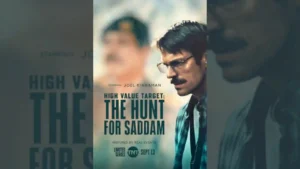

High Value Target: The Hunt For Saddam
Where It Has the Edge
- period authenticity is 4.6 vs 2.5. Archival footage, production details, and recreations often make the early-2000s setting feel convincing. Even reviews skeptical of narrative...

Scorata scores summarize analyzed review evidence on a 1–5 scale; they are not laboratory measurements or a simple average of customer star ratings. Feature scores summarize the reviews covering that feature. The overall score averages feature scores within each review, then combines review averages. When both expert and customer evidence are available, those two groups receive equal weight. Products can have different review coverage, so small score gaps do not establish a winner.
Recommendations prioritize important features for the category, with a score of at least 3.5, a gap of at least 0.25 points and at least two supporting reviews per product. Features with widely varying scores or broad connectivity contexts are excluded from recommendations. These safeguards do not establish statistical significance.
Quick verdict
The review evidence points to a tradeoff: period authenticity versus series finale quality and acting performance. Choose according to which strengths matter more to you; the overall score alone does not settle that choice.
Choose High Value Target: The Hunt For Saddam for period authenticity.
Choose A Tale of Two Cities for series finale quality and acting performance.
Scores are out of 5. Missing scores mean missing review evidence, not a missing feature.
The ending is a major weakness in the harshest reviews, with one calling a final scene truly awful and another saying investment in the characters has evaporated by the last episode.
The ending earns emphatic approval from the reviewer who praises the series for building to an excellent climax.
Hair and makeup are praised for quietly reinforcing period authenticity and differentiating characters without calling attention to themselves.
A beard and wig on Dr. Manette receive unusually blunt criticism and stand out as a weak visual detail.
Because this is a limited series, the final episode also functions as the series ending, and the strongest reactions are negative. Critics fault both the climactic scene and the loss of emotional investment.
The climax is a major bright spot across several sources, described as excellent, superb, convincing, and moving.
The Nixon-Hussein dynamic is widely treated as the show’s best material, with the interrogations producing tension, intelligence, and psychological friction. Even more critical reviews often come alive when Kinnaman and Zuaiter share the screen.
One strongly negative review finds the romantic chemistry among Mack, Civil, and Harington wholly lacking.
Archival footage, production details, and recreations often make the early-2000s setting feel convincing. Even reviews skeptical of narrative accuracy can still praise the physical period texture.
Period authenticity is a recurring caveat: one review questions the costuming, and another says the fast-moving romance feels disconnected from the era.
Character writing draws mixed-to-negative reactions outside the central arc. Some reviews call supporting figures one-dimensional or underdeveloped, though a more favorable review praises the writing for balancing exposition with development.
Lucie's expanded agency and Sydney's richer arc earn repeated praise, though one harsh review finds the characterizations thin and another notes some relationships and arcs remain underdeveloped.
The interrogation material is generally treated as close to the spirit of Nixon’s account, but the capture storyline draws significant criticism for enlarging his historical role. Fidelity is strongest in the conversations and weakest in the action-hero embellishment.
The adaptation takes substantial liberties, but favorable reviewers argue that the changes mostly improve the material while preserving Dickens at the core. Another calls it both a new take and a faithful love letter.
One review finds the first episode especially clumsy, citing repetitive characterization around Nixon’s insistence that he knows Saddam better than anyone.
The premiere is generally seen as promising but imperfect: two reviews call the beginning good, while another finds the first episode somewhat ponderous.
Saddam is presented with more complexity than a simple monster, and reviewers generally value that choice when it does not excuse his atrocities. Zuaiter’s authority and unpredictability make the character a major dramatic draw.
Madame Defarge is a point of disagreement: one review finds her a compelling, understandable antagonist, while another says her cause is reduced to mechanical plot function.
The structure fares better when episodes track Nixon’s changing perspective or build toward a raid. One negative review argues that many episodes could be removed without hurting the story.
The simultaneous presentation of plotlines was praised for adding momentum compared with the novel's more sequential structure.
Emotional impact varies widely. Some scenes, especially around Iraqi loss and the Nixon family, are called moving or powerful, while other critics find pivotal moments surprisingly underwhelming.
Sydney's late arc lands strongly for one critic, who describes the payoff as more convincing and moving because of his earlier cynicism.
As a reflective political drama, the series often works better than expected; as a thriller, it frequently disappoints. Viewers seeking analysis and interrogation drama are more likely to connect with it than those expecting relentless suspense.
Period-drama fans receive a generally favorable signal: one critic calls it a very good historical drama, and another considers it well worth seeing for genre viewers.
Suspense is one of the biggest divides. The interrogation scenes can create strong tension through conversation, but multiple critics say the broader manhunt never generates pressure equal to the historical stakes.
The Alexandre Manette mystery is specifically cited as a reason to keep watching after the first episode.
The eight-episode length is a recurring concern. Several critics think the story could have worked better as a feature or with substantial cuts.
The four-episode format feels too short to one reviewer, who wishes important later developments had another episode to breathe.
The season often takes too long to reach its best material and can feel padded by repetitive action or supporting threads. A few reviewers nevertheless praise the later momentum once the interrogations take over.
The four-part run can feel compressed: one review described a hard sprint through the romance that leaves some groundwork thin.
The show works best once the interrogations begin, where several critics find genuine dramatic power. Others feel the broader series repeatedly falls short as drama despite strong political ideas.
One review calls the series a very good historical drama, highlighting the production's success within the genre.
Dialogue is highly inconsistent. The interrogation exchanges are praised as insightful and nuanced, but exposition-heavy conference-room scenes and some later lines are criticized as clumsy, blunt, or unnatural.
One critic objects to the adaptation's stagy exchanges, making dialogue a specific weakness in that review.
Early episodes are a frequent complaint, with multiple critics saying the series takes too long to reach its strongest material. More favorable reviews find the later interrogation rhythm and episode construction effective.
Pacing is one of the sharpest divides. Some critics found the episodes excellent and fast-moving, while others thought the opener ponderous, later developments rushed, or individual beats too crowded to land.
The screenplay is strongest in the interrogation room and weakest when it turns explanatory. Repeated complaints include heavy-handed exposition, contrivance, blunt political messaging, and thin secondary characters.
Daniel West's adaptation writing receives strong praise from one reviewer for preserving Dickens while making effective enhancements.
One strongly positive review praises the confident visual language as a good fit for a politically charged thriller.
Evocative framing and naturalistic lighting are singled out as major visual strengths.
Direction receives opposite reactions: one critic calls it generally uninspired and faults bland action staging, while another praises Greif’s assured handling of visual language, tension, and atmosphere.
Direction receives both praise for cinematic polish and criticism for choppy construction that fails to build emotional or geographical momentum.
The series earns substantial credit for examining intelligence failures, political certainty, civilian consequences, and the difference between removing a dictator and understanding a country. Some critics think those ideas are repeated too bluntly.
The adaptation's themes are praised as remaining relevant and timely despite the age of the source material.
Critics generally see the series as deliberately reflective about U.S. policy, intelligence certainty, and the long consequences of the Iraq War. Some praise that perspective as nuanced, while one critic finds the framing close to jingoistic.
Modernization is central to the response. Several reviewers praise the updated relevance and stronger female agency, while one critic thinks the revolutionary context is oversimplified.
The core story is considered inherently compelling, particularly once Nixon meets Saddam, but opinions diverge on execution. Praise for a fresh, thoughtful historical angle sits alongside complaints of blandness, padding, and over-ambition.
Several reviewers found the adaptation engaging and well told, but others called it slow to reward patience or a bland disappointment. The core Dickens story still earns credit even from some of the harsher takes.
Rooms, offices, military sites, and interrogation spaces are praised for contributing to atmosphere and making the historical setting feel credible.
Art design, sets, and period detail win strong praise in several reviews, but two critics find the environments artificial, overly manicured, or too similar between London and Paris.
A favorable review credits the visual details, military locations, offices, and interrogation rooms with transporting viewers into Nixon’s investigative world.
World-building ranges from excellent class contrast and a convincing revolutionary atmosphere to criticism that London and Paris look interchangeable. The setting works for some reviewers but feels stage-bound to others.
The costumes are praised for reflecting professional roles, military environments, personal circumstances, and the early-2000s setting without feeling showy.
Costumes are generally admired as beautiful and elegant, though one reviewer questions whether they always look right for the period.
Visual execution receives mixed reactions: conflict staging is called flat and forgettable by one critic, while another praises the confident visual language and historical atmosphere.
The show's look is divisive: some see richness and elegance, while others complain about murky darkness or an artificial period-drama sheen.
Reaction to individual characters is mixed. Nixon can be hard to sympathize with in the early going, while the Jerry character drew specific praise from the real John Nixon.
Sydney immediately fascinates one reviewer, while Charles is also described as interesting despite having less emotional space early on.
Several critics think the leads and political intrigue can keep viewers invested, especially those drawn to reflective historical drama. The appeal is narrower for viewers expecting a consistently propulsive manhunt.
Appeal is contested: one source points to strong chart performance and another recommends it to period-drama fans, while a negative critic doubts the telling would draw viewers to the service.
Early critical reception was reported as overwhelmingly positive at launch, even though the broader set of supplied reviews ranges from enthusiastic to sharply negative.
An early critical roundup reports enough positive feedback to produce an 80% Rotten Tomatoes score at that point in time.
Performances are one of the clearest strengths, especially around the interrogations, though critics differ on Kinnaman’s casting. Zuaiter is repeatedly singled out as commanding, while some supporting work is much less memorable.
Across the broader ensemble, reviewers repeatedly call the cast superb or very good, and Harington's climactic work receives especially strong praise.
Supporting performances range from excellent individual turns to a generally forgettable ensemble. Dar Salim and Tom Berenger receive notable praise, while other secondary figures leave less impression.
Supporting performances are frequently praised, especially Roxane Duran, with Sharon Duncan-Brewster and Ian Pirie also receiving positive notice. One negative review still credits Duran with bringing rage to an underwritten role.
The leads carry much of the series. Kinnaman is often praised as convincing or magnetic despite one strong miscasting complaint, while the central pairing consistently gives the show its strongest screen presence.
The leads are usually a strength, with repeated praise for Mirren Mack and Kit Harington and positive notices for François Civil. Even favorable reviews sometimes find Darnay less interesting than Carton.
Overall enjoyment is polarized. Supporters find the series compelling and engaging, while harsher critics call it tedious, exploitative, boring, or not worth the full runtime.
One review says the adaptation can entertain even non-Dickens fans, while another warns that its best moments require patience.
The strongest reviews praise the show for criticizing U.S. policy without excusing Saddam’s brutality. Its best scenes keep consequences for Iraqi civilians in view while resisting a simple hero-villain frame.
Action is uneven: some capture sequences land with intensity, and one review praises the grounded stunts, but others call the military material repetitive, bland, or underplayed. The show is generally stronger when people are talking than when it turns to combat.
One critic thinks Harington's performance does not fully sell the effects of Carton's self-destructive drinking.
Opinions split sharply on staying power. One critic says the performances can carry viewers to the end, while another finds eight hours with the story emphatically not worth the commitment.
Casting drew opposite reactions: one critic praised the Harington/Civil resemblance and another called Mack exactly right for Lucie, while a separate review found the crucial male resemblance unconvincing.
One critic cites CGI crowds as part of the adaptation's artificial look.
One review sharply criticizes the episode-ending cliffhangers for lacking the urgency associated with Dickens.
The better-received elements present Iraqis as people rather than a monolithic enemy and give civilian suffering meaningful weight. Several critics value the specificity of Iraqi settings and perspectives, especially through Samir.
The treatment of Rebecca’s multiple sclerosis is criticized as thinly integrated into her characterization, leaving the illness attached to a supporting figure some reviewers already find underdeveloped.
The use of archival news and documentary footage is a notable strength, helping anchor the dramatization in a recognizable historical texture.
Secondary material is a recurring weakness: several critics say the story over-centers Nixon, loses focus on the margins, or gives supporting characters too little depth. The core interrogation triangle is much better received.
The research foundation is a strength, especially where the show draws on firsthand experience and Nixon’s own interrogation account. The most grounded material comes from the early debriefings.
The analyst-centered perspective is viewed as a fresh angle on a familiar historical event, shifting emphasis from a conventional military manhunt to interrogation and changing beliefs.
One episode-one review praised how clearly the London and France threads were linked, making the political and personal strands easier to follow.
Realism is split between atmosphere and events: several critics find the world and key recreations impressively authentic, while others object to major fictionalization of Nixon’s role in Saddam’s capture.
The expanded love triangle is highly divisive. Some reviewers buy into it or prefer the new setup, while others find one side underdeveloped, rushed, or completely lacking passion.
The musical approach gets a sharp criticism for using stereotypical, cartoonishly Middle Eastern cues that undercut otherwise nuanced cultural representation.
The limited-series finale is criticized for a badly received final scene and for failing to preserve emotional investment through the end.
The racier sex scenes are noted as more explicit than the novel but are judged to fit the show's streaming home.
The show sometimes struggles to reconcile reflective political drama with conventional thriller expectations. One critic also finds the shift from authentic archival footage to broad historical impersonation especially jarring.
One critic pairs the show’s violence with its tedium, suggesting that repeated war imagery can become draining rather than dramatically effective.
Several reviews value the series for offering fresh context on the Iraq War, intelligence failures, and the aftermath of regime change. One source cautions that the dramatization should not be treated as a literal history lesson.
One enthusiastic reviewer says the series made them want to rewatch this interpretation before returning to more Dickens.

Best for sharp adult humor, magnetic chemistry and a deeply satisfying farewell. Skip it if familiar will-they-won’t-they plotting or deliberately messy leads are dealbreakers.
Pros: humor, writing quality

Choose Widow’s Bay for its dark laughs, richly haunted island and memorable ensemble. Skip it if you need straightforward scares, rapid answers to every mystery or a completely resolved finale.
Pros: humor, genre satisfaction
Cons: ending satisfaction, season pacing

Choose Season 15 for warm, character-driven comedy, meaningful growth, and a finale that rewards longtime fans. Skip it if the short binge format, uneven replacement voices, or occasional clumsy commentary...
Pros: franchise connection, character development

Best for sharply acted, compassionate, high-pressure hospital drama. Skip it if graphic procedures unsettle you or you need a neatly resolved season finale.
Pros: character development, acting performance
Cons: character consistency, dialogue quality