Scorata scores summarize analyzed review evidence on a 1–5 scale; they are not laboratory measurements or a simple average of customer star ratings. Feature scores summarize the reviews covering that feature. The overall score averages feature scores within each review, then combines review averages. When both expert and customer evidence are available, those two groups receive equal weight. Products can have different review coverage, so small score gaps do not establish a winner.
Recommendations prioritize important features for the category, with a score of at least 3.5, a gap of at least 0.25 points and at least two supporting reviews per product. Features with widely varying scores or broad connectivity contexts are excluded from recommendations. These safeguards do not establish statistical significance.
Quick verdict
What each product is best for
The review evidence points to a tradeoff: Stereo imaging accuracy and Gaming performance versus Status indicators and Home theater integration. Choose according to which strengths matter more to you; the overall score alone does not settle that choice.
Choose KEF XIO for Stereo imaging accuracy and Gaming performance.
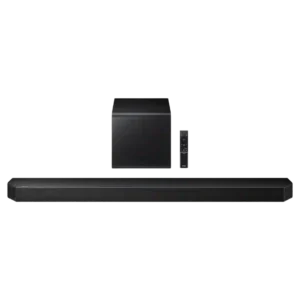
Choose Samsung Q800F for Status indicators and Home theater integration.
Why these recommendations?
KEF XIO
Where It Has the Edge
Stereo imaging accuracy is 4.6 vs 3.0. Stereo imaging is unusually wide and precise for a soundbar, often placing vocals and instruments beyond the cabinet...
Gaming performance is 5.0 vs 4.5. Games benefit from excellent positional cues, convincing height, and clear directionality, making opponents and environmental sounds easy to...
Samsung Q800F
Where It Has the Edge
Status indicators is 4.5 vs 1.9. The front display is easy to read and useful for quick feedback, though its information is fairly basic.
Home theater integration is 5.0 vs 2.8. Samsung TV integration is a major strength. Q-Symphony is repeatedly described as easy to use and capable of...
Size and TV fit is 4.8 vs 3.7. Fit is generally excellent: the bar is low enough to sit under most screens and the cube-shaped sub...
KEF XIO4.4 overall score
Samsung Q800F4.2 overall score
Compare features
Scores are out of 5. Missing scores mean missing review evidence, not a missing feature.
Scored on both products
Ownership and support
Reliability
KEF XIO
3.3
Samsung Q800F
2.0
Details and evidence for Reliability
KEF XIO
Reliability reports conflict sharply. One test had persistent CEC issues across two samples, while another experienced responsive, issue-free operation.
Reliability feedback is concerning despite one owner reporting perfect operation. Other customers describe eARC failure, wireless TV or subwoofer dropouts, and even a unit that failed after one day.
Details and evidence for Video passthrough support
KEF XIO
HDMI passthrough is the most repeated specification complaint. A soundbar this expensive having no extra HDMI input forces all source switching through the TV and feels under-equipped beside premium rivals.
The HDMI input is useful for simplifying source cabling, but video passthrough is capped at 4K/60Hz. That makes it adequate for many setups but a poor fit for gamers who want 4K/120Hz through the bar.
Value is the biggest tradeoff: the XIO sounds expensive in the best sense, but it also costs enough to compete with complete surround packages. Some reviewers say the performance justifies it; others consider the premium hard to rationalize.
Value is strongest at discounted prices, where several reviewers call the package excellent or strong value. A few owners felt it was not worth MSRP, especially when bass disappointed or reliability failed.
Setup is overwhelmingly straightforward, often taking only minutes from HDMI connection to calibrated playback. Early firmware/app problems and occasional HDMI handshakes are the main exceptions.
Wall mounting is exceptionally well supported, with sturdy included hardware and orientation-aware driver routing. Several reviewers specifically preferred how cleanly the XIO sits under a mounted TV.
Status feedback is a consistent usability weakness: LEDs can be hard to read, disappear from view in horizontal placement, and there is no full front display.
The included HDMI cable works, but its straight connector is less convenient for hiding cables in a wall-mounted installation than the angled power connector.
The XIO is formidable as a one-box home-theater solution, but current expansion is limited by the absence of dedicated wireless surrounds. That makes it less flexible than ecosystems built around add-on rear speakers.
Samsung TV integration is a major strength. Q-Symphony is repeatedly described as easy to use and capable of making the presentation larger, richer, and more theater-like.
TV connection stability is the clearest technical concern in the set. Several tests reported eARC/CEC synchronization or handshake problems, including one severe case reproduced across two TVs and two samples.
TV connection stability is mixed. Several owners report seamless Samsung-TV pairing and perfect operation, while others experienced an eARC quirk or complete wireless connection failures after months of use.
The remote is generally easy to understand and sometimes praised for its layout or backlighting, but several tests found it sluggish, limited, or not premium enough for the price.
Remote operation is a standout for ease of use: the included remote is repeatedly described as straightforward, elegant, and convenient, with TV-remote control further simplifying daily use.
Privacy is mixed: the hardware microphone-disable switch is a thoughtful safeguard, but mandatory online account creation for deeper app setup drew criticism.
One owner valued that the system can be set up and managed offline, avoiding a Samsung account, network connection, and the tracking concerns that came with them.
Details and evidence for Inter-speaker connectivity
KEF XIO
Wireless subwoofer integration can be stable and delay-free, but broader speaker expansion remains uneven: some options require an extra adapter and promised rear connectivity still lacks a firm timeline.
The subwoofer normally pairs automatically and works seamlessly right out of the box. One owner later experienced a complete subwoofer connection failure, creating a notable reliability caveat.
Wireless rear-speaker expansion remains a weakness because the promised bespoke satellites have not yet arrived and no confirmed timeline was available.
HDMI eARC is usually a simple, convenient one-cable path that works well with TV controls. One owner reported a serious eARC failure after months of use, pulling the overall picture down.
Room tuning is usually quick and noticeably improves balance, spatial scale, and placement. A few tests found it confusing, limited compared with full room correction, or troublesome before firmware updates.
Overall product quality is exceptionally well regarded for its sound, construction, and one-box convenience. The main reservations are price, scarce HDMI connectivity, ecosystem limitations, and a sharply negative report of persistent CEC bugs.
The overall product is widely recommended for its sound, compact design, features, and easy integration. Negative outliers center on disappointing bass, returns, and a few serious reliability failures.
Details and evidence for Loudness / maximum volume
KEF XIO
The XIO can play extremely loud and usually stays composed while doing it, easily filling medium and larger rooms. One critical test found the sound shouty and resonant at higher levels.
The built-in bass is strong enough that many users may skip a subwoofer, but adding one can deepen impact, improve scale, and offload the lowest frequencies. Integration is generally easy, though cost can rise quickly.
The compact subwoofer is praised by experts and several owners for strong, smooth output and easy placement. Customer feedback is sharply divided, though, with complaints ranging from weak bass to overwhelming bass.
The XIO can create convincing scale and envelopment even in smaller rooms, so it does not need a huge space acoustically. Its physical width still needs to fit the furniture and TV.
The Q800F works especially well where space is limited thanks to its low-profile bar, compact subwoofer, and space-conscious design. Moderate Bass mode adds another option when the sub cannot be accommodated.
Details and evidence for Distortion at high volume
KEF XIO
Most tests found the XIO remarkably clean at high output, with very low audible distortion or compression. One notably negative sample showed cabinet vibration, resonance, and compression when driven hard.
High-volume clarity is generally strong, with very little loss of definition at maximum output. One source did note that treble can become slightly sharp when pushed.
Details and evidence for Dolby Atmos height effects
KEF XIO
Atmos height is often convincing and sometimes described as class-leading for a standalone bar, with effects clearly lifting above the screen. Results remain room-dependent, and a few tests found the height illusion less dramatic than rival bars or discrete speakers.
Atmos height effects are usually impressive, with strong overhead cues and convincing vertical scale in favorable rooms. Results are room-dependent, and one owner found Atmos effects almost imperceptible.
Details and evidence for Frequency response balance
KEF XIO
Tonal balance is usually natural, neutral-to-warm, and impressively even across the range. A few music tests exposed isolated lower-mid or bass tonal weak spots.
Tonal balance is widely praised as clean, controlled, and accurate, with strong mids and vocals. A mild sharpness in the treble at higher volumes is the main caveat.
Fine detail is a standout strength, from subtle debris and ambience in movies to instrument texture and low-level information in music. Complex scenes stay unusually easy to follow.
The sound modes and EQ options are useful and often make an audible improvement, with bass/treble or expert controls available in some paths. A few reviewers wanted deeper manual EQ access or clearer feedback on what each profile changes.
Sound adjustment options are extensive, but outcomes vary. The controls and EQ are flexible, yet two owners could not tune the system to fix the sound balance they disliked.
On-bar controls range from intuitive and nicely backlit to frustratingly hidden in horizontal placement. Physical usability depends heavily on orientation.
KEF Connect is generally clean, fast, stable, and easy to navigate, with useful setup and EQ controls. There are notable exceptions, including slow service browsing, early setup trouble, and TV-mode connectivity problems.
SmartThings is generally praised as responsive, logically laid out, and easy to navigate. One owner still found Samsung’s broader software experience annoyingly overcomplicated.
Music is a major reason to consider the XIO, with unusually natural vocals, strong separation, wide staging, and hi-fi-like refinement for a soundbar. Dedicated stereo speakers can still win on imaging and subtlety, and one reviewer found music merely average.
Music performance is consistently excellent, with strong results on both Atmos mixes and ordinary stereo tracks. Reviewers praise natural vocals, punchy bass, separation, and enjoyable Adaptive-mode playback.
Bluetooth is part of a wireless connection set reviewers consider comprehensive and sufficient for most users, though these comments focus on availability and convenience rather than long-range stress testing.
Voices come through cleanly and distinctly, from regular TV speech to music vocals. Owners repeatedly describe speech as easy to hear without excessive volume.
The smart-feature suite is unusually rich, including adaptive processing, streaming integrations, and Samsung ecosystem features. Owners also responded positively to Adaptive mode and AirPlay/HomeKit integration.
Stereo imaging is unusually wide and precise for a soundbar, often placing vocals and instruments beyond the cabinet with convincing separation. Dedicated stereo speakers and a few rival bars can still produce a wider or more magical stage.
Stereo imaging is mixed. The bar can sound wider than its chassis, but channel separation trails dedicated stereo speakers and some listeners found left/right placement or Adaptive-mode panning less defined.
Bass is one of the XIO’s defining strengths: deep, punchy, controlled, and unusually substantial for a single bar, often enough without a subwoofer. A few listeners wanted tighter or deeper sub-bass, and one negative test heard compression and resonance when pushed.
Bass is the most polarizing trait. Experts often praise it as deep, agile, controlled, and room-shaking, but several owners call it weak while another found the subwoofer overpowering and difficult to tame.
Details and evidence for Surround sound simulation
KEF XIO
For a single bar, surround simulation is frequently impressive, enveloping, and spatially convincing, with strong left-right movement and some rear illusion. Physical rear speakers still win for true behind-the-listener placement, and one critical test found the effect merely average.
Virtual surround can create a convincing sense of space, but it remains front-led without dedicated rears. Some listeners find it acceptable or immersive, while one owner found the surround effect nearly invisible and another said rear speakers were necessary.
Low-volume listening is a strength: dialogue and detail remain engaging, while Night and Dialogue modes make late viewing easier without simply turning everything dull.
Low-volume performance is mostly good, with owners reporting clear, room-filling sound without needing extreme volume. One listener, however, found the system only became immersive after it was already too loud.
Gaming performance itself is good, with low latency and a useful Game Mode Pro. The experience is held back mainly by the separate 4K/120Hz passthrough limitation.
Details and evidence for Dialogue clarity (for TV/soundbar use)
KEF XIO
Dialogue is usually exceptionally clear, centered, and easy to understand even during busy scenes or at modest volume. A small minority heard muffled, chesty, or partially buried voices with certain material.
Overall sound quality is the XIO’s strongest case: powerful, detailed, balanced, spacious, and remarkably refined for a single soundbar. Most tests place it near the top of the category, though one reviewer found it underwhelming and resonant.
Overall sound quality is very strong across most sources, with frequent praise for clarity, scale, bass, dialogue, and musicality. A small number of owners found the presentation less rich than expected or little better than TV speakers.
Format support is a major strength, covering the leading immersive formats and high-resolution playback without leaving meaningful gaps for typical movie or music use.
Format support is broad and includes major immersive options such as Dolby Atmos and DTS:X, contributing to the Q800F’s strong home-theater feature set.
The up-firing drivers create a strong sense of height in several tests, though one test source considered the effect merely passable compared with real overhead speakers.
The low profile helps the XIO sit beneath a TV, but its roughly 47–48-inch width and substantial depth demand a wide stand and generally look best with a 55-inch-or-larger screen. Wall mounting reduces the visual bulk.
Fit is generally excellent: the bar is low enough to sit under most screens and the cube-shaped sub is easy to place. The bar’s width can still be awkward between the feet of some 65-inch TVs.
The understated fabric-and-metal design is widely praised as premium, elegant, and easy to blend into a living room. Its considerable width is the main visual caveat.
The compact subwoofer and clean metal styling are well liked, while the main black bar is more understated than striking. Overall, the system looks polished but not especially distinctive.
Build quality is consistently strong, with sturdy metal-heavy construction, a solid feel, and multiple comments that the system looks built to last rather than cheap or plasticky.
Despite the large number of drivers, the XIO usually sounds unified and well organized. Music and movie mixes keep separation without losing the sense of one coherent presentation.
The listening sweet spot is wider than expected for a soundbar, with several tests reporting consistent clarity off-center. Rear envelopment can fade when moving substantially away from the middle seat.