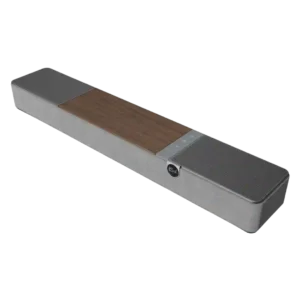

Klipsch Flexus Core 100
Where It Has the Edge
No clear scored advantage over the other product.

Scorata scores summarize analyzed review evidence on a 1–5 scale; they are not laboratory measurements or a simple average of customer star ratings. Feature scores summarize the reviews covering that feature. The overall score averages feature scores within each review, then combines review averages. When both expert and customer evidence are available, those two groups receive equal weight. Products can have different review coverage, so small score gaps do not establish a winner.
Recommendations prioritize important features for the category, with a score of at least 3.5, a gap of at least 0.25 points and at least two supporting reviews per product. Features with widely varying scores or broad connectivity contexts are excluded from recommendations. These safeguards do not establish statistical significance.
Quick verdict
The available evidence supports the recommendation below, but does not establish an overall winner. Check the remaining features against your priorities.
There is not enough comparable review evidence to recommend Klipsch Flexus Core 100 over the other product.
Choose KEF XIO for AirPlay compatibility and Vocal clarity.
No clear scored advantage over the other product.
Scores are out of 5. Missing scores mean missing review evidence, not a missing feature.
Long-term reliability is the most serious concern in customer feedback. Some reviewers describe set-it-and-forget-it operation, but others report remote failures, Bluetooth breakdowns, frozen controls, and units failing within a year.
Reliability reports conflict sharply. One test had persistent CEC issues across two samples, while another experienced responsive, issue-free operation.
Spotify Connect is unavailable, which frustrated reviewers who prefer direct high-quality streaming instead of routing music over Bluetooth.
Spotify Connect worked cleanly in direct testing, with smooth playback and strong sound quality.
Wall mounting is supported with included hardware and works neatly when all parts are present. One buyer was frustrated by a missing mounting template.
Wall mounting is exceptionally well supported, with sturdy included hardware and orientation-aware driver routing. Several reviewers specifically preferred how cleanly the XIO sits under a mounted TV.
One owner experienced the bar shutting itself off after only a few minutes and handing audio back to the TV, a serious power-behavior problem.
One extensive test found persistent CEC/handshake behavior frustrating enough to undermine day-to-day power and connection reliability.
Value is a major strength, especially for buyers prioritizing bass, clarity, and a compact single-bar setup under premium-brand pricing. A handful of reliability failures turn that equation upside down for affected owners.
Value is the biggest tradeoff: the XIO sounds expensive in the best sense, but it also costs enough to compete with complete surround packages. Some reviewers say the performance justifies it; others consider the premium hard to rationalize.
The Core 100 is not a good fit for setups that depend on HDMI video passthrough through an AV receiver; one owner had to rewire the system entirely.
HDMI passthrough is the most repeated specification complaint. A soundbar this expensive having no extra HDMI input forces all source switching through the TV and feels under-equipped beside premium rivals.
Optical can work cleanly and even support TV-remote control in some setups, but one owner had a deeply frustrating optical-control and firmware experience. HDMI eARC is the safer path when available.
Optical is a useful fallback for older televisions, but it is treated as a secondary option behind HDMI eARC.
Setup is usually fast and straightforward, with many users getting sound within minutes over HDMI. The main exceptions involve TV handshakes, missing documentation, or firmware/control issues that can turn setup into a troubleshooting exercise.
Setup is overwhelmingly straightforward, often taking only minutes from HDMI connection to calibrated playback. Early firmware/app problems and occasional HDMI handshakes are the main exceptions.
AirPlay is not available, and reviewers who rely on ecosystem or multi-room streaming consistently treated that omission as a drawback.
AirPlay worked smoothly in the tests that used it, fitting naturally into the XIO’s strong wireless streaming setup.
Google Cast/Chromecast streaming is absent, limiting whole-home and app-based wireless playback for users invested in that ecosystem.
Google Cast is part of a wireless streaming suite praised for broad, convenient access from different apps and devices.
The modular rear-speaker system is flexible, letting buyers add surrounds later instead of committing to a full package up front.
Wireless rear-speaker expansion remains a weakness because the promised bespoke satellites have not yet arrived and no confirmed timeline was available.
The package includes the needed connection cables, which one owner specifically praised as part of a well-thought-out unboxing.
The included HDMI cable works, but its straight connector is less convenient for hiding cables in a wall-mounted installation than the angled power connector.
The top touch controls were praised for working well while blending neatly into the design.
The top touch controls are a weak spot: they can feel imprecise or fiddly, especially without a clear front display confirming the command.
There is no room-calibration system, and reviewers accustomed to automatic room tuning clearly missed it.
Room tuning is usually quick and noticeably improves balance, spatial scale, and placement. A few tests found it confusing, limited compared with full room correction, or troublesome before firmware updates.
The Core 100 decodes Atmos but lacks dedicated up-firing height drivers, so convincing vertical effects are not its norm. One retailer demo heard impressive overhead cues, but most expert testing found height modest or absent.
Atmos height is often convincing and sometimes described as class-leading for a standalone bar, with effects clearly lifting above the screen. Results remain room-dependent, and a few tests found the height illusion less dramatic than rival bars or discrete speakers.
Fine detail is one of the more variable parts of the sound. Some material comes through crisp and well resolved, while other reviews cite dull percussion, missing high-frequency texture, or generally limited nuance.
Fine detail is a standout strength, from subtle debris and ambience in movies to instrument texture and low-level information in music. Complex scenes stay unusually easy to follow.
The large front display is a standout, with clear source, mode, and volume readouts. Some owners still wanted more status information, such as the incoming audio format, and one disliked the unlit controls.
Status feedback is a consistent usability weakness: LEDs can be hard to read, disappear from view in horizontal placement, and there is no full front display.
Expansion is a major advantage: owners can start with the bar and add a wired or wireless subwoofer and rear speakers later. That modular path is widely praised, though a few compatibility and latency issues can complicate mixed-brand systems.
The XIO is formidable as a one-box home-theater solution, but current expansion is limited by the absence of dedicated wireless surrounds. That makes it less flexible than ecosystems built around add-on rear speakers.
Tonal balance ranges from clean and well separated to thin or treble-shy depending on source and mode. The best results deliver tight bass and clear highs, while the harshest customer complaints cite missing highs and mids.
Tonal balance is usually natural, neutral-to-warm, and impressively even across the range. A few music tests exposed isolated lower-mid or bass tonal weak spots.
HDMI ARC/eARC is generally easy and convenient once established, often enabling single-remote control. A few owners experienced handshake failures or dropouts after initially successful setup.
HDMI eARC is the preferred TV connection and is described as the route to the XIO’s best wired sound quality.
Older wired subwoofers can integrate successfully, including models that are many years old, giving the Core 100 useful backwards compatibility for existing audio gear.
Older TVs remain usable through the optical input, although HDMI eARC is preferred when available for the best performance.
Remote experiences are sharply mixed. The included remote feels comfortable and premium to some reviewers, but pairing failures, replacement shortages, third-party remote incompatibility, and outright remote failures are recurring customer complaints.
The remote is generally easy to understand and sometimes praised for its layout or backlighting, but several tests found it sluggish, limited, or not premium enough for the price.
Privacy-conscious users may appreciate that the app does not require a sign-up or personal information. One reviewer also viewed the lack of Wi-Fi as a benefit for avoiding streaming-service restrictions.
Privacy is mixed: the hardware microphone-disable switch is a thoughtful safeguard, but mandatory online account creation for deeper app setup drew criticism.
The bar is compact but heavier than its footprint suggests because of its substantial construction. Some owners view that heft as reassuring, while others flag it as a mounting consideration.
The XIO is heavy for a soundbar, and its roughly 10.5 kg/23 lb mass requires care when lifting or wall mounting.
Most reviewers consider the Core 100 an excellent compact TV upgrade with unusually strong sound for the price. The main caveat is that a smaller group of owners report severe reliability and control failures that undermine the otherwise strong package.
Overall product quality is exceptionally well regarded for its sound, construction, and one-box convenience. The main reservations are price, scarce HDMI connectivity, ecosystem limitations, and a sharply negative report of persistent CEC bugs.
TV connection reliability is one of the biggest customer pain points. Many setups connect automatically, but several owners report ARC handshakes, pairing failures, unexpected fallback to TV speakers, or eventual loss of connection.
TV connection stability is the clearest technical concern in the set. Several tests reported eARC/CEC synchronization or handshake problems, including one severe case reproduced across two TVs and two samples.
Voice enhancement is generally effective, with strong praise for the multi-level dialogue tools and clear speech in many scenes. Dense, bass-heavy material can still make voices harder to follow.
Voices are consistently natural, clear, and well separated, whether in music or spoken content, with strong midrange presence and intelligibility.
Dynamic punch is excellent for the bar’s size, with strong impact on music and movies. An external sub can extend that sense of scale further.
Dynamic headroom is exceptional, letting the XIO move from subtle passages to large action peaks with speed, control, and little compression.
High-volume playback is a strength: demanding bass tracks stayed clean without obvious rattling or distortion, and dialogue remained composed even when the bar was pushed hard.
Most tests found the XIO remarkably clean at high output, with very low audible distortion or compression. One notably negative sample showed cabinet vibration, resonance, and compression when driven hard.
Klipsch’s expansion link can be very stable, but compatibility is not universal. Some owners needed extra modules or wiring, and early peripheral glitches were reported.
Wireless subwoofer integration can be stable and delay-free, but broader speaker expansion remains uneven: some options require an extra adapter and promised rear connectivity still lacks a firm timeline.
The Core 100 is especially well suited to bedrooms, studios, smaller living rooms, and compact TV setups. Its short width saves space while still delivering much more output than its size suggests.
The XIO can create convincing scale and envelopment even in smaller rooms, so it does not need a huge space acoustically. Its physical width still needs to fit the furniture and TV.
Dialogue is one of the Core 100’s most consistent strengths, staying clear across movies, TV, and quieter speech. Heavy action mixes can occasionally overwhelm the center image, but most users report a major intelligibility upgrade over TV speakers.
Dialogue is usually exceptionally clear, centered, and easy to understand even during busy scenes or at modest volume. A small minority heard muffled, chesty, or partially buried voices with certain material.
The Core 100 gets surprisingly loud for its compact size, with several owners filling bedrooms, living rooms, and even larger spaces comfortably. A few users still wanted more output, especially when comparing it with bigger traditional systems.
The XIO can play extremely loud and usually stays composed while doing it, easily filling medium and larger rooms. One critical test found the sound shouty and resonant at higher levels.
The wooden MDF enclosure is notably solid and finely built, giving the compact bar a more substantial cabinet than typical plastic designs.
The force-canceling cabinet and woofer design translates into very clean playback with little audible vibration, even when the bar is working hard.
Movie presentation can stay cohesive and cinematic despite the narrow cabinet, with smooth front-stage transitions and strong impact when the mix suits the bar.
Despite the large number of drivers, the XIO usually sounds unified and well organized. Music and movie mixes keep separation without losing the sense of one coherent presentation.
Wi-Fi streaming is the clearest feature omission. AirPlay, Google Cast, Spotify Connect, and multi-room streaming are repeatedly missed, although one reviewer considered the omission acceptable at this price.
In the explicit wireless-streaming test, network playback worked reliably and sounded excellent.
Wireless expansion reliability is mixed. Klipsch’s dedicated transport link was praised as stable in one system, while another review reported a rear speaker repeatedly disconnecting.
The tested wireless speaker/sub connection stayed stable and delay-free, with seamless interaction between the soundbar and woofer.
The smart-control experience is capable but incomplete. Mode switching can be smooth, yet the bar lacks automatic music-mode switching and broader smart-home integration found on some rivals.
Streaming and app-based control make the XIO a convenient all-in-one smart music system as well as a TV soundbar.
The physical buttons are simple and easy to use for quick volume and playback adjustments when the remote or app is not at hand.
On-bar controls range from intuitive and nicely backlit to frustratingly hidden in horizontal placement. Physical usability depends heavily on orientation.
Music performance divides reviewers more than movie playback. Some hear rich, engaging sound with strong bass and clear vocals, while others find the stage narrow, detail limited, or dedicated speakers noticeably better.
Music is a major reason to consider the XIO, with unusually natural vocals, strong separation, wide staging, and hi-fi-like refinement for a soundbar. Dedicated stereo speakers can still win on imaging and subtlety, and one reviewer found music merely average.
Basic Bluetooth streaming is easy and convenient for many users, and several reviewers paired phones without trouble. It remains a fallback rather than a full replacement for the missing Wi-Fi streaming ecosystem.
Bluetooth sits within a wireless connectivity package that was praised as unusually complete and convenient.
Review contexts may differ, so use caution when interpreting the score gap.
Sound tuning is unusually flexible for the price, with bass, mids, treble, presets, and custom profiles available through the app or controls. Most reviewers found these adjustments easy and useful, though one unhappy listener could not tune away poor sound.
The sound modes and EQ options are useful and often make an audible improvement, with bass/treble or expert controls available in some paths. A few reviewers wanted deeper manual EQ access or clearer feedback on what each profile changes.
Klipsch Connect Plus is usually a highlight: it is described as responsive, easy to navigate, polished, and useful for tuning. A small number of owners report severe connectivity failures that can make app control unreliable or unusable.
KEF Connect is generally clean, fast, stable, and easy to navigate, with useful setup and EQ controls. There are notable exceptions, including slow service browsing, early setup trouble, and TV-mode connectivity problems.
Dolby Atmos support is useful, but the lack of DTS support is a meaningful limitation for buyers with Blu-ray libraries that use the format.
Format support is a major strength, covering the leading immersive formats and high-resolution playback without leaving meaningful gaps for typical movie or music use.
Vertical soundstage height is limited. Reviewers repeatedly heard only a minimal sense of overhead movement from the virtualized Atmos presentation.
Soundstage height can be striking, with one listener immediately noticing a much taller sonic wall than the previous stereo setup.
Stereo width can be impressive for such a narrow bar, but imaging precision is inconsistent. Multiple reviewers heard effects as overly localized, choppy, or difficult to place accurately, while a few praised the wider-than-expected stage.
Stereo imaging is unusually wide and precise for a soundbar, often placing vocals and instruments beyond the cabinet with convincing separation. Dedicated stereo speakers and a few rival bars can still produce a wider or more magical stage.
Perceived elevation varies dramatically: most expert testing found weak or minimal overhead effects, while one demo reported convincing sounds from above.
The presentation can lift well above the physical bar, creating a noticeably taller wall of sound.
Virtual surround is highly room- and source-dependent. Some listeners heard convincing width and envelopment, while others found little to no surround sensation from the 2.1-channel bar.
For a single bar, surround simulation is frequently impressive, enveloping, and spatially convincing, with strong left-right movement and some rear illusion. Physical rear speakers still win for true behind-the-listener placement, and one critical test found the effect merely average.
Quiet listening is effective in a small room, with dialogue and whispers remaining understandable without cranking the TV volume.
Low-volume listening is a strength: dialogue and detail remain engaging, while Night and Dialogue modes make late viewing easier without simply turning everything dull.
Overall sound quality is overwhelmingly praised for a compact single bar, especially its bass, clarity, and ability to outperform TV speakers. The minority of negative reviews focus on thin treble, localized sound, muffling, or disappointing near-field performance.
Overall sound quality is the XIO’s strongest case: powerful, detailed, balanced, spacious, and remarkably refined for a single soundbar. Most tests place it near the top of the category, though one reviewer found it underwhelming and resonant.
Bass is the Core 100’s defining strength, with unusually deep, punchy output from the built-in woofers and enough low end for many users to skip a sub. A few listeners still want more punch, deeper extension, or an added sub for maximum movie impact.
Bass is one of the XIO’s defining strengths: deep, punchy, controlled, and unusually substantial for a single bar, often enough without a subwoofer. A few listeners wanted tighter or deeper sub-bass, and one negative test heard compression and resonance when pushed.
The built-in woofers are strong enough for many users to skip a separate sub, and the wired/wireless expansion options are unusually flexible. Add-on sub integration is usually praised, though one expert found the optional sub difficult to dial down.
The built-in bass is strong enough that many users may skip a subwoofer, but adding one can deepen impact, improve scale, and offload the lowest frequencies. Integration is generally easy, though cost can rise quickly.
Gaming performance impressed in a PS5 test, with precise positional cues and minimal lag helping off-screen effects feel easier to locate.
Games benefit from excellent positional cues, convincing height, and clear directionality, making opponents and environmental sounds easy to locate.
The bar offers useful wired flexibility, especially optical and subwoofer connections, but buyers needing analog or phono input should look elsewhere.
Wired connectivity is easy for a basic TV setup, but the limited physical input selection becomes restrictive if you have several external sources.
Materials and construction are widely praised, especially the wood-based cabinet, fabric, and metal details. A rare quality-control complaint involved a scratched wooden panel straight from the box.
Build quality is consistently described as premium, solid, and meticulously finished, with materials that feel appropriate for the high asking price.
Most reviewers like the compact, understated look, and the walnut finish draws particular praise for its vintage character. The oversized Klipsch logo and more ordinary black finish are the main aesthetic complaints.
The understated fabric-and-metal design is widely praised as premium, elegant, and easy to blend into a living room. Its considerable width is the main visual caveat.
Lip-sync performance is inconsistent across setups: one gaming test found minimal lag, while a customer using an optical multi-room feed measured a very noticeable delay.
Dialogue processing can push voices forward while reducing competing background sound, making speech easier to follow.
The listening sweet spot is wider than expected for a soundbar, with several tests reporting consistent clarity off-center. Rear envelopment can fade when moving substantially away from the middle seat.
Optional rear speakers can make surround more realistic, but their behavior is not perfect for every use; one expert disliked the all-speaker stereo approach for music.
One home-theater test found it hard to settle on a single volume that suited both dialogue and action, leading to frequent manual level adjustments.
Power consumption was described as reasonable, including very low draw in Eco standby.
There is no dedicated HDMI passthrough for a game console, forcing gaming sources through the TV instead of directly through the soundbar.
Google Home integration exists, but it is basic and lacks the deeper multiroom control offered by stronger ecosystems.
The lack of direct HDMI 2.1/4K120 passthrough is a clear drawback for high-end console setups that want to route sources through the soundbar.
The top controls do not illuminate during use, which one owner found disappointing for visibility.
Packaging is generally thoughtful and protective, with praise for cardboard materials and complete cable inclusion. A few units arrived missing key accessories such as a remote, manual, or mounting template.
Packaging choices earn praise for using cardboard instead of crumbly polystyrene, reducing unnecessary plastic while still protecting the product well.
Bluetooth works for basic streaming, but one owner specifically wished the wireless audio implementation delivered higher-fidelity performance.
Bluetooth stability is polarized: several tests found reliable, effortless pairing, while multiple owners report repeated failures that require resets or eventually stop working altogether.
Bluetooth range performed reliably to about 30 feet in testing, giving the bar useful room-scale wireless reach.
Customer support draws mostly negative feedback when hardware or firmware problems arise. Owners describe hard-to-find contact information, repetitive troubleshooting, failed update files, and poor resolution after replacement problems.
The low profile helps the XIO sit beneath a TV, but its roughly 47–48-inch width and substantial depth demand a wide stand and generally look best with a 55-inch-or-larger screen. Wall mounting reduces the visual bulk.
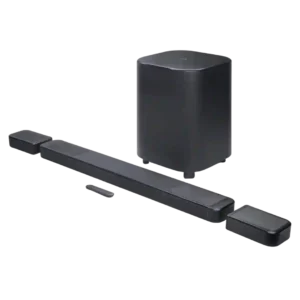
Best for room-filling Atmos, hard-hitting bass and genuinely useful detachable rears. Skip it if 4K/120 passthrough, a compact footprint or consistently polished app control matters more.
Pros: Rear speaker versatility, Overall product quality
Cons: Size and TV fit, Gaming HDMI passthrough
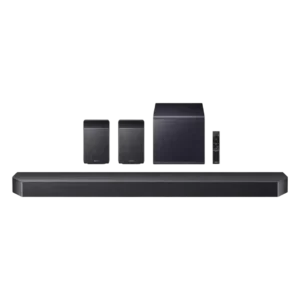
Choose the Samsung HW-Q990F if you want a premium, easy Atmos system with huge surround, strong bass, and Samsung TV perks. Skip it if price, a four-piece setup, music purity,...
Pros: Value for money, Surround sound simulation
Cons: Status indicators, Wi-Fi streaming reliability

Best for class-leading Atmos immersion, clear dialogue, compact but forceful bass, and a complete rear-speaker package. Skip it if you own the Q990F, need a compact one-bar setup, or cannot...
Pros: Home theater integration, Bass performance
Cons: Value for money, Design and aesthetics
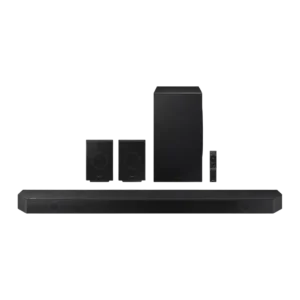
Choose the HW-Q990D for immersive Atmos, clear dialogue, strong bass, and HDMI 2.1 gaming in a full soundbar package. Skip it if price, large hardware, small display, or the cheaper...
Pros: Subwoofer, Value for money
Cons: Remote control usability, Status indicators