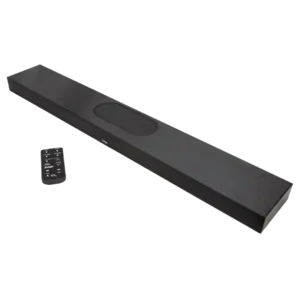
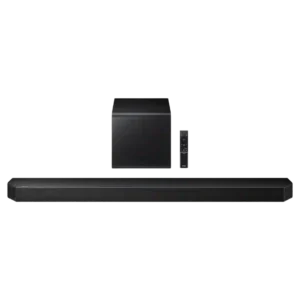
Zvox AccuVoice AV855
Where It Has the Edge
- Status indicators is 5.0 vs 4.5. The hidden front display is a welcome touch because it clearly shows volume and setting changes.

Scorata scores summarize analyzed review evidence on a 1–5 scale; they are not laboratory measurements or a simple average of customer star ratings. Feature scores summarize the reviews covering that feature. The overall score averages feature scores within each review, then combines review averages. When both expert and customer evidence are available, those two groups receive equal weight. Products can have different review coverage, so small score gaps do not establish a winner.
Recommendations prioritize important features for the category, with a score of at least 3.5, a gap of at least 0.25 points and at least two supporting reviews per product. Features with widely varying scores or broad connectivity contexts are excluded from recommendations. These safeguards do not establish statistical significance.
Quick verdict
The review evidence points to a tradeoff: Status indicators versus Vocal clarity. Choose according to which strengths matter more to you; the overall score alone does not settle that choice.
Choose Zvox AccuVoice AV855 for Status indicators.
Choose Samsung Q800F for Vocal clarity.
Scores are out of 5. Missing scores mean missing review evidence, not a missing feature.
Reliability is the most serious recurring concern. Several owners report intermittent connections, sound cutouts, streaming failures, unexpected power behavior, or a defective first unit.
Reliability feedback is concerning despite one owner reporting perfect operation. Other customers describe eARC failure, wireless TV or subwoofer dropouts, and even a unit that failed after one day.
The soundbar lacks a dedicated way to hang it from a wall-mounted television, forcing one owner to improvise.
Wall mounting is well supported with an included kit that forms part of a notably complete in-box package.
Support experiences are inconsistent, ranging from fast, helpful replies to slow email-only service and curt or unhelpful assistance.
One owner had a poor support experience: a lengthy Samsung support session produced only a temporary fix before the connection problem returned.
Most owners consider it worth the price when clearer speech is the priority. Buyers focused on general sound quality may find cheaper or better-rounded alternatives more appealing.
Value is strongest at discounted prices, where several reviewers call the package excellent or strong value. A few owners felt it was not worth MSRP, especially when bass disappointed or reliability failed.
Most buyers found setup quick and straightforward, often with a single cable. A smaller group encountered missing instructions, ambiguous guidance, error codes, or lengthy TV and streaming troubleshooting.
Setup is consistently excellent. Reviewers and owners repeatedly describe plug-and-play installation, automatic subwoofer pairing, and easy HDMI eARC connection.
One Samsung owner found the optical connection unexpectedly useful because it still allowed TV-remote control after HDMI control failed.
The optical input contributes to a connection set judged sufficient for most users, though it was not singled out for deeper performance testing.
Support for immersive formats is limited because the bar lacks Dolby Atmos and DTS:X.
Format support is broad and includes major immersive options such as Dolby Atmos and DTS:X, contributing to the Q800F’s strong home-theater feature set.
The upward-firing drivers add only a modest sense of height, falling short of the reviewer’s expectations.
The up-firing drivers create a strong sense of height in several tests, though one test source considered the effect merely passable compared with real overhead speakers.
One experienced owner described the presentation as surprisingly big, wide, and deep for such a compact bar.
Stereo imaging is mixed. The bar can sound wider than its chassis, but channel separation trails dedicated stereo speakers and some listeners found left/right placement or Adaptive-mode panning less defined.
The bar offers a useful assortment of wired connections, including HDMI, optical, analog, and USB options.
The wired connection set is capable, but the single HDMI input can be limiting for systems with several source devices.
Low-volume speech is excellent: many owners lowered their usual TV volume substantially while understanding more dialogue.
Low-volume performance is mostly good, with owners reporting clear, room-filling sound without needing extreme volume. One listener, however, found the system only became immersive after it was already too loud.
The built-in subwoofers impressed two owners with how much sound they produce from a small enclosure.
The compact subwoofer is praised by experts and several owners for strong, smooth output and easy placement. Customer feedback is sharply divided, though, with complaints ranging from weak bass to overwhelming bass.
Overall sound is often described as clear, strong, and much better than TV speakers, especially for speech. The main tradeoff is a boxy or tinny character and limited fullness for music and movies.
Overall sound quality is very strong across most sources, with frequent praise for clarity, scale, bass, dialogue, and musicality. A small number of owners found the presentation less rich than expected or little better than TV speakers.
Bass feedback is mixed: some owners are amazed by the built-in low end, while one expert hears useful rumble and another finds it thin and lacking impact.
Bass is the most polarizing trait. Experts often praise it as deep, agile, controlled, and room-shaking, but several owners call it weak while another found the subwoofer overpowering and difficult to tame.
The surround modes add some width and fullness, but they are not a substitute for a true theater system. Higher surround settings can also reduce the voice clarity that makes this soundbar special.
Virtual surround can create a convincing sense of space, but it remains front-led without dedicated rears. Some listeners find it acceptable or immersive, while one owner found the surround effect nearly invisible and another said rear speakers were necessary.
One owner reported severe dropouts across streaming platforms and said the system could not maintain a stable streaming-audio connection.
Wi-Fi streaming is described as straightforward and well stocked with streaming options, with no usability complaints in the scored accounts.
Bluetooth is not available, which limits wireless playback from phones and other devices.
Bluetooth is part of a wireless connection set reviewers consider comprehensive and sufficient for most users, though these comments focus on availability and convenience rather than long-range stress testing.
Review contexts may differ, so use caution when interpreting the score gap.
Music performance divides opinion. One longtime ZVOX user praises it, another calls it adequate, while an expert found songs thin, hollow, and lacking weight.
Music performance is consistently excellent, with strong results on both Atmos mixes and ordinary stereo tracks. Reviewers praise natural vocals, punchy bass, separation, and enjoyable Adaptive-mode playback.
The controls are easy to learn through the remote, but there are no physical controls on the soundbar itself.
Physical controls on the bar are simple, accessible, and useful for quick adjustments without reaching for the remote.
Its many AccuVoice, surround, bass, and treble adjustments let listeners tailor speech to their hearing needs. Finding the ideal combination can take experimentation, and one critic found the many boost levels ineffective.
Sound adjustment options are extensive, but outcomes vary. The controls and EQ are flexible, yet two owners could not tune the system to fix the sound balance they disliked.
It does not support Dolby Atmos or DTS:X, so height effects are much less convincing than on a true Atmos soundbar.
Atmos height effects are usually impressive, with strong overhead cues and convincing vertical scale in favorable rooms. Results are room-dependent, and one owner found Atmos effects almost imperceptible.
The AV855 cannot pair with additional speakers, limiting expansion into a larger multi-speaker system.
The subwoofer normally pairs automatically and works seamlessly right out of the box. One owner later experienced a complete subwoofer connection failure, creating a notable reliability caveat.
One owner says the included HDMI cable is below the recommended standard for maximum performance and should be replaced.
An HDMI cable is included, adding convenience for buyers planning a wired TV connection.
It works for everyday TV viewing, but its limited bass, music performance, and spatial impact keep it from delivering a true home-theater experience.
Samsung TV integration is a major strength. Q-Symphony is repeatedly described as easy to use and capable of making the presentation larger, richer, and more theater-like.
Tonal balance is the clearest sound-quality weakness: several listeners call it boxy or tinny, especially at stronger voice-enhancement settings. A few owners found the midrange clear and adjustable enough to tame harsh voices.
Tonal balance is widely praised as clean, controlled, and accurate, with strong mids and vocals. A mild sharpness in the treble at higher volumes is the main caveat.
It can play loudly enough for across-room listening, but its biggest strength is making voices clear without pushing the volume. One dissatisfied owner found that extra loudness did not translate into better clarity.
Output is a clear strength: reviewers describe room-filling, even room-shaking volume, with enough headroom for medium and large living rooms.
The included remote is generally praised for its readable layout, solid feel, and centralized controls. TV-remote pairing is usually easy, but a few owners needed help or could only make it work through HDMI.
Remote operation is a standout for ease of use: the included remote is repeatedly described as straightforward, elegant, and convenient, with TV-remote control further simplifying daily use.
The hidden front display is a welcome touch because it clearly shows volume and setting changes.
The front display is easy to read and useful for quick feedback, though its information is fairly basic.
HDMI ARC usually makes power and volume control simple through the TV remote. Compatibility is inconsistent, however, with some owners reporting failed control, port requirements, or needing HDMI instead of optical.
HDMI eARC is usually a simple, convenient one-cable path that works well with TV controls. One owner reported a serious eARC failure after months of use, pulling the overall picture down.
TV connection experiences vary widely: many owners report seamless power, remote, and ARC behavior, while others encountered error codes, app dropouts, sound cutting out, or incompatibility with specific TVs and services.
TV connection stability is mixed. Several owners report seamless Samsung-TV pairing and perfect operation, while others experienced an eARC quirk or complete wireless connection failures after months of use.
Voices are consistently pulled forward and made more distinct, with many hearing-impaired owners reporting a major improvement. A small minority found voice enhancement ineffective or still struggled with certain speakers.
Voices come through cleanly and distinctly, from regular TV speech to music vocals. Owners repeatedly describe speech as easy to hear without excessive volume.
Dialogue clarity is the AV855’s defining strength, often reducing or eliminating the need for captions. Most owners hear speech far more easily, though a few report only modest gains, dropouts, or louder voices without added clarity.
Dialogue is one of the Q800F’s most consistent strengths, described as crisp, pristine, accurately reproduced, and easy to follow even in busy scenes.
Its low height and compact footprint make it easy to place under a TV or use where space is limited.
The Q800F works especially well where space is limited thanks to its low-profile bar, compact subwoofer, and space-conscious design. Moderate Bass mode adds another option when the sub cannot be accommodated.
Most buyers are highly satisfied because the product solves a specific, frustrating problem: understanding TV dialogue. Negative experiences cluster around compatibility failures, dropouts, and buyers who expected broader cinematic sound.
The overall product is widely recommended for its sound, compact design, features, and easy integration. Negative outliers center on disappointing bass, returns, and a few serious reliability failures.
The design is clean, streamlined, and low-profile, though the expert assessment calls it more utilitarian than stylish.
The compact subwoofer and clean metal styling are well liked, while the main black bar is more understated than striking. Overall, the system looks polished but not especially distinctive.
Build quality is a standout, with a durable metal enclosure and a premium, solid feel.
Build quality is consistently strong, with sturdy metal-heavy construction, a solid feel, and multiple comments that the system looks built to last rather than cheap or plasticky.
One owner found day-to-day operation a little complicated.
AirPlay use is easy and well integrated; one owner specifically liked being able to add the system alongside HomeKit.
Output leveling is highly effective at controlling loud commercials, music bursts, explosions, and large volume swings.
Chromecast is part of a wireless streaming setup that reviewers describe as straightforward and well equipped.
Fine detail retrieval is excellent, with subtle percussion, background artifacts, and small musical textures remaining clear and well placed.
High-volume clarity is generally strong, with very little loss of definition at maximum output. One source did note that treble can become slightly sharp when pushed.
Dynamic headroom is excellent, combining strong impact and room-shaking output with little compression or clarity loss.
Gaming passthrough is the major weak spot: the HDMI input tops out at 4K/60Hz, and multiple sources wanted 120Hz support.
Google integration is usable but not seamless, with Google Home setup called somewhat clunky.
HDMI gaming support falls short for high-refresh-rate players because 4K/120Hz passthrough is missing.
Packaging reports are split: one unit arrived very well packed, while another costly unit arrived in a mostly open, gaping outer box.
One owner valued that the system can be set up and managed offline, avoiding a Samsung account, network connection, and the tracking concerns that came with them.
Optional rear speakers expand the system effectively, but each rear needs its own power outlet, which can complicate placement.
SpaceFit room calibration is consistently praised for adapting output to room acoustics and reducing the need for manual tuning.
SmartThings is generally praised as responsive, logically laid out, and easy to navigate. One owner still found Samsung’s broader software experience annoyingly overcomplicated.
Voice-assistant integration works, but setup is not entirely polished; Google Home configuration was specifically described as a little clunky.
The smart-feature suite is unusually rich, including adaptive processing, streaming integrations, and Samsung ecosystem features. Owners also responded positively to Adaptive mode and AirPlay/HomeKit integration.
Lip sync is excellent over HDMI eARC, with very low latency and no distracting dialogue synchronization problems reported in testing.
The soundbar excels at separating voices from music, effects, and other background clutter, helping speech stay intelligible without overpowering volume.
Gaming performance itself is good, with low latency and a useful Game Mode Pro. The experience is held back mainly by the separate 4K/120Hz passthrough limitation.
One owner found the optional Samsung rear-speaker kit transformed the system into a much more powerful, convincing full home-theater setup.
The upward-firing speakers are a welcome addition, but the resulting elevation effect remains limited without full immersive-format support.
One owner could not keep the soundbar shut off when switching to other audio outputs, indicating unreliable power behavior with that TV.
Spotify Connect earns positive marks for simple streaming and seamless handoff between listening locations.
The HDMI input is useful for simplifying source cabling, but video passthrough is capped at 4K/60Hz. That makes it adequate for many setups but a poor fit for gamers who want 4K/120Hz through the bar.
Fit is generally excellent: the bar is low enough to sit under most screens and the cube-shaped sub is easy to place. The bar’s width can still be awkward between the feet of some 65-inch TVs.

Choose it if you want unusually hi-fi music, deep standalone bass, clear dialogue, and convincing Atmos from one premium bar. Skip it if you need multiple HDMI inputs, a mature...
Pros: Overall product quality, Overall sound quality
Cons: Value for money, Video passthrough support
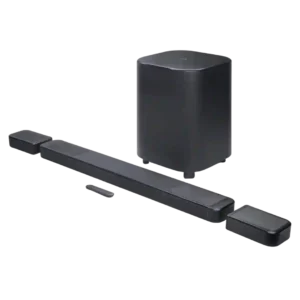
Best for room-filling Atmos, hard-hitting bass and genuinely useful detachable rears. Skip it if 4K/120 passthrough, a compact footprint or consistently polished app control matters more.
Pros: Rear speaker versatility, Overall product quality
Cons: Size and TV fit, Gaming HDMI passthrough
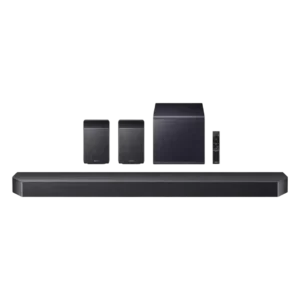
Choose the Samsung HW-Q990F if you want a premium, easy Atmos system with huge surround, strong bass, and Samsung TV perks. Skip it if price, a four-piece setup, music purity,...
Pros: Value for money, Surround sound simulation
Cons: Status indicators, Wi-Fi streaming reliability

Best for class-leading Atmos immersion, clear dialogue, compact but forceful bass, and a complete rear-speaker package. Skip it if you own the Q990F, need a compact one-bar setup, or cannot...
Pros: Home theater integration, Bass performance
Cons: Value for money, Design and aesthetics