

Sony HT-S100F Soundbar
Where It Has the Edge
- Wired audio connectivity is 4.1 vs 2.7. Reviewers liked having multiple wired connection options for different TV setups.

Scorata scores summarize analyzed review evidence on a 1–5 scale; they are not laboratory measurements or a simple average of customer star ratings. Feature scores summarize the reviews covering that feature. The overall score averages feature scores within each review, then combines review averages. When both expert and customer evidence are available, those two groups receive equal weight. Products can have different review coverage, so small score gaps do not establish a winner.
Recommendations prioritize important features for the category, with a score of at least 3.5, a gap of at least 0.25 points and at least two supporting reviews per product. Features with widely varying scores or broad connectivity contexts are excluded from recommendations. These safeguards do not establish statistical significance.
Quick verdict
The review evidence points to a tradeoff: Wired audio connectivity versus Subwoofer performance and Home theater integration. Choose according to which strengths matter more to you; the overall score alone does not settle that choice.
Choose Sony HT-S100F Soundbar for Wired audio connectivity.
Choose Sonos Beam (Gen 2) for Subwoofer performance and Home theater integration.
Scores are out of 5. Missing scores mean missing review evidence, not a missing feature.
One reviewer treated the lack of Dolby Atmos as a major limitation for movie-focused buyers.
Atmos processing was usually considered impressive for the size, but reviewers also warned it is virtual and not fully convincing overhead.
One reviewer found the top touch controls unreliable.
Touch controls were praised as responsive and intuitive, though most reviewers expected users to rely more on app or TV remote control.
Home theater fit was context-dependent: one review liked the cinematic feel, while others said serious movie watchers should look at stronger surround systems.
Home theater integration was a major Sonos advantage, especially the ability to add a Sub, surrounds, or other Sonos speakers over time.
One reviewer praised composure at higher volume, while another said wide dynamic range would not satisfy movie buffs.
Dynamic headroom was strong for the size, with reviewers praising wide dynamic range, punch, and convincing jumps in intensity.
One reviewer praised its ability to stay clear at higher volume without obvious distortion.
Most reviewers found the Beam composed at normal-to-loud levels, with only one noting compression or distortion when pushed above roughly 80 dB.
Reviewers generally described the sound as balanced, clear, and detailed, though one noted the bass and overall sound were a little lacking.
Reviewers consistently described the tonal balance as clear, robust, refined, and larger than expected for the Beam’s size.
Most reviewers agreed the overall presentation improves TV audio with clearer, more immersive, and more enjoyable sound.
One detailed review praised driver handoff and coherence, describing a seamless presentation across the soundfield.
Reviewers praised audible detail in effects and the sound's detailed character.
Detail retrieval was repeatedly praised, with reviewers calling out nuance, timbre, transients, and small sound effects.
HDMI ARC was mostly praised for easy TV connection and remote integration, though one reviewer had occasional auto-on issues.
HDMI ARC/eARC was strongly praised for richer format support, easier setup, and reduced sync issues with TVs and game consoles.
Reviewers generally liked the included remote, describing it as solid, simple, and beginner-friendly.
Remote usability was strong when using a TV or Apple TV remote, but the lack of a dedicated remote was still a minor drawback.
Reviewers found the soundbar loud enough for TV use and small spaces, but one cautioned it is not a roof-raising party speaker.
Maximum volume is generally strong for a compact bar and enough for smaller spaces, though it is not as powerful as larger Sonos options.
Reviewers praised dialogue clarity, especially for TV viewing and voice-focused content.
Dialogue clarity was one of the strongest points across reviews, with repeated praise for clear, accurate, and easy-to-follow speech.
Voice reproduction was consistently described as clear, audible, or vocal-focused.
Vocal reproduction was praised in music and TV contexts, with reviewers noting clearer, more natural voices than expected from a compact soundbar.
One reviewer disliked relying on on-bar buttons for Bluetooth pairing.
On-device controls were praised in one review for working well directly on the unit.
Sound modes were useful for some reviewers, but EQ flexibility was limited and one reviewer heard little difference between modes.
EQ customization is useful but basic; reviewers liked bass/treble adjustment while noting the absence of a full EQ.
One reviewer flagged the lack of DTS support as a limitation to consider.
Audio format support was treated as a meaningful upgrade, especially for Atmos, eARC-era formats, and expanded surround decoding.
Bass was the main limitation; reviewers repeatedly noted the lack of deep bass, subwoofer output, or stronger low-end performance.
Bass is punchy and satisfying for the size, but reviewers agree deep rumble usually requires adding a Sonos Sub or choosing a larger setup.
Reviewers liked having multiple wired connection options for different TV setups.
Wired input options were a recurring weakness because reviewers found the physical port selection limited, especially with only one HDMI port.
Opinions were mixed: some reviewers liked the virtual surround effect, while others said it was not suitable for serious surround or home theater expectations.
Surround simulation was widely liked for width and immersion, though it still falls short of discrete rear-speaker systems.
One reviewer heard good instrument separation during music playback.
Imaging and placement were praised for width and perspective, but music stereo separation remains limited by the single-bar form factor.
One reviewer liked optical because it can free up an HDMI port.
Optical input is useful for older TVs, but reviewers noted it blocks Dolby Atmos playback, making it a fallback rather than the best connection.
One reviewer flagged the absence of HDMI inputs as a limitation for passthrough-style setups.
Video passthrough was a clear weakness because many reviewers criticized the absence of HDMI passthrough or spare HDMI inputs.
Value was a major strength across reviews, especially for buyers upgrading TV speakers on a tight budget.
Most reviewers judged the Beam Gen 2 as strong value for a compact Sonos soundbar, though some disliked the upgrade cost or add-on expense.
Setup simplicity was one of the strongest points, with reviewers repeatedly calling installation easy, simple, or straightforward.
Setup was one of the clearest strengths, repeatedly described as quick, painless, simple, or only a few minutes long.
Reviewers consistently liked the slim, understated, compact design and how easily it fit into rooms or TV setups.
The Beam’s compact, stylish look was a major strength, with reviewers praising its clean appearance and room-friendly footprint.
Build quality was mostly positive, with praise for premium feel and sturdiness, though one reviewer noted the plastic construction.
Build quality was praised for the durable polycarbonate grille, premium feel, and improved ease of cleaning versus fabric.
Reviewers viewed the 120-watt output positively, connecting it to stronger loudness for a compact soundbar.
Inter-speaker connectivity was a Sonos strength, with reviewers praising easy syncing, grouping, and wireless expansion.
Microphone quality was praised for clarity and far-field voice use, supporting both voice assistants and Sonos control.
TruePlay room calibration was often praised for improving clarity and spatial performance, but Android exclusion remained a common caveat.
One reviewer praised Sonos for using sustainable packaging without surface foam.
TV connection stability was praised in one review, which reported no missed beats during streaming tests.
The Sonos app was mostly praised as stable, polished, and easy to use, with one reviewer noting it can feel confusing at first.
Bluetooth generally worked reliably in the reviews that tested it.
Reviewers repeatedly treated the lack of Bluetooth as a real limitation, especially for users who want direct, app-free playback from varied devices.
Review contexts may differ, so use caution when interpreting the score gap.
One review strongly praised Sonos multi-speaker syncing, describing add-on speakers as simple to connect and keep in sync.
Smart assistant integration was framed positively for users who want built-in Alexa or Google-style control in the soundbar.
Smart features were considered broad and useful, combining ecosystem streaming, voice support, app control, and expandable home-audio options.
Voice assistant responsiveness was generally praised, with reviewers saying commands worked reliably even in active listening environments.
Voice recognition accuracy was praised in one review, where far-field microphones heard commands from across a large room.
Lip-sync and TV latency were praised, with reviews noting minimal lag, flawless syncing, or excellent measured performance.
Night mode was praised in one review for reducing sudden loud effects and making late-night viewing easier.
One reviewer noticed lower perceived loudness when sitting off to the side, limiting side-room coverage.
Soundstage height was the most mixed area: reviewers heard some height, but many said true overhead effects were limited or unconvincing.

Choose it if you want unusually hi-fi music, deep standalone bass, clear dialogue, and convincing Atmos from one premium bar. Skip it if you need multiple HDMI inputs, a mature...
Pros: Overall product quality, Overall sound quality
Cons: Value for money, Video passthrough support

Best for room-filling Atmos, hard-hitting bass and genuinely useful detachable rears. Skip it if 4K/120 passthrough, a compact footprint or consistently polished app control matters more.
Pros: Rear speaker versatility, Overall product quality
Cons: Size and TV fit, Gaming HDMI passthrough
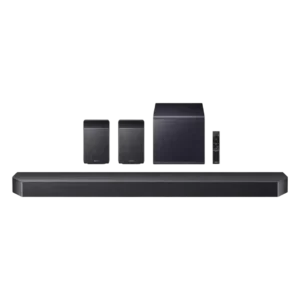
Choose the Samsung HW-Q990F if you want a premium, easy Atmos system with huge surround, strong bass, and Samsung TV perks. Skip it if price, a four-piece setup, music purity,...
Pros: Value for money, Surround sound simulation
Cons: Status indicators, Wi-Fi streaming reliability

Best for class-leading Atmos immersion, clear dialogue, compact but forceful bass, and a complete rear-speaker package. Skip it if you own the Q990F, need a compact one-bar setup, or cannot...
Pros: Home theater integration, Bass performance
Cons: Value for money, Design and aesthetics